 Anacortes Siding
 Every siding contractor gets asked some version of the same question: "What's the best siding for my house?" Most give an answer that depends on what they happen to have a good supplier deal on that month. We don't do that. After years of installing and repairing siding across Skagit County, we made a decision to install one product system — James Hardie fiber cement — and to stop installing everything else. This page explains why, in plain terms, without the sales pitch.
The Short Version
Anacortes sits on the water. Salt air moves inland with the wind off Fidalgo Bay and the Guemes Channel, driving rain comes sideways off Rosario Strait for months at a stretch, and the shaded, damp corners of a lot here grow moss on anything that holds moisture. That combination is hard on siding. Over time we watched certain products hold up to it and others struggle, and we stopped being willing to install the products that struggle. That's the whole story. It's not a marketing angle — it's a standard we set because we were tired of getting callbacks on materials we knew were going to be a problem in five to ten years.
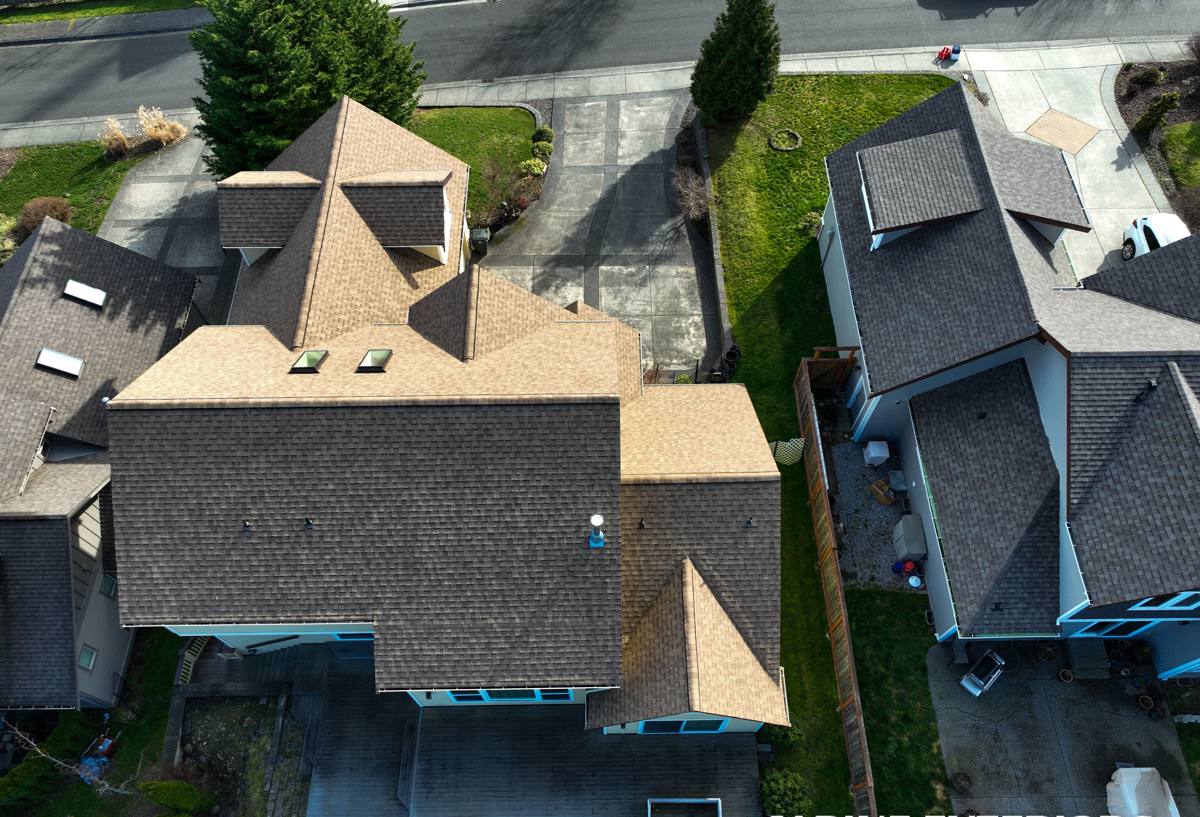
What Skagit County's Climate Actually Does to Siding
Salt Air
Anacortes and the surrounding shoreline communities get real salt exposure, especially on west- and south-facing walls that catch the prevailing weather. Salt air accelerates corrosion of fasteners and trim metal, and it degrades some paint and coating systems faster than manufacturers' inland test data would suggest. Any siding product marketed with a "coastal" or "marine" performance claim should be able to explain, specifically, what in its manufacturing process addresses that — not just say the word "coastal" on a brochure.
Driving, Wind-Driven Rain
This isn't Seattle drizzle. Storms coming off the Strait push rain horizontally into wall assemblies, which stresses every seam, joint, and butt edge in a siding system. Products that rely on surface paint alone, rather than being engineered at the substrate level for moisture, are the ones we see failing first — bubbling, delaminating, or swelling at the edges.
A Long Moss and Mildew Season
Between the marine layer, tree cover common in Anacortes neighborhoods, and our extended wet season, north-facing and shaded walls stay damp far longer than they do in drier parts of the state. Anything organic in the siding material itself gives moss, algae, and mildew something to feed on. Anything that swells when it absorbs moisture opens gaps that trap that dampness against the wall.
Why We Don't Install Certain Products Anymore
We want to be fair here. None of these products are frauds or scams — they're legitimate building materials used successfully across the country, including in wetter climates than ours when installed and maintained correctly. Our decision isn't that they "don't work." It's that, for our specific climate and for the way most homeowners actually live in and maintain a house, the trade-offs stopped making sense for us to stand behind.
| Product | What It Gets Right | Why We Stopped Installing It Here |
|---|---|---|
| Vinyl siding | Low upfront cost, low maintenance, wide color availability | Can warp or distort in temperature swings, seams and butt joints are a repeated water-entry point, colors fade in UV over time, and it's the first thing to show storm damage in high wind |
| LP SmartSide (engineered wood strand) | Good workability, decent impact resistance, lower cost than fiber cement | Wood-strand core is more moisture-sensitive at cut edges and butt joints than fiber cement; installation tolerances for caulking and flashing are less forgiving in a wet climate |
| Primed spruce / solid wood lap | Traditional look, repairable board by board | Requires the most frequent repainting and caulk maintenance of anything on this list; end grain and knots are chronic failure points in sustained moisture |
| Cedar siding | Real wood character, good reputation, ages naturally if left unfinished | High maintenance to keep finished; unfinished cedar greys and can host moss/mildew fast in shaded coastal exposure; cost has climbed close to or above fiber cement |
| Cemplank / Allura (other fiber cement brands) | Same core material category as Hardie, generally solid product | Not a performance objection — we simply standardized crews, install specs, and warranty administration on one manufacturer rather than splitting expertise across several similar products |
What Makes James Hardie Different
It's Non-Combustible
Fiber cement is roughly 90% Portland cement, sand, and cellulose fiber. It doesn't burn. In a region where wildfire smoke and dry-season fire risk have become a real part of the summer conversation in Washington, that's not a minor detail — it's a material property vinyl and wood-based sidings simply can't match.
It's Engineered for Climate Zones
James Hardie makes region-specific product formulations — their HZ5 line, for instance, is engineered for climates with more moisture cycling and freeze-thaw exposure, which fits the Pacific Northwest better than a one-size-fits-all national product. That's an actual manufacturing difference, not a marketing label.
ColorPlus Factory Finish
Rather than field-painting the siding after install (where weather, temperature, and crew consistency all affect the result), Hardie's ColorPlus products are finished in a controlled factory process with baked-on coats and a UV-cured topcoat. That finish holds color longer and resists the chalking and fading that field-applied paint shows first, especially on south- and west-facing walls that take the most sun and salt exposure.
It Doesn't Feed Moss and Mildew
Because the material itself is cement-based rather than organic, it doesn't provide the same food source for moss, algae, and mildew that wood-based products do. It can still get dirty on shaded, damp walls — nothing outdoors is immune to that in this climate — but it isn't degrading structurally the way an organic substrate can.
A Warranty Structure Homeowners Can Actually Use
Hardie backs its siding with a non-prorated limited warranty on the substrate, and ColorPlus finishes carry their own separate finish warranty, both of which are transferable to a subsequent homeowner within the warranty period if the home sells. That transferability matters more than people expect — it's a real selling point when a Hardie-sided home in Anacortes eventually goes on the market.
What Correct Installation Actually Involves
Buying the right product is half the equation. Fiber cement siding fails prematurely almost exclusively because of installation mistakes, not material defects. Manufacturer specs exist for a reason, and cutting corners on any of these is where the "fiber cement doesn't hold up" complaints usually come from:
- Correct fastener type, spacing, and embedment depth — under- or over-driven nails are a leading cause of cracking
- Proper clearance from grade, roofing, decks, and other siding terminations (Hardie specifies minimum gaps for a reason — ground and roof splash carry moisture and debris)
- Weather-resistant barrier and flashing installed correctly behind the siding, not just caulk relied on as the only water management
- Field-cut edges primed or sealed before installation, since factory finish doesn't cover a cut you make on site
- Correct joint treatment at butt seams — sealed and flashed, not just butted and caulked
- Panel or lap gaps sized to allow for expansion rather than installed dead tight
What This Means for Your Anacortes Home
If you're planning a re-side in Anacortes, Fidalgo Island, or elsewhere in Skagit County, your house is going to face salt air, sideways rain, and a long damp season no matter which contractor you hire or which product they sell you. That's just the environment. The question worth asking any contractor isn't "what's the cheapest option" — it's "what product and installation approach actually accounts for where I live." We settled on James Hardie because, across enough installs and enough years watching how different products age in this specific climate, it's the one we're willing to warranty and stand behind without hedging.
A Straightforward Cost Perspective
We won't quote fake numbers here, but the honest framing is this: James Hardie generally costs more upfront than vinyl and is often comparable to or somewhat more than engineered wood siding, depending on the specific line and finish you choose. The way to think about it isn't sticker price alone — it's cost over the life of the siding, factoring in repainting cycles, caulk maintenance, moisture-related repairs, and how the finish is likely to look in fifteen years on a wall that faces the water. For most homeowners planning to stay in their home, or planning to sell it well-maintained, that math favors Hardie. For a homeowner doing a fast, minimum-cost flip, it may not — and we'd rather tell you that upfront than oversell you.
Questions Worth Asking Before You Hire Anyone
- Is the contractor a certified James Hardie installer, or are they installing it without manufacturer-specific training?
- Does their quote specify fastener type and spacing, clearance details, and flashing approach — or just "siding install, materials included"?
- Will field-cut edges be sealed before installation, and is that written into the scope?
- What does the warranty actually cover, and is it transferable if you sell the home?
- Are they willing to explain why they'd recommend a different product for your specific house, if they would?
If you'd like a straight answer on what James Hardie siding would look like on your home — no pressure, no upsell to a product we don't stand behind — we're happy to come take a look and walk you through it. The estimate is free.