 Anacortes Siding
 Two Very Different Materials, One Big Decision
If you're re-siding a home in Anacortes, you've almost certainly run into the vinyl-versus-fiber-cement question. They're not close cousins — vinyl is an extruded PVC plastic product, and James Hardie siding is fiber cement, a blend of Portland cement, sand, and cellulose fiber pressed into planks and cured. They install differently, age differently, and behave differently once they're facing a Fidalgo Island winter. This page lays out the honest trade-offs so you can make the call with real information, not sales pitches.
We'll say up front where we land: this company installs James Hardie fiber cement siding exclusively. We don't install vinyl. That's not because vinyl is a scam or a bad product for every application — it isn't — but because of specific, repeatable trade-offs we've concluded aren't worth carrying on a Skagit County home. Read through the comparison below and decide for yourself.
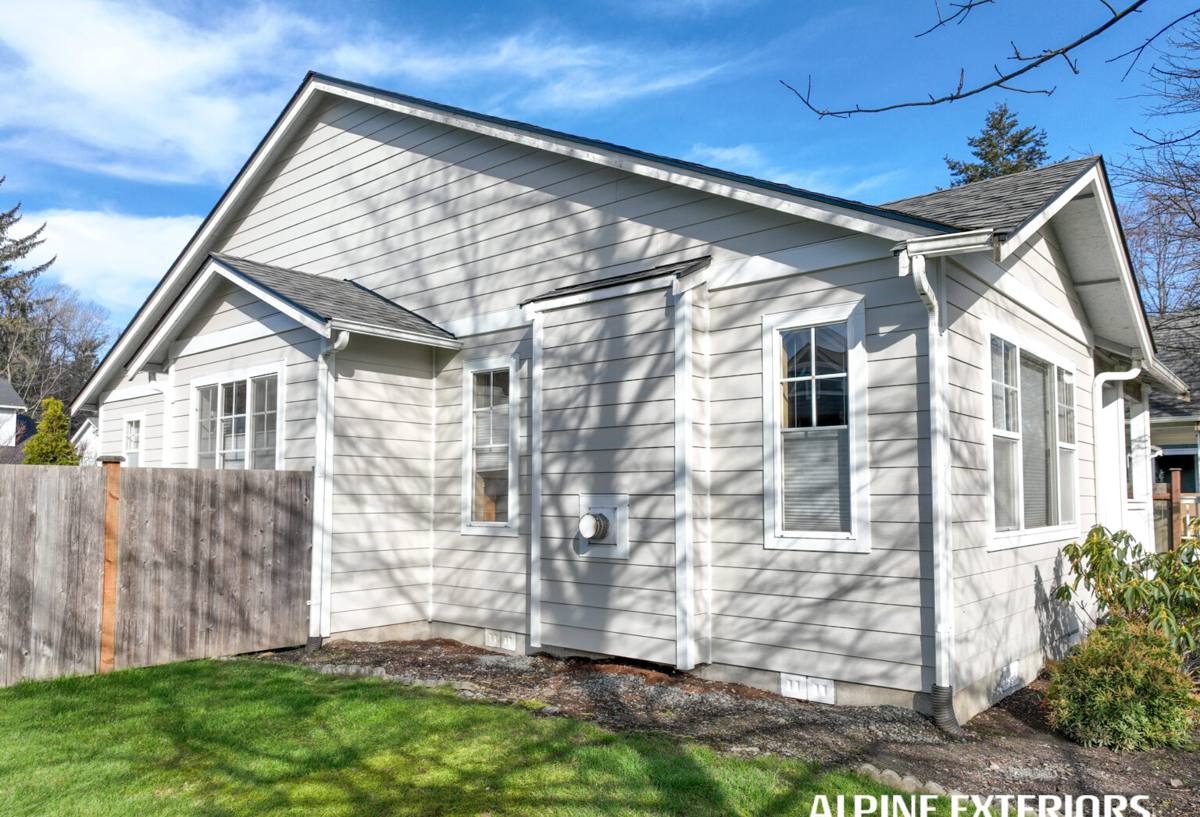
What Vinyl Siding Gets Right
Vinyl earns its market share honestly. It's the least expensive siding option on the market, it goes up quickly, and modern vinyl profiles have gotten better at mimicking traditional lap siding shadow lines. It doesn't rot, doesn't rust, and never needs paint. For a homeowner working with a tight budget who needs a functional, weatherproof exterior, vinyl does the job.
It also has real limitations that show up over time, and those limitations are the reason we don't install it:
- It's a thin plastic skin, not a structural material. Panels flex, and in wind-driven rain — which Anacortes gets plenty of off Rosario Strait and the Guemes Channel — water can work behind panels at seams and penetrations.
- Color is baked in, not applied, and it fades. UV exposure over years shifts vinyl color, especially darker tones, and there's no practical way to refresh it short of replacement.
- It's temperature-sensitive. Vinyl contracts in cold and expands in heat more than fiber cement, which is why you'll see slight waviness in panels on older installations, especially in direct afternoon sun.
- Impact resistance is modest. A stray branch, a ladder bump, or hail can crack a panel, and matching faded replacement panels years later is often impossible.
- It doesn't stop fire. Vinyl is a petroleum-based plastic; it softens and burns in a way non-combustible materials don't.
What James Hardie Fiber Cement Gets Right
James Hardie's fiber cement siding is engineered for exactly the conditions that stress vinyl. It's dimensionally stable — it doesn't expand and contract with temperature the way plastic does — so seams and reveals stay tight for the long haul. It's rigid enough to resist impact damage that would crack a vinyl panel, and it's non-combustible, which matters both for insurance conversations and peace of mind.
Two things set the Hardie system apart from generic fiber cement or off-brand competitors:
- Climate-engineered product lines. James Hardie makes HZ5 and HZ10 formulations specifically tuned for different U.S. climate zones, accounting for moisture cycling, freeze-thaw, and humidity — the Pacific Northwest gets a different engineered mix than the desert Southwest.
- ColorPlus factory-applied finish. Instead of field-painted or baked-in plastic color, ColorPlus is a multi-coat finish cured onto the plank at the factory under controlled conditions, which gives it better fade and chip resistance than jobsite painting and far better resistance than pigmented vinyl.
How Each Material Handles Skagit County Weather
This is where the comparison gets local. Anacortes sits on Fidalgo Island, surrounded by saltwater on three sides, with a wet season that runs long and a fair amount of wind-driven rain coming off the water. North-facing and shaded elevations here also tend to grow moss and algae over a few damp winters if the siding surface holds moisture.
Salt air
Salt-laden air doesn't corrode vinyl or fiber cement siding the way it corrodes metal fasteners and trim, but it does accelerate the breakdown of unprotected or poorly sealed materials and it's hard on paint and finishes generally. Hardie's factory-cured ColorPlus finish is built to hold up under UV and weather exposure better than field-applied paint, which matters on homes facing open water.
Driving rain
Wind-driven rain finds every gap in a siding system. Vinyl's overlapping panel design relies on gravity and lap coverage to shed water, and in sustained wind-driven rain, water can get pushed up and behind panels at butt joints and inside corners. Fiber cement lap siding, installed correctly with proper flashing and house wrap detailing, sheds water the same way traditional wood lap siding always has — a system that's been proven in wet coastal climates for generations.
Moss and algae
Moss doesn't grow on the material itself so much as on the film of moisture, pollen, and organic debris that builds up on any exterior surface in a shaded, damp environment. Both vinyl and fiber cement can develop this film. The practical difference is maintenance: Hardie's factory finish generally cleans up with a soft wash without stripping color, while vinyl's surface can show scrubbing wear and, because the color runs through the material, fading becomes more visible once the surface film is disturbed.
Side-by-Side Comparison
| Factor | Vinyl Siding | James Hardie Fiber Cement |
|---|---|---|
| Material | Extruded PVC plastic | Cement, sand, and cellulose fiber |
| Fire behavior | Combustible plastic | Non-combustible |
| Dimensional stability | Expands/contracts with temperature | Stable across temperature swings |
| Impact resistance | Can crack from impact | Resists impact well when installed to spec |
| Color/finish | Pigmented through plastic; fades with UV | Factory-cured ColorPlus finish |
| Typical lifespan | Roughly 20-30 years | Manufacturer-rated 30+ years with proper install |
| Installed cost | Generally the lowest-cost siding option | Mid-to-upper range; premium over vinyl |
| Installation sensitivity | Lower — more forgiving of minor errors | Higher — flashing, fastening, and clearances must be correct |
Exact installed pricing depends heavily on home size, elevation complexity, tear-off needs, and trim detailing — get a written, itemized estimate rather than relying on a per-square-foot number pulled from the internet.
Installation Sensitivity: The Part Homeowners Rarely Hear About
Here's an honest trade-off that doesn't get talked about enough: James Hardie siding is less forgiving of installation shortcuts than vinyl. Fiber cement requires correct fastener placement, proper flashing at windows, doors, and butt joints, minimum clearance above rooflines and decks, and correct field-cutting and caulking practices. Installed wrong, fiber cement can trap moisture and fail early — which is exactly the kind of failure that gives the material an undeserved bad reputation when the real cause was a rushed crew.
Vinyl is more tolerant of imperfect installation because it's designed to float and flex with minor misalignment. That tolerance is part of why it's cheaper to install — but it also means the material is doing less structural work protecting your home, and it's compensating for the same wind-driven rain with a thinner, more flexible defense.
This is a big part of why we standardized on one product: it lets our crews build deep, repeatable expertise in one installation system instead of splitting attention across several, and it lets us stand fully behind the workmanship because we know the material's requirements cold.
Warranty Structure: What's Actually Covered
Vinyl warranties vary widely by manufacturer and grade, and many are prorated — meaning the payout for a failure shrinks the longer you've owned the siding, and coverage is often reduced or voided on transfer to a new owner. Read the fine print before assuming "lifetime warranty" means what it sounds like.
James Hardie backs its siding with a non-prorated limited warranty and a separate finish warranty on ColorPlus products, and the warranty is transferable to subsequent homeowners within its terms — a real factor if you plan to sell within the coverage period. As with any manufacturer warranty, proper installation to spec is typically a condition of coverage, which is another reason installation quality isn't optional with this product.
Questions to Ask Before You Choose a Siding Material
- Is the warranty prorated, and does coverage change if I sell the house?
- What does the manufacturer require for installation to keep the warranty valid?
- How does this material perform in wind-driven rain and coastal humidity specifically?
- What's the realistic maintenance schedule — washing, caulking, painting — over 20 years?
- Can the contractor show me completed installations of this exact product?
- Is the material rated non-combustible, and does that affect my insurance?
Maintenance Over the Life of the Siding
Vinyl's low-maintenance reputation is mostly accurate day to day — no painting — but it isn't maintenance-free. Panels can loosen, warp, or crack over time and need individual replacement, and matching faded color on an older home is often not possible. Fiber cement needs periodic caulk inspection at joints and trim and an occasional soft wash, and if it's ever field-painted rather than factory-finished, it will need repainting on a normal exterior paint cycle. ColorPlus-finished Hardie siding is designed to avoid that repainting cycle for a long time when properly maintained.
Why We Standardized on James Hardie
We don't install vinyl, LP SmartSide, Cemplank, Allura, or bare cedar and primed spruce — not because there's no legitimate use for those products anywhere, but because after years of installing and servicing exterior siding in this climate, James Hardie's engineered fiber cement system gave us the most consistent, defensible results against salt air, driving rain, and a long moss season. Standardizing on one manufacturer's system also means our crews aren't relearning installation requirements from job to job — they're applying the same proven detailing every time, which is what actually protects a home long-term, not just the material spec sheet.
If you're weighing vinyl against James Hardie for your Anacortes home, we're happy to walk your property, look at your specific exposure and elevations, and give you a straightforward, no-pressure estimate for a Hardie installation — including what correct detailing looks like for your home's particular wind and moisture exposure.