 Anacortes Siding
 Exterior Work Built for the Oak Harbor Climate
Oak Harbor sits close enough to saltwater and open water exposure that the exterior of a home takes a different kind of beating than it would twenty miles inland. Homes here deal with salt-laden air off the water, long stretches of driving rain through the fall and winter, and a moss season that can run half the year on north-facing walls and shaded roof planes. None of that is dramatic on its own, but stacked together year after year, it's exactly the combination that finds every weak point in a home's exterior — the wrong siding material, a poorly flashed window, a roof valley that was never quite right, or decking that was never designed for standing moisture.
We work throughout the Anacortes and North Puget Sound area, and Oak Harbor is a regular part of that territory. That matters more than it sounds like it should. A crew that works this coastline regularly knows which details actually matter here — how much lap gap to leave for a fiber cement panel in a salt-air environment, where moss pressure washing has already caused failures on other homes' original siding, and how differently a west-facing wall ages compared to one tucked out of the weather. That's not knowledge you get from a spec sheet. It's knowledge you get from doing the work in this specific climate, repeatedly.
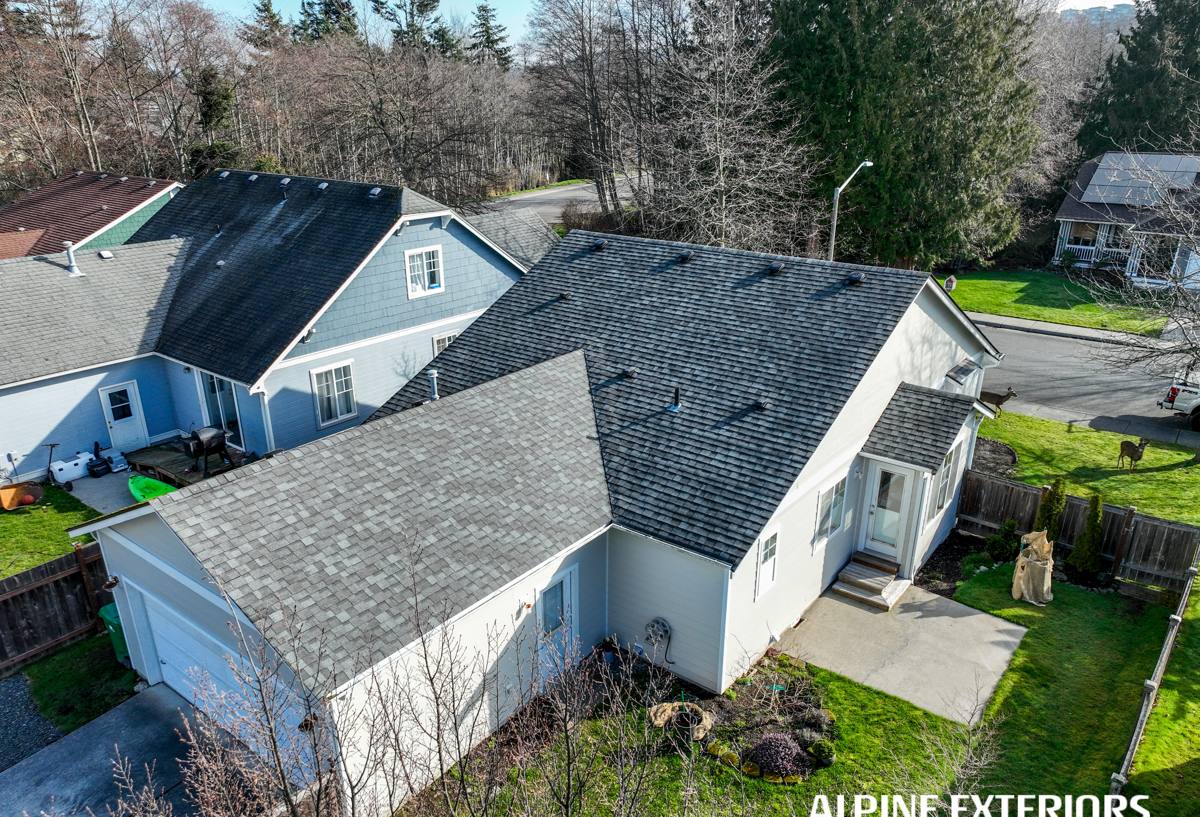
What Salt Air and Rain Actually Do to a Home's Exterior
Salt air is corrosive to metal fasteners, flashing, and trim long before most homeowners notice any visible damage. It also accelerates the breakdown of finishes that aren't engineered to resist it — paint chalks and fades faster, caulk joints fail sooner, and any wood-based siding product starts absorbing moisture at the cut edges and fastener points where the factory coating has been compromised.
Driving rain adds a second problem: wind-driven water doesn't just run down a wall, it gets pushed sideways and upward into laps, seams, and penetrations. A siding system that isn't installed with the right gapping, flashing, and drainage plane will eventually let water behind it — and once water gets behind siding in a climate that rarely gets a long dry stretch to fully dry things out, rot and mold have all the time they need.
Moss Season and What It Means for Siding
Moss and algae growth on north- and shade-facing walls is common throughout this region, and it's more than a cosmetic issue. Organic growth holds moisture against the surface of the siding, and repeated pressure washing to remove it — which most homeowners eventually do — is hard on softer or absorbent siding materials. A siding product needs to tolerate both the growth and the cleaning without breaking down.
Why We Only Install James Hardie
We install James Hardie fiber cement siding exclusively. We don't install vinyl, LP SmartSide, or other engineered wood products, and we don't install unprimed cedar or spruce siding. That's a deliberate professional standard, not a sales preference, and in a climate like Oak Harbor's it's an easy standard to defend.
Fiber cement is non-combustible and dimensionally stable — it doesn't expand and contract with moisture the way wood-based products do, which is exactly the failure mode that salt air and constant rain exploit over time. James Hardie's ColorPlus finish is factory-applied and baked on, which gives it far better fade and moisture resistance at cut edges and laps than field-applied paint, and Hardie's HZ5 product line is specifically engineered for cold, wet Pacific Northwest exposure. The company backs it with a strong transferable warranty, which matters to a lot of Oak Harbor homeowners who bought here to stay for the long haul, or who want that warranty to carry value if they sell.
None of this means other products are junk. Vinyl is inexpensive and low-maintenance in the right setting. Engineered wood siding has real advantages in dry climates. Cedar has a look a lot of homeowners love. Our position is narrower than "these products are bad" — it's that after years of exterior work on this coastline, fiber cement is the only material we're willing to put our name behind here, and we'd rather turn down a job than install something we don't believe will hold up.
| Factor | Vinyl Siding | Engineered Wood (LP SmartSide) | James Hardie Fiber Cement |
|---|---|---|---|
| Moisture absorption at cut edges | Low, but seams can leak | Higher — requires strict edge sealing | Low, factory-treated |
| Salt air / coastal durability | Fair, can become brittle over time | Sensitive if seals fail | Strong, non-combustible material |
| Tolerance for pressure washing (moss removal) | Good | Fair, avoid high pressure near seams | Good |
| Finish life before repaint/refinish | N/A (color molded in, can fade) | Field or factory paint, varies | 15+ years typical on ColorPlus finish |
| Fire rating | Combustible | Combustible | Non-combustible |
A Full Exterior Envelope, Not Just Siding
Siding doesn't work in isolation. We handle roofing, windows, and decks as well, because the exterior of a home is one connected system — a roof that isn't shedding water correctly will send moisture down onto the siding below it, a window that isn't flashed properly will leak into the wall assembly no matter how good the siding is, and a deck that traps water against the house will rot the ledger board and the siding around it.
Roofing
In an area that sees this much sustained rain and shaded, moss-prone roof planes, correct underlayment, flashing, and ventilation matter as much as the roofing material itself. We look at the roof as part of the same water-management plan as the siding.
Windows
Window replacement is one of the most common places for water intrusion to start, because flashing details around the opening are easy to get wrong and hard to inspect once the siding is closed up. We integrate window flashing with the siding installation rather than treating them as separate trades.
Decks
Decks here need to shed water away from the house, not toward it. Ledger flashing, proper slope, and material choice all affect how long a deck lasts in a climate that doesn't give lumber much chance to dry out between storms.
What a Local Crew Actually Changes
A lot of exterior problems in this region trace back to installation that was done to a generic spec rather than to what this specific coastline demands. Fastener spacing, caulk selection, flashing sequencing, and even how tight or loose a lap is set all need to account for salt exposure and near-constant moisture cycling. A crew that works Oak Harbor, Anacortes, and the surrounding area regularly sees the same failure patterns repeatedly on other homes' exteriors — and that shapes how we detail our own installs to avoid repeating them.
There's also a practical side to hiring locally: shorter response times for warranty callbacks, familiarity with the permitting expectations in the area, and a crew that isn't learning the region's quirks on your project.
What the Process Looks Like
- On-site assessment of existing siding, trim, flashing, and any moisture or moss damage
- Honest evaluation of whether full replacement or targeted repair makes sense
- James Hardie product and color selection, including HZ5 specification for this climate zone
- Removal of old siding and inspection of the sheathing and weather barrier underneath
- Correct installation per manufacturer spec — gapping, fastening, flashing, and caulking
- Final walkthrough and warranty paperwork
What Drives Cost on a Siding Project
| Factor | Why It Matters |
|---|---|
| Extent of existing damage | Rotted sheathing or framing found during tear-off adds repair scope |
| House size and complexity | More corners, gables, and trim detail means more labor |
| Product line (HZ5 vs. standard) | Climate-engineered lines cost more but perform better here |
| Trim and accessory choices | Fascia, soffit, and trim board upgrades add to the total |
| Access and site conditions | Steep lots, tight setbacks, or multi-story walls affect labor time |
Questions Worth Asking Before You Hire
- Is the crew installing to the manufacturer's climate-specific spec, or a generic one?
- Will they show you the condition of the sheathing once old siding is removed?
- What's covered under the material warranty versus the workmanship warranty?
- Do they handle flashing integration for windows and roof-to-wall transitions themselves?
- How do they detail fastener spacing and caulk joints for a coastal climate?
- Are they willing to explain why they recommend one product over another, in plain terms?
Getting Started
If your Oak Harbor home is showing early signs of wear from salt air, driving rain, or moss buildup — or if it's simply time to plan ahead before those problems start — we're happy to take a look and walk you through what we're seeing. There's no pressure and no cost to have us out for an estimate; use the form below to get started.