 Anacortes Siding
 Two Different Materials, One Big Decision
If you've been researching siding for a home in Anacortes or anywhere else in Skagit County, you've probably run into both James Hardie fiber cement and LP SmartSide in the same breath, as if they're interchangeable options that just come in different price tiers. They're not. They're built from entirely different raw materials, they respond to moisture in opposite ways, and they age differently once they've spent a few winters facing Rosario Strait weather. This guide walks through both products honestly — what each one is made of, how they perform in our specific climate, and why our crews install only James Hardie on the homes we work on.
What Each Product Actually Is
James Hardie siding is fiber cement: a mix of Portland cement, sand, and cellulose fiber, cured into dense, rigid boards and panels. It is not wood, and it does not burn, swell, or rot the way wood-based products can.
LP SmartSide is an engineered wood product — strands of wood fiber bonded with resin under heat and pressure, similar in concept to oriented strand board (OSB), then treated with a zinc borate additive for insect and fungal resistance and coated with a resin-saturated overlay. It is a genuine improvement over old-style hardboard siding from decades past, and LP has invested real engineering into making it more moisture-tolerant. But at its core, it is still wood fiber, and wood fiber's relationship with water is different from cement's.
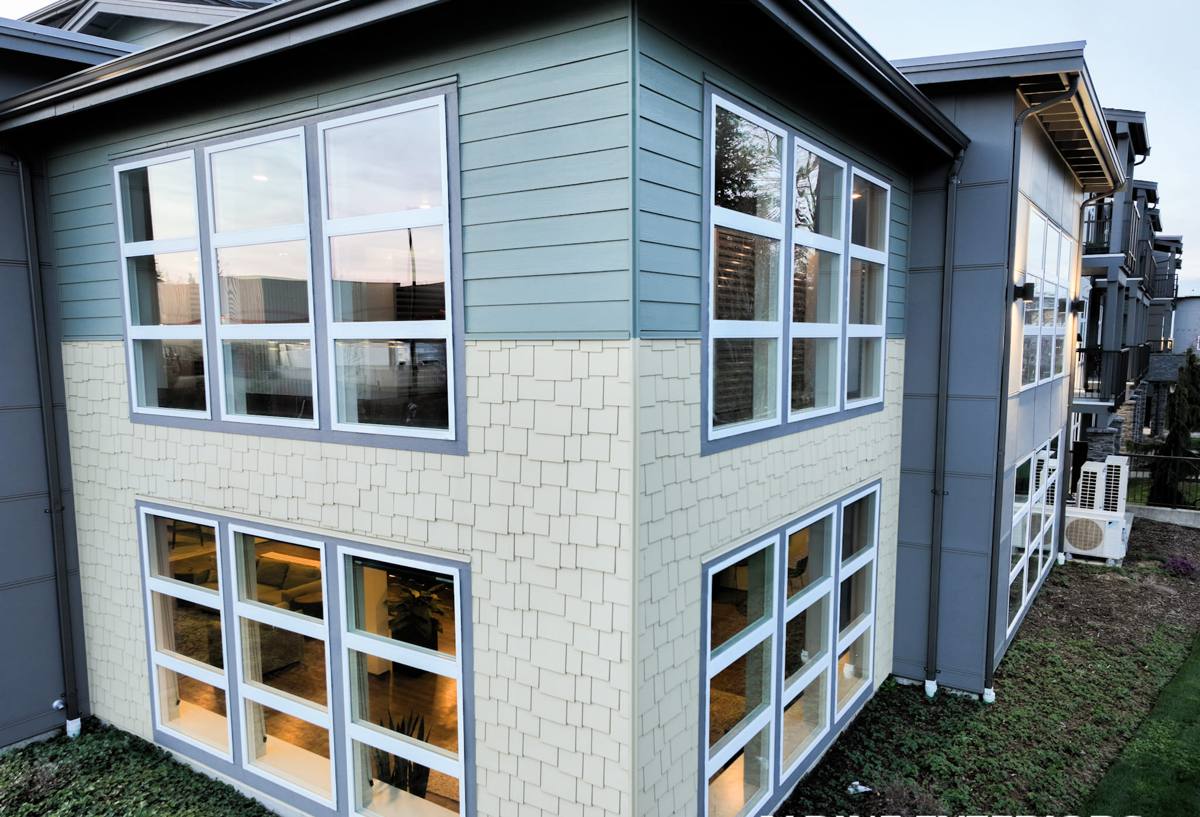
Why Moisture Behavior Matters More Here Than Almost Anywhere
Anacortes sits at the water on three sides, which means siding here deals with more than ordinary Pacific Northwest rain. Salt-laden air off the Strait accelerates corrosion on fasteners and trim, wind-driven rain during winter storms pushes moisture sideways into joints and cut edges, and the long, damp shoulder seasons keep humidity elevated for months at a time — ideal conditions for moss and algae growth on any surface that stays damp. A siding product's long-term performance in this town is decided less by how it looks on day one and more by how it handles water intrusion over ten, twenty, and thirty years.
Fiber cement is dimensionally stable and doesn't absorb water into its structure the way wood-based products can. It can get wet on the surface without swelling, and it won't support rot. Engineered wood products like LP SmartSide are treated and sealed specifically to resist this, and the treatment works reasonably well when installation is done exactly to spec — but the product's vulnerability point is real: any cut edge, nail hole, or seam that isn't fully primed and caulked becomes a place where moisture can get into the wood fiber. Once that happens, swelling, delamination, and soft spots can follow, and the damage isn't always visible from the outside until it's advanced.
Installation Sensitivity: The Detail That Decides Everything
Both products can perform well when installed correctly, and both can fail early when installed carelessly. But the margin for error is not the same.
With LP SmartSide, every field cut has to be primed before it goes up, every joint has to be properly caulked, and the manufacturer's clearances from grade, decks, and roof lines have to be respected exactly — because the product's warranty and its real-world durability both depend on keeping raw wood fiber sealed from water. Skip a step on a rainy Tuesday in November, and that shortcut can show up as a soft panel five years later.
Fiber cement is more forgiving of the everyday realities of a jobsite. It still requires correct fastening, proper flashing, and factory-finish touch-up where needed, but a cut edge that isn't perfectly sealed doesn't create the same swelling risk that it does in a wood-based product. That forgiveness matters on real homes, in real weather, installed by real crews — not laboratory conditions.
Finish and Maintenance Over Time
James Hardie's ColorPlus Finish
Hardie's ColorPlus technology is a factory-applied, baked-on finish that's more UV- and weather-resistant than field-applied paint, and it comes backed by its own finish warranty separate from the product warranty. In practice, that means longer stretches between repainting and touch-up work rather than site-applied topcoats.
LP SmartSide's Finish
LP SmartSide typically ships primed, requiring a field-applied topcoat after installation, and that painted surface will need repainting on a normal exterior-paint cycle going forward — same as any painted wood siding. In a climate with our rainfall and moss pressure, that maintenance cycle tends to run shorter than homeowners expect going in.
Moss, Algae, and Cleaning
Neither product is immune to moss and algae staining in a place with our shade cover and moisture levels — anything that stays damp on the north side of a house under fir trees is going to grow something eventually. The difference is what happens when you clean it. Fiber cement tolerates routine gentle washing without damaging the substrate underneath. On engineered wood siding, aggressive cleaning or pressure washing done incorrectly can drive water past the finish and into the wood fiber itself, which is a maintenance risk homeowners aren't always warned about.
Fire Performance
This is one of the more consequential differences and worth stating plainly. James Hardie fiber cement is non-combustible. LP SmartSide, being wood-based, is combustible, even with its treatments. For homes closer to wooded lots or in areas where wildfire smoke and ember exposure have become a more regular late-summer concern across Washington, that distinction has real weight — both for safety and, in some cases, for insurance considerations.
Warranty Structure
Warranty length numbers alone don't tell the whole story — how a warranty pays out over time matters just as much as its stated term.
| Factor | James Hardie | LP SmartSide |
|---|---|---|
| Core material | Fiber cement (cement, sand, cellulose) | Engineered wood strand (resin-bonded, zinc borate treated) |
| Combustibility | Non-combustible | Combustible |
| Factory finish | ColorPlus baked-on finish available, separate finish warranty | Primed; field-applied topcoat typically required |
| Moisture response | Dimensionally stable, does not swell from surface moisture | Vulnerable at unsealed cuts, joints, and fastener penetrations |
| Maintenance cycle | Longer intervals between finish touch-up | Standard exterior repaint cycle applies |
| Product warranty | Long-term, transferable | Long-term, often with terms that shift over time (e.g., prorated coverage) |
Read the fine print on any warranty before you sign a contract — the length of coverage on the page and the actual value of a claim ten or fifteen years in are not always the same thing.
Cost Considerations
LP SmartSide is typically the lower up-front material cost of the two, which is a real and fair point in its favor for homeowners working within a tight budget. James Hardie carries a higher installed cost, reflecting the material itself, the ColorPlus finish option, and the labor practices correct fiber cement installation requires. The way we'd frame the trade-off honestly: LP SmartSide can be the right call for some budgets and some projects, but for the total cost of ownership on a home exposed to Anacortes weather — factoring in repainting cycles, moisture risk at seams, and expected service life — fiber cement tends to come out ahead over the life of the siding, not just at closing on the install.
Why We Install Only James Hardie
We made a decision as a company to standardize on James Hardie fiber cement and not install LP SmartSide, vinyl, or other engineered or wood-based siding products. That's not a knock on every homeowner's choice — LP SmartSide is a legitimate, engineered product with real manufacturer backing, and plenty of installers do good work with it. Our standard comes from what we see hold up over decades in this specific climate: non-combustible material, a factory finish that doesn't depend on field paint quality or timing, dimensional stability that isn't compromised by an imperfectly sealed cut edge on a wet install day, and a warranty structure we're comfortable standing behind on every home we touch. When we commit to one product line, we also commit to knowing its HZ climate-engineered variants, its fastening and clearance specs, and its finish system inside and out — rather than splitting that expertise across multiple product families with different installation rules.
Questions to Ask Before You Choose
- What is the core material, and how does it behave when it gets wet at a cut edge or seam?
- Is the finish factory-applied or field-applied, and what's the expected repaint interval?
- Is the product combustible, and does that matter for your lot, insurance, or local conditions?
- What does the warranty actually cover in year 15 or 20, not just in year one?
- Does the installer have documented experience with this specific product's clearance and sealing requirements?
- How will the product hold up to routine washing needed to manage moss and algae in our climate?
Get an Honest Look at Your Home
Every house on Fidalgo Island faces a slightly different mix of sun, shade, wind, and moisture, and the right siding decision should account for your specific exposure, not just a general product comparison. We're happy to walk your home, point out what we see, and explain exactly why James Hardie is what we'd put on it — no pressure, no obligation. Reach out for a free estimate and we'll give you a straight answer.