 Anacortes Siding
 Cap Sante's Exterior Weather Problem
Homes around Cap Sante sit close enough to the water that the exterior of a house does a different job here than it does twenty miles inland. Salt-laden air moves off the marina and Guemes Channel and settles on siding, trim, and fascia year-round. Add Skagit County's long wet season, wind-driven rain that hits walls sideways instead of falling straight down, and the shaded, damp conditions that let moss and algae take hold on north- and west-facing walls, and you get an exterior envelope that's under more or less constant stress. It's not dramatic weather, most days. It's persistent weather, and persistent is what wears siding out.
We work on homes throughout Anacortes, and the properties near Cap Sante consistently show the same pattern: siding failure that starts small — a soft spot near a window sill, a strip of paint that won't hold, a corner that stays green longer than the rest of the wall — and spreads because the underlying material can't recover from repeated wetting. That pattern is exactly why we made the call, years back, to install only one siding product.
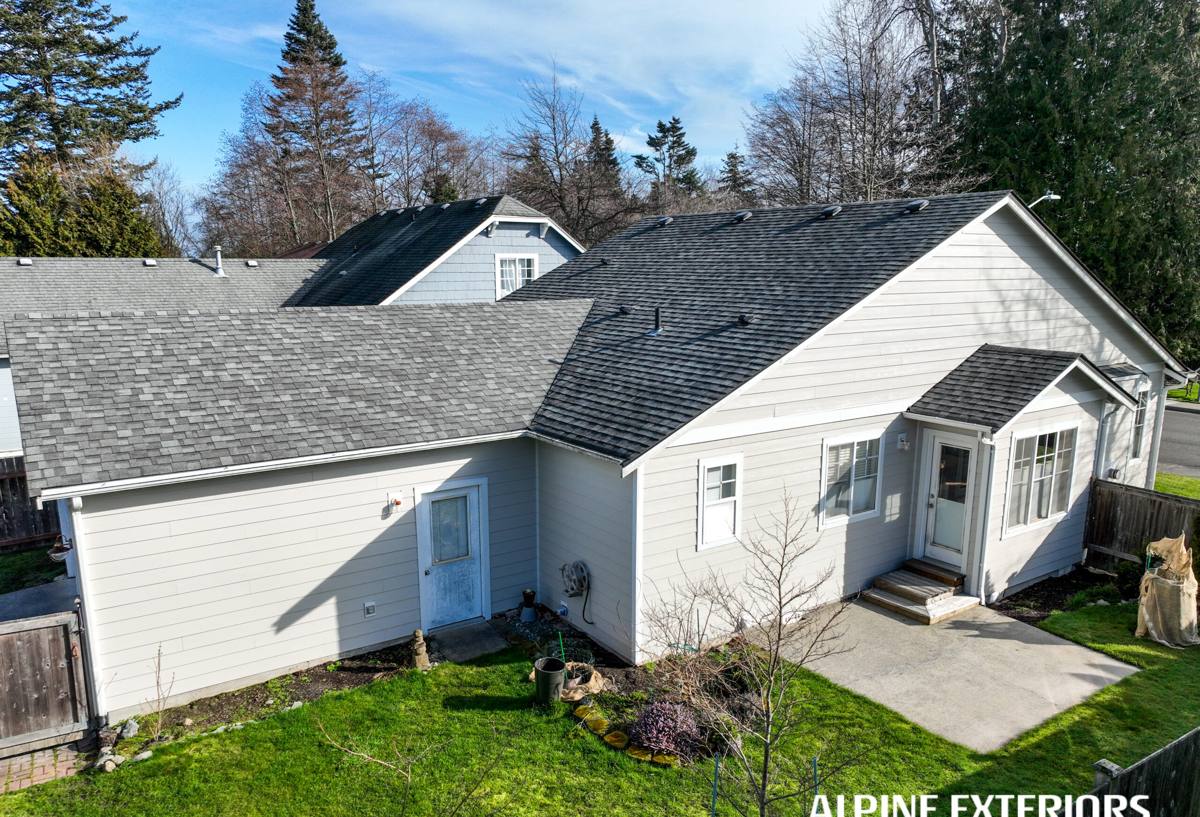
Why We Only Install James Hardie Fiber Cement
We don't install vinyl siding, LP SmartSide, Cemplank, Allura, primed spruce, or cedar. That's not a marketing angle — it's a standard we set after seeing how each of those products actually holds up in this specific climate, not a lab or a showroom. Every one of those alternatives has legitimate strengths. Cedar looks the way a lot of people want a Pacific Northwest home to look. Vinyl is inexpensive and low-maintenance in dry climates. Engineered wood siding installs fast. But in a marine environment with sustained moisture exposure, each of them has a real weakness that shows up on a wall within a handful of years, not decades.
What This Means in Practice
James Hardie fiber cement is cement, sand, and cellulose fiber. It doesn't absorb water the way wood-based products do, it doesn't soften or delaminate at cut edges and seams the way engineered wood can when moisture gets behind it, and it doesn't expand and contract with temperature swings the way vinyl does — which matters when a wall goes from a cold, damp morning off the water to direct afternoon sun. It's also non-combustible, which is a meaningful consideration as wildfire smoke and ember exposure become a bigger part of summer in Western Washington generally.
Hardie's ColorPlus finish is baked on at the factory under controlled conditions, not brushed on at the jobsite. That matters near salt air specifically, because factory-applied finishes bond to the substrate more evenly and hold color longer against UV and salt exposure than field-applied paint, which tends to chalk and fade faster the closer a home sits to open water.
Siding Materials Compared for This Climate
| Material | Moisture Behavior Near Salt Air | Maintenance Burden | Typical Lifespan Here |
|---|---|---|---|
| James Hardie fiber cement | Resists moisture absorption; won't rot or swell | Occasional wash; factory finish holds color | Decades with correct install |
| Cedar | Absorbs moisture; needs sealed end-grain and joints | Re-stain/re-seal every few years | Shorter without diligent upkeep |
| Vinyl | Doesn't rot, but panels can warp and gap; seams let moisture behind the wall | Low, but hides problems rather than preventing them | Variable; hidden moisture damage is common |
| Engineered wood (LP SmartSide and similar) | Vulnerable at cut edges and fastener points if not fully sealed | Moderate; edge sealing is critical and easy to miss | Depends heavily on installation quality |
The lifespan column is the honest part of this table. Every product in it can perform reasonably if installed perfectly and maintained faithfully. What changes near Cap Sante is the margin for error — moisture exposure here is high enough, often enough, that small installation mistakes turn into real problems faster than they would in a drier inland town.
What Correct Installation Looks Like Near the Water
Fiber cement siding earns its reputation only when it's installed to spec, and installation quality is where a lot of the product's real-world failures actually originate. A few details we treat as non-negotiable on every Cap Sante-area job:
- Proper clearance between the bottom of the siding and grade, decking, or roofing so water can't wick up into the board
- Correct flashing and weather-resistive barrier detailing at every window, door, and penetration
- Fastener placement and spacing that follows Hardie's specifications, not shortcuts
- Factory-cut edges kept intact wherever possible, and field-cut edges properly sealed
- Caulking only where Hardie's install guide calls for it — over-caulking traps moisture instead of blocking it
- Adequate rainscreen or drainage plane behind the siding on exposed elevations
None of this is exotic. It's careful, unglamorous work that takes longer than a rushed install — and it's the difference between siding that shrugs off thirty years of marine weather and siding that needs attention in year eight.
Moss, Algae, and Shaded Walls
North and west-facing walls near Cap Sante that sit under tree cover or in the shadow of a neighboring structure tend to stay damp longer after a storm, and that's exactly where moss and algae take hold first. On wood siding, that moisture retention accelerates rot from underneath, often before it's visible from the outside. Fiber cement doesn't feed the same kind of decay — moss and algae can still grow on the surface, but they're not compromising the board itself, and a periodic wash keeps it looking clean rather than requiring replacement.
A Note on HZ5 Engineering
James Hardie engineers its HZ product lines for specific climate zones, and the HZ5 line is built for regions like ours — colder, wetter, and more moisture-exposed than the HZ10 line built for hot, humid Southeast climates. Specifying the right HZ line for Skagit County isn't a marketing detail; it affects how the product's moisture and freeze-thaw performance actually holds up on your specific wall.
Beyond Siding: The Full Exterior Envelope
Siding doesn't work in isolation. We also handle roofing, windows, and decks, because a home's exterior only performs as well as its weakest connection point. A tight, well-flashed roof-to-wall transition matters as much as the siding itself near Cap Sante, since wind-driven rain finds gaps at rooflines and window flanges before it finds anything else. When we're on-site for a siding project, we're looking at the whole envelope — roof edges, window flashing, deck ledger connections — because those are the spots where water actually gets in, regardless of how good the siding itself is.
Why That Matters for Planning a Project
If your roof is nearing the end of its service life, or your windows are original single-pane units, it's often more cost-effective to sequence that work around a siding project rather than doing it separately a few years later. Tearing into wall assemblies once, correctly, costs less over time than opening them up twice.
What to Expect Working With a Local Crew
A crew that works Anacortes and greater Skagit County regularly knows things a traveling or out-of-area installer doesn't — how far wind-driven rain actually reaches up a wall on an exposed lot, which HZ line and detailing choices make sense for a Cap Sante elevation versus a more sheltered inland property, and what permitting and inspection expectations look like locally. That familiarity shows up in the small decisions made on-site, not just in the sales pitch.
Our process on a typical project:
- An on-site walkthrough to assess current siding condition, moisture exposure, and any hidden damage behind existing material
- A written estimate that specifies the Hardie product line, color, and installation details — not just a square-footage price
- Removal of old siding with a check for sheathing or framing damage before anything new goes up
- Installation following Hardie's fastening, flashing, and clearance specifications
- A final walkthrough covering care and maintenance expectations for your specific exposure
Maintenance in a Marine Climate
Hardie siding is genuinely low-maintenance, but "low" isn't "none," especially this close to the water. A simple annual routine keeps it performing and looking right:
- Rinse siding with a garden hose (not a pressure washer aimed directly at seams) once or twice a year to clear salt residue and organic growth
- Walk the exterior after major windstorms to check for any loose or displaced trim
- Keep gutters clear so overflow doesn't run directly down wall sections
- Trim back vegetation that keeps a wall section shaded and damp longer than the rest of the house
- Note any caulking that's cracked or pulled away and have it addressed before winter
Signs Your Current Siding Is Past Its Service Life
A few warning signs we see often on Cap Sante-area homes before an owner calls us:
- Paint that won't hold more than a season or two, especially on walls facing prevailing wind and rain
- Soft or spongy spots when you press on siding near the bottom edge or below windows
- Persistent moss or dark staining that comes back within weeks of cleaning
- Visible gaps or warping at seams and panel joints
- A musty smell or interior wall staining that suggests moisture is getting past the siding entirely
Any one of these is worth a look. Several together usually mean the siding is no longer doing its job as a weather barrier, whatever it looks like from the curb.
Cost Factors on a Cap Sante Project
| Factor | Why It Affects Price |
|---|---|
| Home size and number of stories | More surface area and higher scaffolding/access needs |
| Current siding removal | Tear-off and disposal of old material, plus any sheathing repair found underneath |
| Hardie product selection | Lap siding, shingle-style panels, and board-and-batten carry different material and labor costs |
| Trim and detail work | Window and door surrounds, corner boards, and fascia detailing add labor time |
| Site exposure | Higher wind or salt exposure can call for additional flashing and drainage detailing |
We give a written, itemized estimate after an in-person walkthrough rather than a phone quote, because the condition behind the existing siding is often the biggest variable in the actual cost.
If you're weighing a siding project for a home near Cap Sante — or want a second opinion on roofing, windows, or decking while we're looking at the exterior — we're glad to walk the property with you. There's a free, no-pressure estimate form below whenever you're ready.