 Anacortes Siding
 Exterior Work in Flounder Bay
Flounder Bay sits on the water side of Fidalgo Island, and homes here live with a version of the Pacific Northwest climate that's a notch harsher than what you'd find a few miles inland in Anacortes. The exposure to open water means more salt-laden air moving across siding and trim, more wind-driven rain hitting walls at an angle instead of falling straight down, and a longer stretch of damp, shaded months where moss and algae get a real foothold. We've worked on enough homes along this stretch of Skagit County to know that "it's just weather" undersells what's actually happening to an exterior over ten or twenty years.
This page is about siding specifically, but it's worth saying up front that we also handle roofing, windows, and decks. On a waterfront-adjacent property, those four systems are tied together more than most homeowners realize — a compromised roof edge, a leaky window flashing, or a rotting deck ledger board all eventually show up as a siding problem, and vice versa. When we look at a Flounder Bay home, we're looking at the whole envelope, not just one wall.
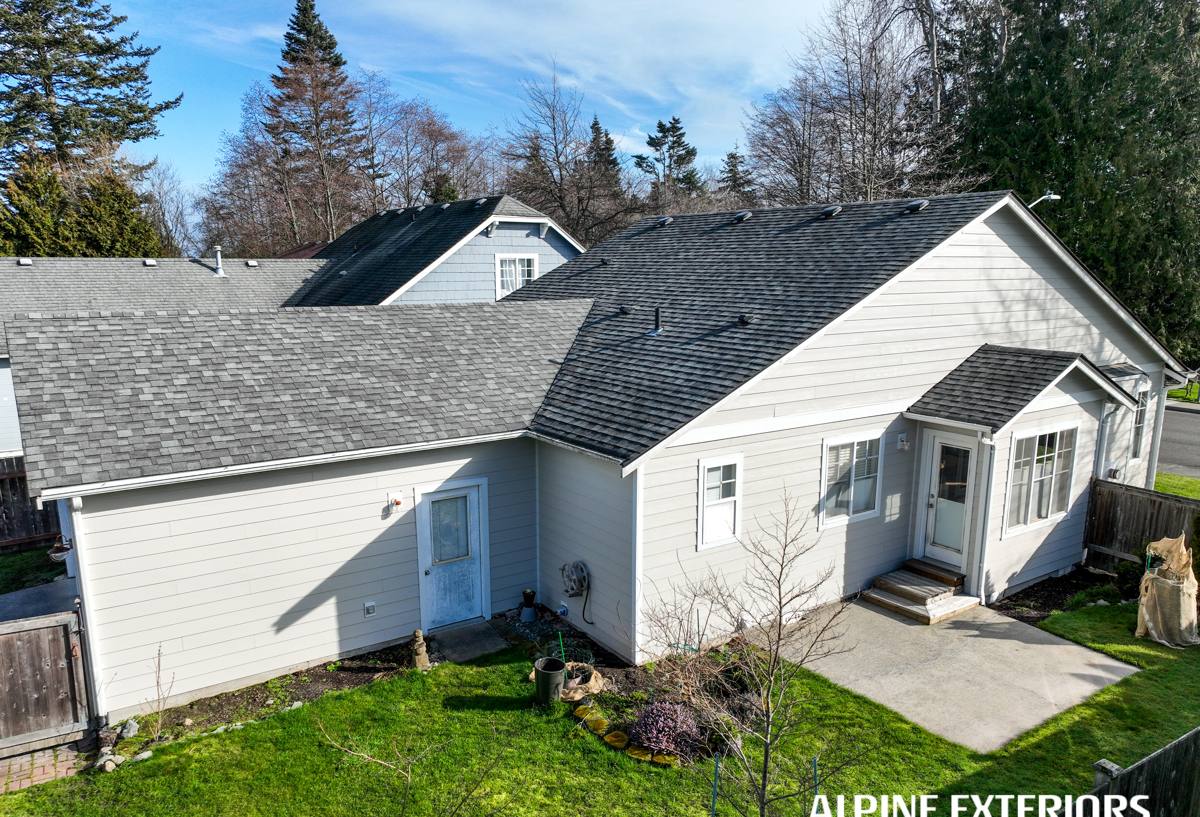
What Salt Air and Marine Exposure Actually Do
Salt air isn't just an inconvenience that makes cars rust a little faster near the water. On a home, airborne salt settles into every crevice of the siding — nail heads, seams, the underside of trim boards — and it's hygroscopic, meaning it pulls moisture out of the air and holds it against the surface it's sitting on. That constant low-grade dampness is what accelerates corrosion on fasteners and metal flashing, and it's what keeps wood-based sidings wetter, more often, than they'd be a mile inland.
For fasteners and flashing, this is why the materials that go behind and around the siding matter as much as the siding itself. We use corrosion-resistant fastening appropriate to the exposure, and we pay close attention to flashing details at windows, doors, and roof-to-wall intersections — the places where a marine environment finds the weak point first.
Driving Rain and Wind-Loaded Walls
Anacortes gets rain that often arrives sideways, pushed by wind off the Strait and Rosario Strait. Wind-driven rain behaves differently than a straight vertical downpour — it gets forced up under laps, into seams, and behind trim that would stay dry in a calmer setting. This is a big part of why lap orientation, proper overlap, and correctly sealed or flashed joints matter more here than in a sheltered inland neighborhood. A siding installation that would hold up fine in a low-wind area can fail years early on an exposed lot near the water if those details were rushed.
Moss, Algae, and the Long Wet Season
Western Washington's moss season isn't a two-month event — on shaded, north-facing, or water-adjacent walls it can be close to year-round. Moss and algae need moisture and organic material to grow, and untreated or absorbent siding surfaces give them both. Once established, moss holds water against the wall surface, which speeds up any underlying decay in wood-based products and keeps paint film wetter for longer stretches, accelerating peeling and blistering.
Why We Standardized on James Hardie
We install James Hardie fiber cement siding exclusively. Not LP SmartSide, not vinyl, not Cemplank, not Allura, not primed spruce or cedar. That's a deliberate call, not a brand loyalty thing, and it comes down to how these products perform specifically in a marine, high-moisture climate like Flounder Bay's.
Fiber cement is made from cement, sand, and cellulose fibers — there's no wood component for moisture to swell, and it's non-combustible, which matters more every year as wildfire smoke and dry-season risk become part of the regional conversation even in a historically wet corner of the state. Hardie's ColorPlus factory-applied finish is baked on under controlled conditions, which gives it more consistent adhesion and UV resistance than field-applied paint can typically match, and Hardie's HZ5 product line is engineered specifically for the kind of freeze-thaw and moisture cycling the Pacific Northwest sees.
What We're Not Installing, and Why
- Vinyl siding: Lightweight and inexpensive, but it expands and contracts significantly with temperature swings, can become brittle over time, and offers limited protection against wind-driven rain at seams and corners compared to a properly lapped and sealed fiber cement system.
- LP SmartSide: An engineered wood product with real strengths, but it's still wood-based at its core — any breach in the factory coating or a caulking failure at a cut edge gives moisture a path into the substrate, which is a bigger risk on a lot with sustained salt-air exposure.
- Cemplank / Allura: Both are fiber cement competitors to Hardie, and fiber cement as a category is the right call for this climate. Our choice to standardize on Hardie specifically comes down to their ColorPlus finish process, their HZ climate-zone engineering, and the strength of their transferable warranty — not a knock on the category.
- Primed spruce or cedar: Beautiful in the right setting, but solid wood siding demands a maintenance schedule — recoating, caulking, spot repairs — that most homeowners underestimate, and that burden only grows in a damp, moss-prone, salt-exposed environment.
How a Flounder Bay Siding Project Works
Every job starts with a walk-around, not a sales pitch. We're looking at the current siding's condition, the state of the sheathing and weather barrier underneath where accessible, the flashing at windows and rooflines, and any signs of moisture intrusion around penetrations. On a waterfront-exposed home, we pay particular attention to the sides that take the most wind and rain — often the water-facing and southwest walls — because that's usually where deterioration shows up first and worst.
Typical Project Sequence
- On-site assessment and measurement, including a look at trim, flashing, and any deck or window work that should be coordinated with the siding replacement
- Removal of existing siding and inspection of the sheathing underneath for rot or moisture damage
- Repair of any compromised sheathing or framing found during removal
- Installation of a weather-resistive barrier and correct flashing at all penetrations, corners, and roof-to-wall transitions
- Installation of James Hardie panels or lap siding with manufacturer-specified fastening and clearances
- Trim, caulking at appropriate joints only, and final detail work
- Walkthrough with the homeowner
Cost Factors on an Exposed Lot
Every Flounder Bay property is different, so we don't quote sight unseen, but there are a handful of factors that consistently move the number up or down on jobs like this.
| Factor | Why It Matters Here |
|---|---|
| Sheathing condition | Salt air and driving rain increase the odds of hidden moisture damage behind old siding, which adds repair scope once it's opened up |
| Wall exposure | Water-facing and wind-exposed walls often need more careful flashing and detailing than sheltered elevations |
| Access and site logistics | Waterfront lots can have tighter access, slopes, or limited staging area compared to a standard inland lot |
| Trim and detail complexity | Homes with more windows, corners, and rooflines require more cut edges and flashing points, which adds labor |
| Existing moss or algae buildup | Heavier buildup may indicate longer-term moisture exposure worth addressing before new siding goes on |
Roofing, Windows, and Decks in the Same Environment
Because we handle more than siding, we often catch issues on a Flounder Bay estimate that a siding-only company would miss. A roof edge without adequate drip flashing can send water directly behind new siding no matter how well the siding itself is installed. Window flashing that wasn't integrated correctly with the weather barrier is one of the most common sources of hidden rot we find when we open up a wall. And a deck ledger board attached without proper flashing against the house is a classic moisture entry point in wet coastal climates. Addressing these together, rather than one at a time over several years, is usually more cost-effective and gives the whole exterior a consistent moisture-management strategy.
Why a Local Crew Matters
Anacortes and the surrounding parts of Skagit County have their own microclimate quirks — Flounder Bay's water exposure is different from a sheltered lot near downtown Anacortes, which is different again from inland county properties. A crew that works this area regularly knows which walls tend to take the worst weather, how local moss and algae growth behaves through the seasons, and what flashing details actually hold up here versus what looks fine on paper. That local pattern recognition is hard to replace with a general contractor working from a different region's assumptions.
Signs It's Time to Have Your Siding Looked At
- Persistent moss or algae staining that returns shortly after cleaning
- Soft or spongy spots when you press on the siding, especially near the bottom edges or trim
- Peeling, bubbling, or chalky paint that keeps recurring in the same spots
- Visible gaps, warping, or separation at seams and corners
- Rust streaking from fasteners or metal trim
- Musty smells or interior wall staining near exterior walls
Get a Straight Answer on Your Home
If you're not sure whether your Flounder Bay home's siding is holding up or quietly failing behind the surface, the only way to know is to have someone look at it who understands what this exposure does over time. We'll walk the exterior with you, tell you honestly what we see, and explain what a James Hardie installation would involve for your specific home — no pressure, no inflated urgency. Reach out for a free estimate using the form below.