 Anacortes Siding
 Decking Built for March Point's Marine Climate
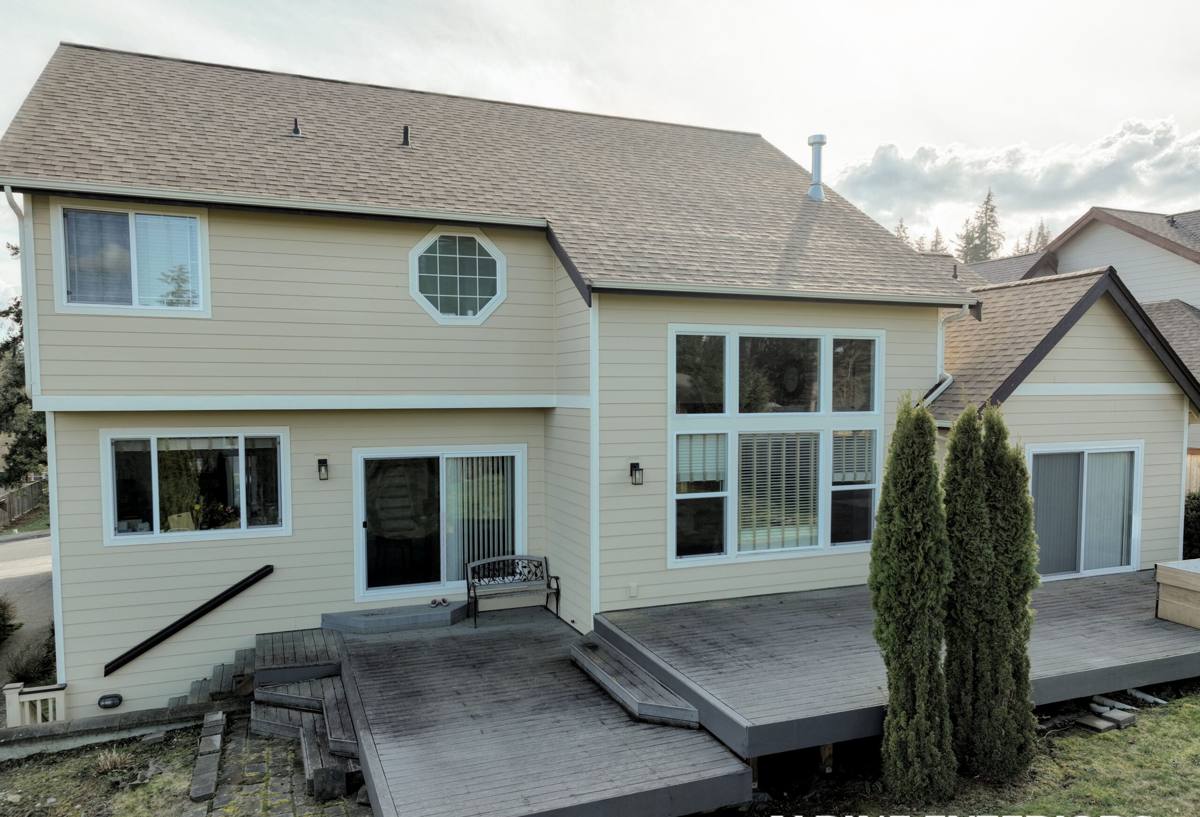
March Point sits out on the water, surrounded by Fidalgo Bay and Padilla Bay, which means homes here catch more wind, more salt-laden air, and more sustained rain than properties just a few miles inland. A deck built for a dry-side climate doesn't hold up the same way out here. Boards cup, fasteners corrode faster, and anything shaded by the mature evergreens common around Anacortes stays damp for weeks at a time during the wet season. Composite decking was designed to handle exactly this kind of exposure, but only if it's installed correctly for the conditions it will actually face.
This page covers what we look for on a March Point composite deck job specifically: the moisture management details that matter most in Skagit County, how we choose and install boards, and what ongoing care looks like once the deck is in.
Why Composite Makes Sense for This Location
Wood decking isn't a bad product, but it asks a lot of a homeowner in a climate like this. It needs regular sealing, sanding, and refinishing to keep water out of the grain, and if that maintenance schedule slips even one season, rot and splintering show up fast — especially on the shaded, north-facing sections of a deck that never fully dries out between rain events.
Composite decking, particularly capped composite, resists moisture absorption at the board level. It won't soak up standing water the way wood fibers do, it doesn't need annual staining, and it holds its color and surface texture much longer under UV and salt exposure. That doesn't mean composite is maintenance-free — we'll cover what upkeep actually looks like further down — but it removes the single biggest failure point we see on older wood decks in this area: water getting into the wood and staying there.
What Composite Doesn't Fix on Its Own
Composite boards are only as good as what's underneath them. A capped composite deck board sitting on a poorly flashed ledger, undersized joists, or a substructure with no ventilation will still fail — just in the framing instead of the decking surface. This is where a lot of the actual work on a correct install happens, and it's invisible once the project is finished.
What a Correct Composite Deck Installation Involves
Substructure and Framing
The frame underneath a composite deck carries the same rain exposure as any wood-framed structure in Skagit County. We use joists and framing sized and spaced to the manufacturer's specification for the board being installed — composite spans differently than wood decking, and undersized joist spacing is one of the most common corners cut on lower-cost installs. Any framing lumber in ground contact or close to grade gets the correct pressure-treated rating for that exposure, not a generic treated board.
Flashing and Moisture Management at the Ledger
Where a deck attaches to the house is the single most common source of hidden water damage we find on older decks in this area, and it has nothing to do with the decking material. A ledger board without proper flashing lets water track behind the siding and into the rim joist and wall framing, often for years before anyone notices. On every ledger-attached deck, we install flashing that sheds water away from the house framing, not just caulk over the gap. In a climate with this much driving rain, this detail matters more than the decking brand on top of it.
Fastening, Gapping and Board Layout
Composite boards expand and contract with temperature more than people expect, and correct gapping between boards and at end joints keeps that movement from telescoping fasteners or buckling the deck surface over time. We use hidden fastener systems on boards designed for them, which also eliminates the exposed screw heads that are the first place rust streaking shows up in a salt-air environment. On the substructure, we run joist tape or an equivalent moisture barrier over the top of each joist — a small step that keeps water from sitting on the wood framing underneath the composite decking, which is often the actual point of failure on decks that "should" have lasted longer.
Moss, Algae, and Salt Air: What March Point Homes Are Actually Fighting
Between the tree cover common around Anacortes properties and the extended damp season, moss and surface algae are a fact of life here, not an occasional problem. Uncapped or lower-grade composite can hold surface moisture in shaded areas long enough for organic growth to take hold, especially on boards that don't get much direct sun. Capped composite boards — where a protective outer layer is fused over the composite core — resist this far better and clean up with routine washing instead of scraping and staining.
Salt air off the bay is the other factor we plan around. It accelerates corrosion on any exposed metal hardware, which is why fastener and bracket selection matters as much as the decking material itself. A deck can have premium composite boards and still show rust streaking within a couple of seasons if the fasteners and structural hardware underneath weren't rated for a marine-adjacent environment.
Choosing the Right Composite Board
Not every composite product is built the same way, and the differences matter more in a wet, shaded, salt-air location than they would somewhere drier. Here's how the common tiers generally compare:
| Board Type | Moisture & Moss Resistance | Maintenance | Typical Warranty Range |
|---|---|---|---|
| Uncapped composite | Absorbs some surface moisture; more prone to algae in shade | Occasional washing; can stain over time | Shorter, often limited to structural defects |
| Capped composite (standard) | Strong resistance to moisture and staining | Periodic rinse or wash | Often in the 25-year range |
| Capped composite (premium) / mineral-based | Best resistance to moisture, fading, and organic growth | Low; occasional cleaning | Frequently 25-50 years, varies by manufacturer |
We'll walk through which tier makes sense for a given deck's sun exposure, tree cover, and budget rather than defaulting to one product for every job — a fully shaded, tree-lined section of a March Point yard has different needs than an open, south-facing area of the same deck.
Our Process, Start to Finish
- On-site assessment — we look at sun exposure, tree cover, drainage, and the condition of any existing structure before recommending a board type or layout.
- Design and material selection — board tier, fastener system, and layout are chosen for that specific site, not a one-size-fits-all package.
- Permitting — decks in Anacortes and unincorporated Skagit County typically require a permit; we handle that process rather than leaving it to the homeowner.
- Framing and flashing — substructure, ledger flashing, and joist protection go in before a single composite board is placed.
- Decking installation — boards, fasteners, and edge details are installed to manufacturer spec, including proper gapping for expansion.
- Final walkthrough — we go over the finished deck and basic care with the homeowner before calling the job done.
Maintenance in a Wet Climate
Composite decking cuts down on maintenance significantly compared to wood, but "low maintenance" isn't "no maintenance," especially with the moss and debris load common in this area. A simple seasonal routine keeps a composite deck looking and performing the way it should:
- Sweep off fir and cedar needles regularly — trapped debris holds moisture against the board surface and encourages moss growth in shaded spots.
- Rinse or wash the deck surface a few times a year, more often in heavily shaded areas, to keep organic growth from taking hold.
- Keep gutters and downspouts near the deck clear so runoff isn't dumping extra water onto one section of boards.
- Check fastener and hardware areas periodically for early rust staining, particularly on decks with more direct exposure to bay wind.
- Confirm nothing is blocking airflow underneath the deck — skirting or storage that seals off ventilation traps moisture against the framing.
Why Hire a Crew That Already Works in March Point
A lot of what makes a composite deck last in this area isn't visible in the finished product — it's the flashing behind the ledger, the fastener grade chosen for salt air, the joist spacing sized for the specific board, and the layout planned around where moss actually forms on that lot. Those are the details a crew learns by working decks in this exact climate repeatedly, not by installing composite decking in a dry inland market and assuming the same approach transfers.
We're familiar with the permitting process for Anacortes and Skagit County, we know how exposure and tree cover vary block to block around March Point, and we build every deck assuming it needs to handle driving rain and a long moss season, because out here, it does.
If you're considering a composite deck for a March Point property, we're happy to walk the site, look at sun exposure and drainage, and put together a straightforward, no-pressure estimate — just fill out the form below to get started.