 Anacortes Siding
 Burlington sits inland from the salt water but still gets the full weather package that defines Skagit County outdoor construction: long wet winters, a moss season that runs longer than most homeowners expect, and enough humidity most of the year to keep untreated wood damp for days after a storm. A deck built here has to survive that cycle year after year without cupping, rotting at the ledger, or turning into a slip hazard every fall. We build decks for homes throughout the Burlington and greater Anacortes area, and the details that matter most are almost always the ones you can't see once the project is finished.
What Burlington's Climate Actually Does to a Deck
A deck failure in this region is rarely dramatic. It's slow. Moisture gets into a joint that wasn't flashed correctly, or water sits against a post base that wasn't set above grade, and three or four years later you've got soft wood, rust streaks from failing fasteners, or a surface that's green and slick by October. Skagit County's rain isn't the heaviest in the state, but it's frequent and it lingers — decks here spend a lot of the year damp rather than truly wet or truly dry, and that in-between state is what rots wood and corrodes hardware over time.
Moss and algae growth is the other constant. Any deck surface that doesn't get much direct sun, which describes a lot of yards around Burlington under mature trees or on the shaded side of a house, will grow a biofilm on the boards. That film holds moisture against the wood and makes the surface slippery. It's manageable with the right material choice and some seasonal maintenance, but it's not optional to think about — it's a design factor from day one.
Salt Air's Reach Inland
Anacortes and the surrounding coastline deal with direct salt air exposure, and while Burlington is far enough inland that it's a smaller factor, fasteners and connectors on any deck in this part of Skagit County still benefit from corrosion-resistant hardware. We spec the same coated and stainless fastener systems for Burlington decks that we use closer to the water, because the cost difference is small and the failure mode — rusted screws backing out or staining the decking — isn't one you want to deal with in year five.
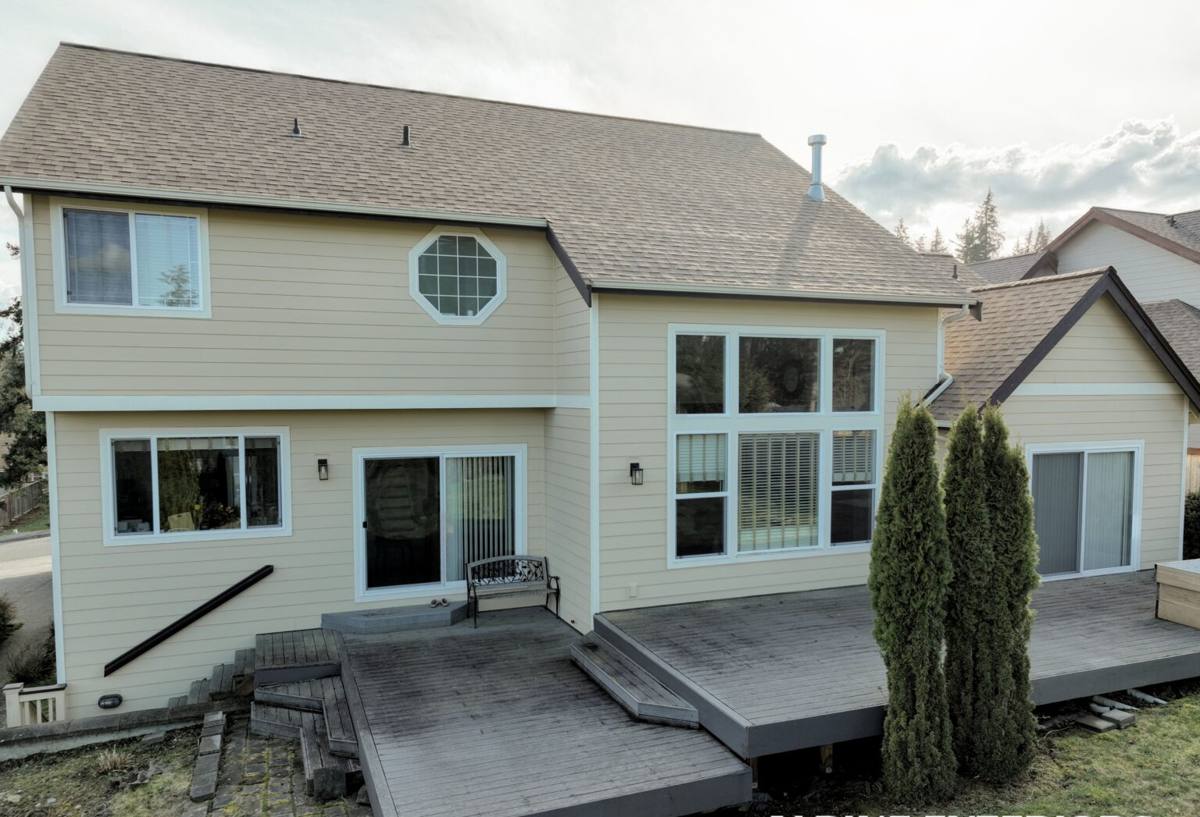
What a Correctly Built Deck Involves
A deck that holds up in this climate is built in layers, and every layer has a job. Skipping or shortcutting any one of them is usually where the slow failures start.
- Footings set below frost depth and on solid bearing soil — not just poured on grade, which shifts over time in our wet clay-heavy soils.
- Ledger board flashing that actually sheds water away from the house — this is the single most common failure point on deck-to-house connections in the Pacific Northwest.
- Joist tape or a moisture barrier on top of every joist — cheap insurance against the standing water that collects under decking boards.
- Corrosion-resistant structural hardware — hangers, hurricane ties, and fasteners rated for treated lumber contact.
- Proper board spacing for drainage and airflow — too tight and water and debris get trapped; too wide and it's uncomfortable underfoot.
- Post bases that keep wood off the concrete — direct wood-to-concrete contact wicks moisture straight into the post end grain.
None of this is visible once the deck is finished, which is exactly why it matters. A deck can look identical from the surface whether it was built to hold up for 25 years or built to look good for the first five.
Decking Material Options for a Burlington Yard
There's no single right answer here — it depends on your budget, how much sun the deck gets, and how much maintenance you actually want to do. We'll walk through the honest trade-offs rather than push whatever has the best margin.
| Material | Upfront Cost | Maintenance | How It Handles Our Climate |
|---|---|---|---|
| Pressure-treated lumber | Lowest | Annual cleaning, periodic staining/sealing | Reliable if sealed and maintained on schedule; will gray and can check if neglected |
| Cedar | Moderate | Regular oiling or sealing to hold color | Naturally rot-resistant but still needs upkeep in shaded, damp spots |
| Composite decking | Higher | Occasional washing, no staining | Handles moisture well; some boards can stay damp-feeling in deep shade without airflow underneath |
| PVC decking | Highest | Lowest — mostly just washing | Best moisture resistance of the group; performs well in shaded, moss-prone yards |
For Burlington yards with a lot of tree cover, we generally steer clients away from bare pressure-treated lumber as the finish surface unless they're committed to real annual maintenance — the shade-plus-moisture combination is exactly what accelerates moss growth and surface wear. Composite and PVC cost more up front but take that maintenance burden off the table almost entirely.
Railings, Stairs, and Fastener Details
Railing systems and stair stringers see more direct weather exposure than the deck field itself because they're vertical and catch driving rain from more angles. We treat these as their own design decision rather than an afterthought:
- Wood railings need the same sealing schedule as wood decking — skipping it shows up first at the post tops and rail caps.
- Metal and composite railing systems reduce that maintenance but need to be installed with compatible, corrosion-resistant hardware to avoid galvanic staining.
- Stair stringers should be cut from pressure-treated stock and, where possible, protected with a stringer cap or coating since they sit closer to grade and collect more standing water.
- All exterior fasteners on the project — not just the structural ones — should be rated for outdoor and treated-lumber exposure to avoid the rust streaking that shows up on lighter-colored decking within a couple of seasons.
Sizing and Placement for How You'll Actually Use It
Before any material gets chosen, we look at how the deck sits relative to the house and yard. A deck that's undersized for how a family actually uses it — grilling, dining, gathering — gets more concentrated foot traffic and wear in less space. Orientation matters too: a deck that faces west gets more direct sun and dries out faster after rain, while a north-facing or heavily shaded deck needs the moisture-resistant material choices covered above just to stay usable through the wet months. We also factor in drainage — where water naturally moves through your yard — so the deck doesn't end up collecting runoff from the roof or higher ground nearby.
Our Process, Start to Finish
- On-site assessment — we look at your yard's sun exposure, drainage, soil, and how the deck will tie into the house before any design decisions get made.
- Design and material walkthrough — honest pros and cons for each decking option based on your specific site conditions and budget, not a generic sales pitch.
- Permitting — decks typically require a permit in Skagit County; we handle that process so it's not on you to navigate.
- Footings and framing — built to the structural details above, inspected before decking goes down.
- Decking, railing, and stairs installed — with the flashing, fastener, and drainage details that determine how long it lasts.
- Final walkthrough — we go over basic care so you know what maintenance, if any, your specific material needs going forward.
Why a Crew That Already Works Burlington Matters
Deck problems in Skagit County aren't the same problems a crew coming from a drier climate is used to solving. A contractor who mostly builds in places with less rainfall and less moss pressure can turn out a deck that looks correct and still isn't detailed for what happens here over a wet winter. Working Burlington and the surrounding Anacortes area regularly means we've seen what actually fails locally — which ledger flashing details leak, which fastener choices rust first, which shaded corners of a yard need a different material than the sunny side — and we build around those lessons rather than learning them on your project.
It also means faster response if something does come up after the build. A local crew can get back out to your property without the scheduling gap that comes with a contractor based well outside the area.
Maintenance That Actually Extends the Life of Your Deck
Whatever material you choose, a few habits make a real difference in how long it holds up under our climate conditions:
- Sweep leaves and debris off the surface regularly, especially in fall — trapped organic matter is what feeds moss and holds moisture against boards.
- Keep gutters and downspouts clear so roof runoff isn't dumping directly onto or near the deck.
- Check railing posts and stair stringers annually for soft spots, since these take more direct weather exposure than the deck field.
- Reseal wood decking and railings on the schedule recommended for your specific product — waiting until it looks bad means the wood has already been unprotected for a while.
- Rinse composite or PVC decking periodically in shaded areas to keep algae from establishing, even though these materials don't need sealing.
If you're planning a new deck or replacing one that's showing its age, we're glad to walk your Burlington property and give you a straight, no-pressure estimate — just fill out the form below.