 Anacortes Siding
 Why La Conner Decks Wear Out Faster Than You'd Expect
La Conner sits right on the water, and that proximity is part of what makes it beautiful and part of what makes deck ownership here harder than it looks. Salt-laden air off the Swinomish Channel corrodes fasteners and hardware from the inside out, long before the wood itself shows obvious damage. Add Skagit County's driving rain, which tends to come in sideways during fall and winter storms, and you get moisture finding its way into joints, ledger connections, and end grain that a drier climate would never expose to that much standing water.
Then there's moss season, which in this part of Washington isn't really a season so much as most of the year. Moss and algae hold moisture against the deck surface and framing long after a storm has passed, which keeps wood damp enough for rot fungus to take hold. On a shaded deck near mature trees or a channel-facing deck that never fully dries between rains, that dampness can sit for days. We see decks in La Conner fail from the inside — in the framing and ledger board — well before the visible decking looks bad, which is exactly why a surface-level look often misses the real problem.
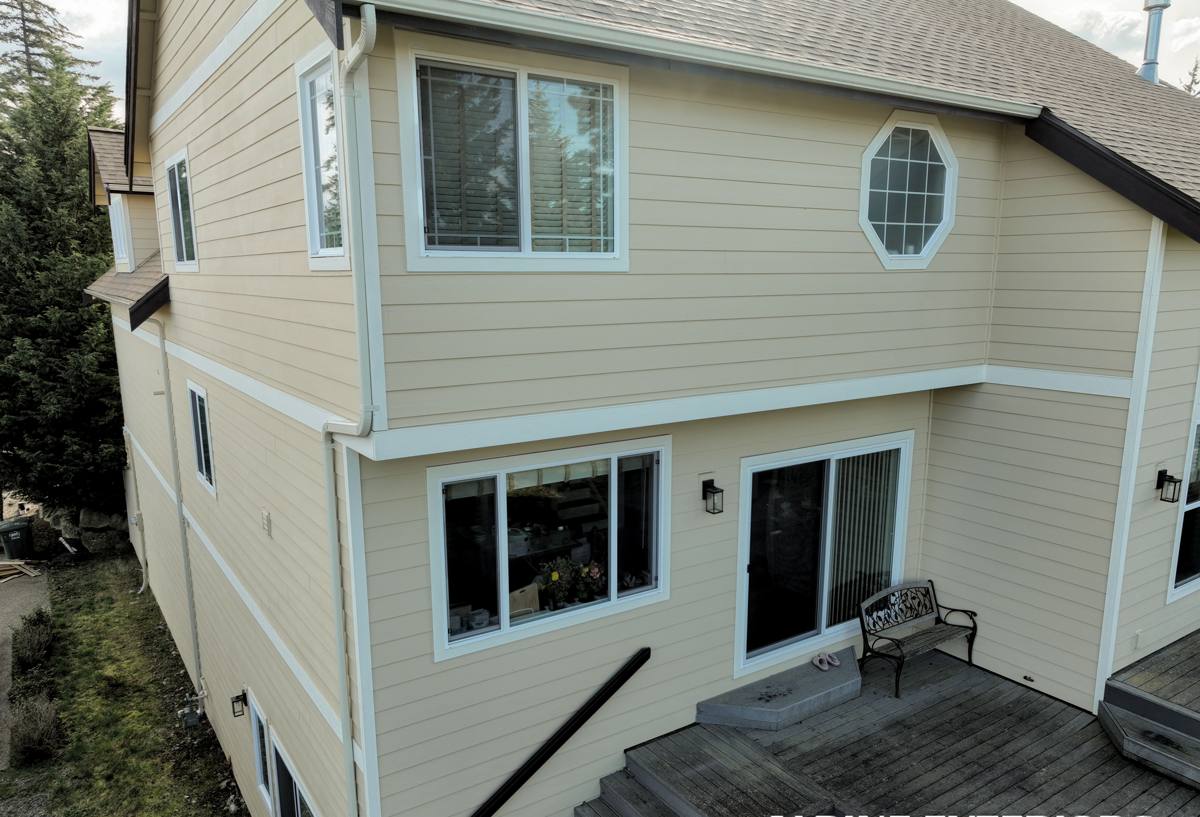
Common Signs Your Deck Needs Repair
Most deck problems don't announce themselves with a collapse. They show up as small, easy-to-dismiss signs first. If you own a deck in La Conner, it's worth checking for these every year, ideally before winter storms set in.
- Soft or spongy spots underfoot, especially near the house or along board edges
- Boards that have cupped, split, or pulled away from their fasteners
- Rust streaks or green/black staining around screws, bolts, or brackets
- A ledger board (where the deck attaches to the house) that looks separated, gapped, or has visible water staining below it
- Railings or posts that feel loose or wobble under hand pressure
- Persistent moss or algae growth that doesn't dry out between rain events
- Stairs that feel less solid than they did a year ago
- Any visible daylight or gap where the deck meets the foundation or house siding
Any one of these on its own might be minor. Several together, or anything involving the ledger board or main support posts, means it's time for a proper inspection rather than a DIY patch.
The Ledger Board Deserves Special Attention
The ledger board is the single most important structural connection on most decks — it's the board bolted to your house that carries a large share of the deck's weight. It's also the part most exposed to trapped moisture, because water running off the house or pooling behind the decking has nowhere to go. A ledger that's been quietly rotting behind the surface is one of the more serious failures we find, because the damage isn't visible until you know exactly where to look and how to check it.
What a Correct Deck Repair Actually Involves
A repair that only replaces the boards you can see is a repair that will need to happen again soon. Doing it right means working from the structure outward.
1. Diagnose Before Cutting Anything
We start by checking the framing, ledger connection, posts, and footings — not just the decking surface. A screwdriver or awl test on suspect wood tells us how far rot has actually spread, since damaged wood often extends well past what's visibly discolored.
2. Address the Structure First
Any compromised joists, beams, posts, or ledger connections get repaired or replaced before we touch the surface boards. Attaching new decking to a weakened frame just hides the problem under a nicer-looking surface.
3. Fasteners and Hardware Matched to the Environment
In a marine air environment like La Conner, standard fasteners corrode faster than the wood around them. We use fasteners and structural connectors rated for coastal and treated-lumber exposure, which matters more here than it would twenty miles inland.
4. Surface Repair or Replacement
Depending on the extent of the damage, this might mean replacing individual boards, resurfacing sections, or full deck board replacement while keeping a sound structure underneath.
5. Water Management Details
Flashing at the ledger, proper gapping between boards for drainage, and grading that directs water away from posts and footings all matter as much as the materials themselves. A repair that skips these details will fail again for the same reason the original deck did.
Repair or Replace? How We Help You Decide
Not every deck problem calls for a full rebuild, and not every deck is worth patching. The right call depends on where the damage is, how much of the structure is affected, and the deck's age and material.
| Factor | Leans Toward Repair | Leans Toward Replacement |
|---|---|---|
| Extent of damage | Isolated boards or one section | Rot found in multiple framing members or the ledger |
| Deck age | Under 15 years, otherwise well-built | Original construction is decades old or undersized by current standards |
| Structural integrity | Framing and footings test sound | Posts, footings, or ledger are compromised |
| Material | Quality lumber that's simply weathered | Original material was low-grade or improperly treated |
| Cost comparison | Repair cost is a fraction of replacement | Repair scope approaches rebuild cost anyway |
Straightforward board or railing repairs on an otherwise sound deck are usually a modest job. Once repairs start touching multiple framing members, the ledger, or several posts, the math often shifts toward a partial or full rebuild — we'll walk you through the actual numbers for your deck rather than quoting a generic range that doesn't apply to your situation.
Our Process for La Conner Deck Repairs
We keep the process straightforward and communicate clearly at each step, since deck repair decisions often come down to judgment calls about what's worth fixing versus replacing.
- On-site inspection. We check framing, ledger, posts, footings, and decking surface, and probe any suspect wood.
- Written scope and estimate. You get a clear breakdown of what's failing, what we recommend, and why — no pressure to upgrade beyond what the deck actually needs.
- Structural repairs first. Framing, ledger, and post work happens before any surface materials go on.
- Surface and hardware work. Board replacement, fastening, and railing repair using materials suited to marine air exposure.
- Final walkthrough. We check the repair together and go over any maintenance steps that will extend its life.
Materials That Hold Up in Skagit County's Marine Climate
Material choice matters more here than in drier parts of the state. Pressure-treated framing lumber is standard for structural members, but the fasteners and connectors around it need to match — mixing untreated hardware with treated lumber in a salt-air environment accelerates corrosion. For decking surfaces, homeowners in La Conner typically choose between quality wood species maintained on a regular schedule, or composite and capped-composite boards that resist moisture absorption and don't need annual staining.
Each option has real trade-offs. Wood decking gives a natural look and is generally more affordable up front, but it requires consistent sealing and cleaning to hold up against moss and driving rain — skip a season of maintenance here and you'll feel it. Composite decking costs more initially and needs far less upkeep, but it still depends entirely on a sound, well-ventilated frame underneath; composite over a rotting structure is just a nicer-looking version of the same problem. We'll talk through what fits your budget, your deck's exposure, and how much maintenance you actually want to keep up with.
Permits and Code Considerations
Deck repair scope determines whether permitting applies — replacing a few boards typically doesn't trigger a permit requirement, while structural work involving framing, footings, or a deck's attachment to the house often does, depending on the jurisdiction and scope. Skagit County and the City of Anacortes each have their own permitting thresholds and building code requirements for deck structures. We handle that determination as part of the estimate so you're not left guessing whether your repair needs sign-off, and we build to current code on any structural work regardless of whether a permit is technically required.
Keeping Your Repaired Deck in Good Shape
A properly executed repair still needs some ongoing attention in this climate, especially with the amount of moss pressure La Conner sees.
- Clear moss and debris from the deck surface and between boards at least once a season
- Keep gutters and downspouts clear so runoff isn't draining directly onto or under the deck
- Check fastener heads and railings for movement once a year, ideally before winter storms
- Reseal or restain wood decking on the schedule appropriate to the product — don't wait until it looks obviously weathered
- Keep vegetation and standing water away from post bases and the area under the deck
Why Local Experience with La Conner Homes Matters
A contractor who works this specific stretch of Skagit County regularly already knows how differently a shaded, tree-lined deck ages compared to one facing open water, and how the salt air and rain patterns here behave differently than they do even a short drive inland. That local familiarity shows up in the details — which fastener grades actually hold up, where moisture tends to collect on homes built to this area's older or newer construction styles, and what permitting looks like with the county versus the city. It also means a crew that isn't guessing at your deck's exposure for the first time, but applying what's worked on other decks facing the same conditions nearby.
If your deck in La Conner is showing any of the signs above, or you just want an honest opinion on its condition, we're happy to take a look. Reach out through the form below for a free, no-pressure estimate — we'll tell you straight what we find and what it would take to fix it right.