 Anacortes Siding
 Guemes Island Decks Face a Different Set of Problems
A deck on Guemes Island doesn't age the way a deck in a sheltered inland neighborhood does. Sitting out in Rosario Strait and Guemes Channel exposure means most island homes get a steady diet of salt-laden air, wind-driven rain, and a moss season that can run from fall through spring. None of that is dramatic on its own, but stacked together year after year, it's exactly what breaks decks down early — corroded fasteners, soft framing, slick and failing surface boards, and finishes that give up long before they should.
We work throughout Skagit County, including regular trips out to Guemes Island, and the deck failures we see out there follow a pattern that's noticeably different from what we find on a typical Anacortes mainland job. If you're planning a deck replacement on the island, it helps to understand why, because it changes what "doing it right" actually looks like.
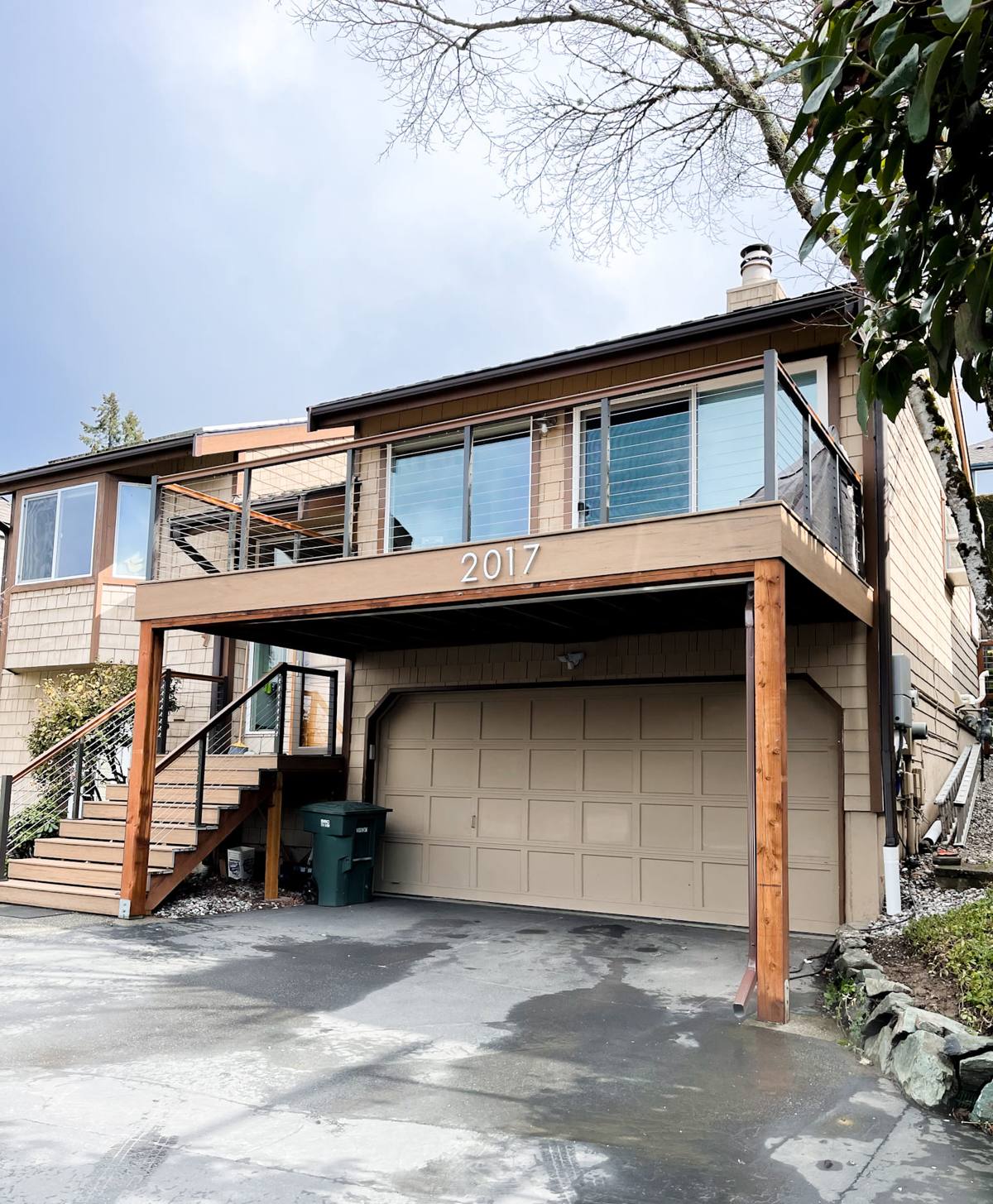
Why Salt Air, Rain, and Moss Age a Deck Faster
Salt Air and Metal Fasteners
Airborne salt accelerates corrosion on anything metal — nails, screws, joist hangers, post bases. On a mainland deck a few miles inland, standard exterior-rated hardware can hold up fine for decades. Out on the island, that same hardware can start showing rust streaks and weakening well ahead of schedule. Once a fastener corrodes, it loses holding strength quietly — you usually don't see it until a board is loose or a railing has some give.
Driving Rain and Moisture Intrusion
Wind-driven rain doesn't just fall on a deck, it gets pushed sideways into ledger boards, under flashing, and into any gap in the framing. Over time, that moisture works its way into end grain and fastener holes even on decking that's rated for exterior use. The ledger connection — where the deck attaches to the house — is usually the first place this shows up as rot, because it's the hardest spot to keep water out of and the easiest to overlook during a quick repair.
Moss and Surface Buildup
A long moss season means more months where a deck surface stays damp instead of drying out between rains. Moss and algae hold moisture against the board surface, which speeds up wood decay and makes composite and wood decking alike genuinely slippery. It's also cosmetic damage that homeowners notice immediately, even when the structure underneath is still sound.
Repair or Replace? How to Tell
Not every tired-looking deck needs full replacement, but a lot of island decks are past the point where patching makes sense. Here's the honest way to think about it:
- Surface boards cupping, splintering, or soft in spots — often repairable if framing underneath is solid.
- Rust staining around fasteners or hardware — a warning sign, not always a dealbreaker on its own.
- Soft or spongy framing near the ledger or posts — this is a structural issue, not cosmetic, and usually points toward replacement.
- Railings with noticeable movement or give — a safety issue that needs to be addressed regardless of the rest of the deck's condition.
- Deck is 15-25+ years old with multiple issues at once — at that point, replacing the whole structure is usually more cost-effective than chasing repairs one at a time.
If your deck has one or two of these issues, a repair might genuinely be the right call. If you're seeing several at once, that's usually the framing telling you it's done.
What a Correct Deck Replacement Actually Involves
A deck replacement done right isn't just pulling up old boards and screwing down new ones. For a deck that has to hold up to island exposure, the parts you don't see matter more than the parts you do.
Ledger and Flashing
The ledger board connection is the single most common failure point on any deck, and it's the place where corner-cutting shows up worst in wet climates. Correct flashing — installed so water is directed away from the house band board rather than trapped behind it — is non-negotiable on a rebuild, even if it adds a step the old deck never had.
Framing and Fasteners
Given the salt exposure, we don't treat "exterior-rated" hardware as automatically good enough for island work. Stainless steel or heavy-duty coated fasteners and connectors cost more up front but hold up dramatically longer against corrosion than standard galvanized hardware in a salt-air environment. The same logic applies to joist hangers, post bases, and structural screws — the framing is only as durable as its weakest connection.
Footings and Posts
Wind exposure on an open island lot puts more lateral load on a deck than a sheltered inland site sees. Footing depth and post connections need to account for that, not just meet the bare minimum.
Decking Surface
Whatever surface material you choose, proper spacing between boards matters more here than in a dry climate — tight gaps trap moisture and speed up moss growth and rot. Airflow underneath the deck is just as important as what's on top.
Choosing a Decking Material for Island Exposure
There's no single "best" decking material — it's a trade-off between upfront cost, maintenance, and how the material handles moisture and salt over time. Here's how the common options actually compare for a Guemes Island application:
| Material | Upfront Cost | Maintenance | Moisture/Salt Behavior |
|---|---|---|---|
| Pressure-treated wood | Lowest | Highest — annual cleaning, periodic sealing | Prone to cupping and splintering if not maintained; needs regular attention in a wet climate |
| Cedar | Moderate | Moderate-high — regular sealing to hold color and resist moisture | Naturally rot-resistant but still needs upkeep against constant moisture and moss |
| Composite decking | Higher | Low — occasional washing, no sealing | Doesn't absorb moisture like wood; resists rot, but quality varies by product tier |
| PVC / capped composite | Highest | Lowest | Best moisture and stain resistance of the group; strongest option for constant salt and rain exposure |
We'll walk through these trade-offs honestly based on your budget and how much maintenance you actually want to keep up with — there's no wrong answer as long as it's an informed one.
The Ferry Factor: Why Local Logistics Actually Matter
Guemes Island is ferry-access only, and that changes how a deck project has to be planned, not just where the crew comes from. Material deliveries, dumpster or debris hauling, and daily crew trips all have to work around the ferry schedule instead of against it. A contractor who hasn't worked the island before will often underestimate this — extra trips back and forth for a forgotten part or tool cost real time and money when every trip means a ferry crossing.
We plan island jobs differently: staging materials in fewer, larger deliveries, confirming everything is on-site before demo starts, and scheduling crew days around ferry timing so the work itself isn't constantly interrupted. It's a small thing that makes a real difference in how smoothly a project actually runs.
Our Deck Replacement Process
- On-site assessment — we inspect the existing deck, ledger connection, framing, and footings to confirm what's actually driving the failure.
- Honest scope and estimate — a clear breakdown of what's being replaced, what materials we recommend and why, and a realistic cost range.
- Permitting — Skagit County permitting requirements apply on the island the same as anywhere else in the county; we handle that process as part of the job.
- Material staging — deliveries planned around ferry logistics so the job isn't waiting on materials mid-project.
- Demolition and framing repair or rebuild — old decking, and any framing that doesn't meet a solid standard, comes out and gets replaced correctly.
- Ledger flashing and structural connections — done to hold up against wind-driven rain and salt exposure, not just to pass a quick look.
- Decking, railing, and finish work — installed with proper spacing and fastening for the material chosen.
- Final walkthrough — we go over the finished deck with you before calling the job done.
What Affects the Cost of a Deck Replacement
| Factor | Why It Matters |
|---|---|
| Deck size and layout | More square footage and complex shapes (multiple levels, angles) mean more material and labor |
| Decking material chosen | Pressure-treated wood costs less upfront than composite or PVC, but with more long-term maintenance |
| Framing condition | If posts, footings, or the ledger connection need rebuilding, not just resurfacing, that adds scope |
| Railing and stair work | Custom railings, glass panels, or multiple stair sets add cost beyond basic surface replacement |
| Site access and logistics | Ferry scheduling and material staging on island jobs factor into overall project timeline and cost |
We'll break these down specifically for your project during the estimate — there's no reason to guess when we can walk the site and give you real numbers.
Keeping a New Deck in Good Shape on Guemes Island
Whatever material you choose, a little seasonal attention goes a long way in this climate:
- Sweep off standing debris and moss buildup regularly, especially through fall and winter
- Rinse salt residue off the surface periodically, particularly after storms with onshore wind
- Check railings and stair connections once or twice a year for movement
- Keep gutters and downspouts clear so runoff isn't draining directly onto or under the deck
- For wood decking, reseal on the schedule recommended for your specific product — don't wait until it's visibly gray and dry
- Watch the ledger connection area for staining or soft spots, since it's the hardest point to inspect casually
Why It Matters to Hire a Crew That Already Works Guemes Island
Deck replacement isn't a job you want to be a learning experience for your contractor. A crew that's already done this work on the island knows what fastener grade actually holds up out here, how to plan around the ferry so the job doesn't stall out, and where island decks typically fail so those spots get built correctly the first time. That experience shows up in fewer surprises during the project and a deck that's actually built for the exposure it's going to see, not just built to a generic spec.
If your deck is showing its age — soft spots, rust streaks, moss that won't quit, a railing that moves more than it should — we're happy to come take a look. Reach out for a free, no-pressure estimate, and we'll give you a straight assessment of what your deck actually needs.