 Anacortes Siding
 Windows Built for a Different Kind of Weather
Oak Harbor sits close enough to the water that its houses take on a different kind of wear than homes twenty miles inland. Wind off the Salish Sea carries salt onto siding, window frames, and hardware nearly every day of the year. Add long stretches of driving rain in the fall and winter, then a wet, shaded moss season that can run from late fall into spring, and you have a climate that is genuinely hard on window assemblies — especially older ones that were never sealed or flashed correctly to begin with.
We're based out of Anacortes and travel to Oak Harbor regularly, usually crossing at Deception Pass, so this isn't a one-off trip for us — it's a route we know and a climate we build for. Custom window work here isn't just about picking a style you like. It's about choosing materials and installation details that hold up to salt exposure and moisture over years, not just for the first winter.
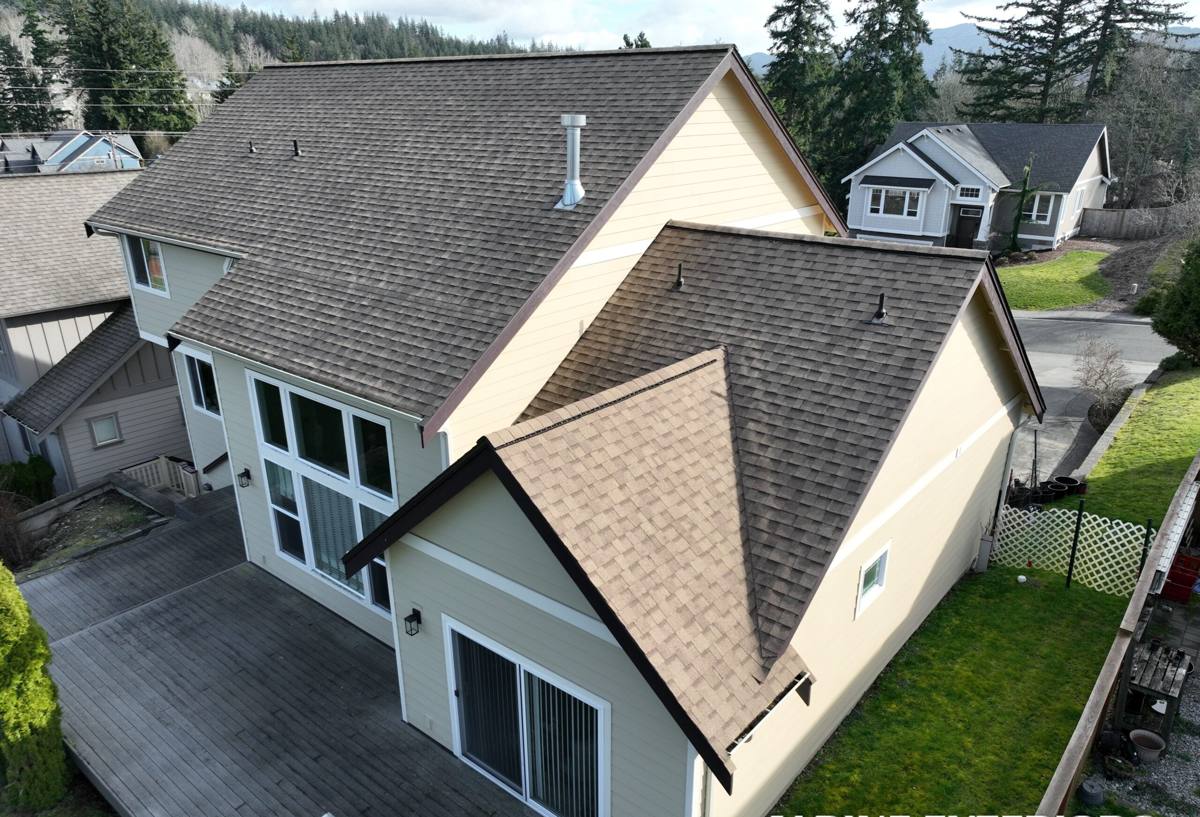
What Salt Air, Rain, and Moss Actually Do to a Window
Each of these three factors attacks a window assembly in a different way, and understanding that helps explain why some installations fail early while others last decades.
Salt Air
Airborne salt is corrosive to exposed metal — screws, hinges, cranks, and lesser-grade cladding fasteners all take the hit over time. It also breaks down cheap finishes faster than inland exposure would, leaving frames chalky or pitted years before they should show wear.
Driving Rain
Wind-driven rain doesn't just fall on a window, it gets pushed sideways and upward into any gap in the flashing or sealant. A window that would be fine in a calm rain can still leak in a storm if the flashing detail behind the trim wasn't built for wind-driven water in the first place.
Moss and Shade
Homes tucked under trees or facing north stay damp longer after every rain. That moisture sits in wood trim, sills, and low-quality caulk joints, and moss takes hold wherever organic buildup accumulates. Once moss gets a foothold near a window opening, it holds water against the frame far longer than open air would.
Signs Your Current Windows Are Losing the Battle
Before recommending replacement or custom work, we look for the practical signs a window's weather seal has already failed. If you're seeing any of the following, it's worth having it looked at before the next wet season:
- Fogging or moisture trapped between panes of a double-pane unit — a sign the seal has failed
- Soft or discolored wood at the sill or bottom corners of the frame
- Visible staining, streaking, or moss growth on siding directly below a window
- Drafts you can feel at the frame edge even when the window is fully latched
- Difficulty opening, closing, or locking a window that used to operate smoothly
- Paint or finish that's chalking, peeling, or pitted faster on some windows than others
- Condensation on the inside of glass during cold, damp mornings
What a Correct Custom Window Installation Actually Involves
"Custom" doesn't just mean a non-standard size — it means the window and its installation are matched to the specific opening, wall assembly, and exposure of your home, rather than forced to fit whatever's on hand. On a coastal property, the installation details matter as much as the window itself.
Sizing and Fit
Older homes and additions often have openings that are slightly out of square or don't match modern standard sizes. Custom units are built to the actual opening, which avoids the shimming and gap-filling that weakens a seal over time.
Flashing and Water Management
This is the step that determines whether a window leaks in ten years or fifty. Correct flashing directs any water that gets behind the trim back out and away from the wall assembly — it doesn't rely on caulk alone to keep water out, because caulk is a maintenance item, not a permanent barrier.
Sealing and Insulation
The gap between the window unit and the framed opening needs to be insulated and air-sealed without over-packing it, which can bow the frame and affect operation. Done right, this also cuts down on the drafts and energy loss that older windows are known for.
Hardware and Fasteners
In a salt-air environment, fastener quality is not a place to cut corners. We use fasteners and hardware rated for coastal exposure rather than standard-grade parts that will corrode and stain the surrounding trim within a few seasons.
Choosing Materials for Coastal Exposure
There's no single "best" window material for every home — it depends on your budget, the home's style, and how much upkeep you're willing to do. Here's how the common options actually compare for a coastal Oak Harbor property:
| Material | Salt Air Performance | Maintenance | Typical Trade-Off |
|---|---|---|---|
| Vinyl | Good — won't corrode or rot | Low — occasional cleaning | Fewer custom color/finish options; can look less premium on higher-end homes |
| Fiberglass | Very good — dimensionally stable, resists warping | Low | Higher upfront cost than vinyl |
| Wood | Requires diligent upkeep in salt/moisture exposure | High — regular refinishing needed | Best traditional appearance; highest long-term maintenance burden here |
| Wood-clad (wood interior, metal/composite exterior) | Good if cladding and flashing are done correctly | Moderate | Interior wood look with better exterior protection; installation quality matters more |
| Aluminum | Prone to corrosion unless marine-grade and properly coated | Moderate to high | Not our default recommendation for this exposure unless it's a specific architectural match |
For most Oak Harbor homes we work on, vinyl or fiberglass ends up being the practical choice — they hold up to the salt and moisture cycle with the least ongoing attention. Where a homeowner wants a wood look, wood-clad units let us get closer to that appearance without accepting the full maintenance burden of solid wood in this climate.
Our Process, Start to Finish
- Site visit and assessment — we look at every opening in person, checking framing condition, current flashing, and exposure to wind and rain, not just window count.
- Material and style selection — we walk through the options above based on your home's style, budget, and how much upkeep you want to do down the road.
- Accurate measurement and ordering — custom units are built to the actual opening, which is why measurement happens before anything is ordered, not estimated from a floor plan.
- Removal and prep — old units come out carefully, and we inspect the framing underneath for hidden rot or water damage before anything new goes in.
- Installation with proper flashing and sealing — this is where most of the long-term performance is decided, and it's not a step we shortcut to save time.
- Final check and cleanup — every window is tested for smooth operation and a tight seal before we consider the job done.
Why a Crew That Already Works Oak Harbor Matters
Window work isn't purely about the product — it's about who's installing it and whether they understand the specific conditions of your property. A crew that regularly works between Anacortes and Oak Harbor already knows what wind exposure looks like on a bluff-facing home versus a sheltered lot, how moss builds up differently depending on tree cover, and which flashing details actually hold up through a full wet season here rather than just on paper.
There's also a practical side to working with a local, established crew: consistent scheduling, a known point of contact if something needs adjustment after installation, and a crew that isn't learning Skagit and Island County coastal conditions on your project for the first time.
What Affects the Cost of a Custom Window Project
Every home is different, so we don't quote sight unseen — but these are the main factors that move the price up or down:
| Factor | How It Affects Cost |
|---|---|
| Number of windows | Per-unit cost typically drops slightly on larger multi-window projects |
| Material chosen | Vinyl is generally the most budget-friendly; fiberglass and wood-clad cost more upfront |
| Opening condition | Rotted or out-of-square framing adds repair time before the new window can go in |
| Custom sizing or shape | Non-standard sizes, arched tops, or specialty shapes cost more than standard rectangular units |
| Access and location | Second-story or hard-to-reach openings take more time and equipment |
| Trim and finish work | Matching existing interior or exterior trim adds labor beyond the window install itself |
Getting Your New Windows Through Moss Season
A properly installed window doesn't need much upkeep, but a few habits go a long way in this climate:
- Rinse salt residue off frames and glass periodically, especially after windy weather off the water
- Keep gutters and downspouts clear so runoff isn't pooling near window openings
- Trim back tree branches or vegetation that keeps a window shaded and damp longer than necessary
- Check caulk lines once a year, typically before the wet season starts, and touch up any that have cracked
- Operate opening windows periodically even in winter to keep hardware from seizing
If you're weighing whether it's time to replace aging windows or want a straightforward look at what custom options make sense for your home, we're glad to come take a look. We offer free, no-pressure estimates for Oak Harbor homeowners — just fill out the form below and we'll get in touch.