 Anacortes Siding
 Siding Installation Built for Conway's Delta Climate
Conway sits low in the Skagit River delta, close enough to Skagit Bay that the air carries salt most of the year and the ground rarely dries out completely between storms. Homes here take a different kind of beating than houses twenty minutes inland. The combination of humid river-bottom air, wind-driven rain off the Sound, and long stretches of gray, low-sun winter creates near-perfect conditions for moss, algae, and slow moisture intrusion in siding that isn't installed with this specific environment in mind.
We install siding for homes throughout the Anacortes and Skagit County area, and Conway is one of the toughest micro-climates we work in. A siding job that would hold up fine on a hillside home in town can fail early down in the delta lowlands if the installer doesn't account for the extra moisture load, the salt exposure, and the moss pressure that comes with sitting close to tidal water and diked farmland.
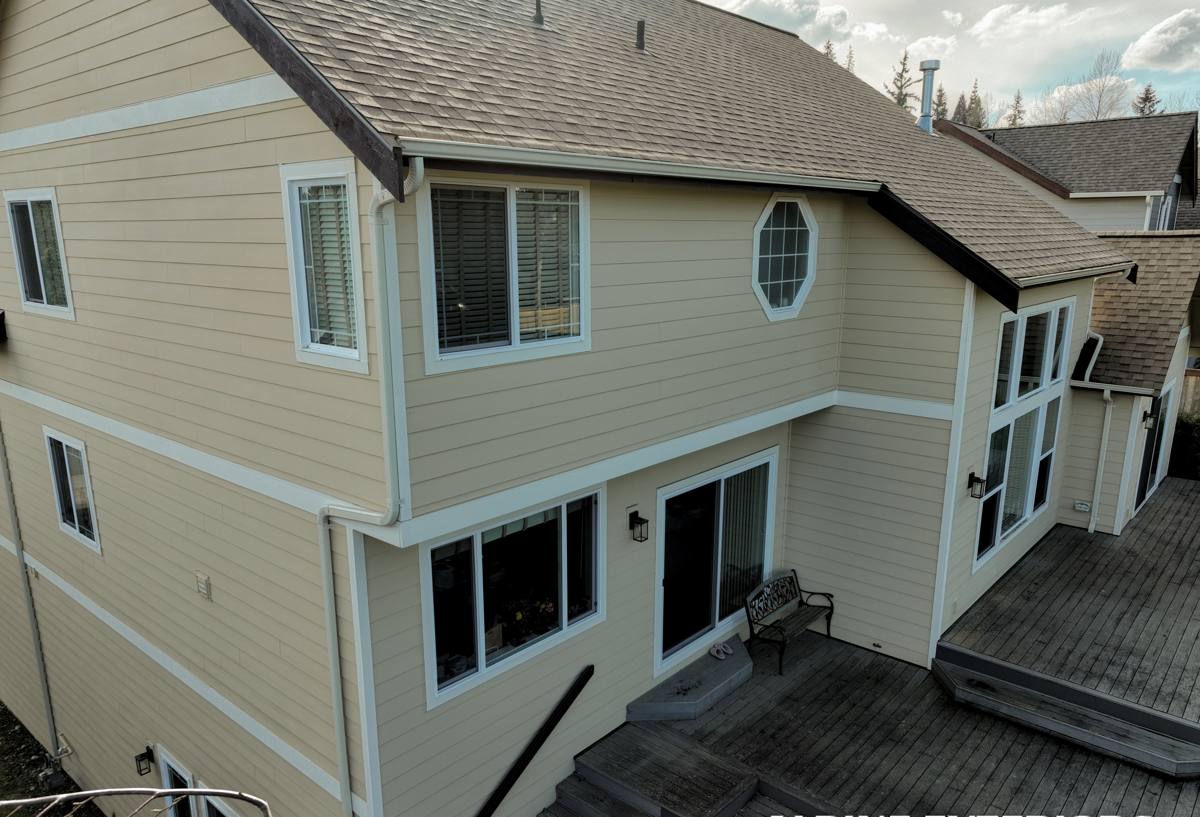
What Conway's Climate Actually Does to Siding
Salt Air
Salt-laden air moving up the estuary accelerates corrosion on anything metal — fasteners, flashing, trim caps — and it also degrades cheaper paint finishes faster than inland exposure would. Siding with a weak factory finish, or siding installed with the wrong fastener, tends to show chalking, fading, and rust bleed years ahead of schedule in this kind of setting.
Driving Rain
Storms coming off the Sound don't just fall straight down here — wind pushes rain sideways into wall assemblies, especially on west- and south-facing elevations. That means water is being forced at seams, laps, and penetrations far more aggressively than a calm-weather rain would ever manage. Any weakness in the water-management details behind the siding gets found quickly.
Moss and Algae Season
Low elevation, poor drainage in places, and long damp winters add up to an extended moss and algae season. Anything that stays wet longer than it should — north-facing walls, areas under tree canopy, low clearance near grade — becomes a growth surface. Moss doesn't just look bad; it holds moisture against the surface underneath it, which is exactly what you don't want happening against a wall assembly for months at a time.
What a Correct Siding Installation Involves Here
Given all that, a Conway siding job isn't just about picking a product and nailing it up. Correct installation means the water-management system behind the siding is doing most of the real work, and the siding itself is a durable, well-finished final layer on top of it.
- A weather-resistive barrier installed and lapped correctly, with all seams taped or shingled to shed water downward
- Proper flashing at every window, door, and penetration — not caulk substituting for flashing
- Rainscreen or drainage gap where conditions call for it, so moisture that does get behind the cladding can actually drain and dry
- Minimum ground clearance maintained so the bottom course isn't sitting in splash-back or standing moisture
- Corrosion-resistant fasteners suited to a salt-air environment, not generic hardware
- Tight, consistent caulking at trim joints using a product rated for exterior movement, not a bead that will shrink and crack in a season or two
Skip any one of these and the siding itself becomes almost irrelevant — water will find the weak point regardless of what material is on the outside.
Why We Install Only James Hardie Fiber Cement
We don't install vinyl, LP SmartSide, primed spruce, cedar, or other fiber cement brands. That's a deliberate standard, not a lack of options. In a climate like Conway's, the differences between products stop being cosmetic and start being structural.
Vinyl expands and contracts with temperature swings and can warp or crack under prolonged UV and moisture cycling; it's also a petroleum-based product with real limits on paintability and impact resistance. Wood-based products — cedar, primed spruce, engineered wood siding like LP SmartSide — depend on an intact factory or field-applied coating to keep moisture out, and in a environment this damp, any gap in that coating (a cut edge, a fastener hole, a scuff from installation) becomes an entry point for rot. These products can perform well in the right hands and the right climate, but the maintenance burden and moisture sensitivity are real trade-offs we're not willing to put on a home that sits in a delta floodplain with salt air on top of it.
James Hardie fiber cement is cement, sand, and cellulose fiber — it doesn't absorb water the way wood-based products do, it won't warp like vinyl, and it's non-combustible. Hardie's HZ5 product line is specifically engineered for wet, harsh climates, which is exactly the category Conway falls into. The ColorPlus factory finish is baked on under controlled conditions and backed by a substantial finish warranty, which matters a lot in an area where sun, salt, and moss all attack the surface finish simultaneously. It's also heavy and rigid enough to hold a straight, tight reveal line for decades rather than a few years.
Comparing Siding Options in a Salt-Air, High-Moisture Climate
| Factor | Vinyl | Wood / Engineered Wood | James Hardie Fiber Cement |
|---|---|---|---|
| Moisture absorption | None, but traps moisture behind it if not vented | High if coating is breached | Very low; won't rot |
| Salt air resistance | Fair; finish can chalk | Poor without diligent recoating | Strong factory finish resists fading and salt exposure |
| Moss/algae resistance | Moderate | Poor; organic material feeds growth | Good; non-organic surface |
| Fire resistance | Low; melts/deforms | Combustible | Non-combustible |
| Maintenance | Low, but limited repair options | High; recoat/repaint on a cycle | Low; occasional wash, repaint on a much longer cycle |
| Typical lifespan installed to spec | 20–30 years | Varies widely with upkeep | 30+ years, often longer |
Signs a Conway Home Needs Siding Attention
Because of the climate here, problems often show up sooner than a homeowner expects, and not always where you'd look first.
- Moss or dark streaking building up on north-facing or shaded walls year after year, even after cleaning
- Soft spots, bubbling, or visible warping, especially near the bottom courses close to grade
- Caulk that's cracked, shrunk, or pulled away from trim and window edges
- Peeling or chalking paint that returns quickly after repainting
- Rust staining running down from fasteners or metal flashing
- Interior signs — musty smell, peeling interior paint, or soft drywall near exterior walls — that suggest moisture is already getting through
Any of these on their own might just mean a repair. Several at once, especially on a home that's original siding from decades back, usually means it's time to talk about full replacement before the sheathing underneath starts taking damage too.
Our Installation Process
The process doesn't change much from house to house, but the attention we put into the water-management layer does scale up for a site like Conway.
- On-site assessment — we look at drainage around the foundation, existing siding condition, moss patterns, and any moisture already present at penetrations or trim.
- Tear-off and sheathing check — old siding comes off and we inspect the sheathing underneath for soft spots or existing rot before anything new goes on.
- Weather-resistive barrier and flashing — a correctly lapped barrier, with flashing at every window, door, and penetration, is installed before a single piece of siding goes up.
- Drainage plane — where conditions call for it, we build in a drainage gap so any moisture that gets behind the cladding has somewhere to go and can dry out.
- Hardie installation — panels, planks, or shingle-style siding installed to Hardie's fastening and clearance specifications, using corrosion-resistant fasteners suited for salt air.
- Trim, caulk, and finish detail — tight joints, correctly rated sealant, and a clean finish line at grade, soffits, and corners.
- Final walkthrough — we go over the completed work and what maintenance, if any, to expect going forward.
What to Ask Before Hiring a Siding Contractor in Conway
Because so much of the performance of a siding job is hidden behind the final surface, it's worth being deliberate about who you hire.
- Do they install a proper weather-resistive barrier and flashing system, or just nail siding over what's already there?
- Can they explain how their approach accounts for wind-driven rain and salt air specifically, not just siding installation in general?
- Are they licensed and insured in Washington, and can they show proof without hesitation?
- Do they have experience working in the Skagit delta lowlands, not just general Skagit County or Anacortes hillside work?
- What warranty covers both the product and the labor, and who do you call if something goes wrong down the road?
- Will they give you a written, itemized estimate rather than a vague lump-sum number?
After Installation: Keeping Conway Siding Performing
Fiber cement siding installed correctly needs far less upkeep than wood or vinyl, but it's not zero-maintenance in this climate. A yearly rinse-down to knock back moss and algae buildup, especially on shaded and north-facing walls, keeps growth from establishing a foothold. Keep an eye on caulk lines at trim and window edges and have any cracking resealed before it becomes a moisture path. Repainting, when it's eventually needed, is on a much longer cycle than wood siding thanks to the ColorPlus factory finish — but it's still worth a visual check each year, particularly after a hard winter storm season.
If you're weighing a siding project on a Conway home, we're happy to take a look and walk you through what your house specifically needs, given its exposure, age, and condition. Reach out for a free, no-pressure estimate — we'll tell you honestly what we find, not just what sells a job.