 Anacortes Siding
 Storm Damage Roof Repair, Built for Burlington's Weather
When a windstorm rolls through Skagit County, Burlington homes take it on the chin in a different way than the waterfront neighborhoods closer to Anacortes. We're based just up the road in Anacortes, but a good share of our storm calls come from Burlington and the rest of the Skagit Valley — and after enough of those calls, you start to see the patterns in how local roofs actually fail. This page is about one job: repairing storm-damaged roofs on Burlington homes, done right the first time, without upselling a full tear-off when a targeted repair will genuinely hold up.
Storm damage repair is not glamorous work, but it's the kind of job where shortcuts show up two winters later as a stained ceiling or a soft spot in the decking. We'd rather explain what's actually wrong with your roof and give you a straight answer than talk you into more than you need.
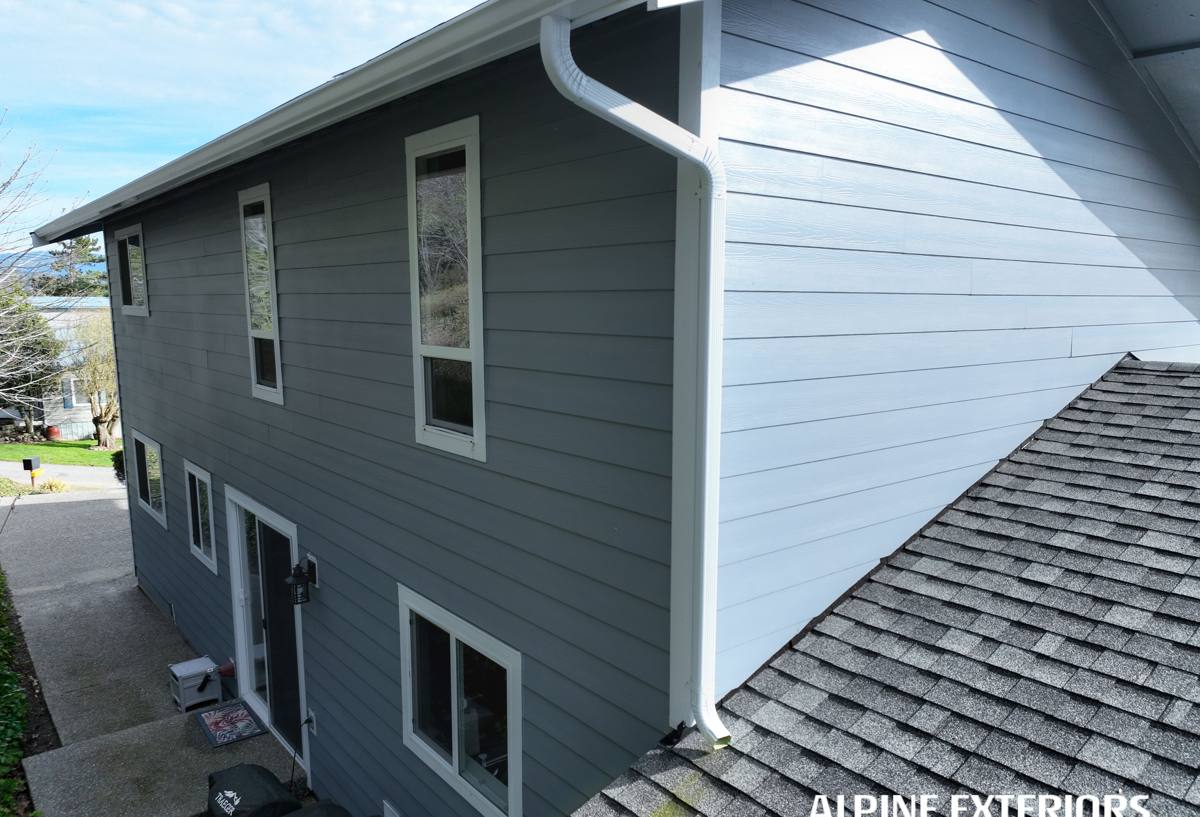
Why Burlington Roofs Take a Different Kind of Beating
Burlington sits a few miles inland from Anacortes, on the flatter ground of the Skagit Valley rather than right on the water. That matters. The salt-laden air and constant wind that define Anacortes' immediate waterfront still reach Burlington on the stronger storm systems that push in off the Salish Sea, but the bigger day-to-day factors for Burlington roofs are the valley's wind exposure, the volume of driving rain, and a moss season that runs longer than most homeowners expect.
Wind Funneling Through the Valley
Open valley terrain doesn't slow wind down the way a wooded hillside or tight neighborhood does. Gusts that would lose energy elsewhere can stay strong across Burlington's flatter ground, which is exactly the kind of wind that lifts shingle tabs, peels back ridge caps, and works loose fasteners that were already marginal.
Driving Rain and Wind-Driven Intrusion
Skagit County storms rarely come straight down. When rain arrives sideways, it finds every gap a roof has — lifted shingle edges, worn flashing, nail pops, and old pipe boots — and pushes water uphill under the roofing where gravity alone would never take it. This is why a roof can look mostly fine from the ground after a storm and still be leaking into the attic.
A Long Moss Season
Between the shade from mature trees common on Burlington lots and the region's long stretch of wet, mild weather, moss gets a real foothold on north-facing slopes and shaded valleys. Moss holds moisture against the roofing material year-round, and a storm hitting an already moss-softened roof does more damage than the same storm would on a clean, dry one.
What Actually Counts as Storm Damage
Homeowners often picture storm damage as a hole punched through the roof, but most of what we repair is quieter than that. Wind can crease a shingle without tearing it off, rain can drive under flashing without leaving a visible gap, and a falling branch can bruise shingles or crack decking without ever penetrating through. All of it counts as storm damage, and all of it shortens the life of the roof if it's ignored.
The trouble with the quiet kind of damage is that it doesn't announce itself right away. A ceiling stain today might be from a storm three months ago that let a small amount of water in every time it rained since. That lag is exactly why a post-storm inspection is worth doing even when nothing looks obviously wrong.
Storm Damage Signs and What They Usually Mean
| What You Notice | What It Usually Means | How Urgent |
|---|---|---|
| Shingle tabs lifted or missing | Wind has broken the seal or torn shingles loose | Repair soon — exposed felt or decking underneath |
| Granules collecting in gutters after a storm | Wind and hail-like debris impact stripping shingle surface | Monitor — accelerates aging, not always urgent alone |
| Ceiling stain appearing after a windy, rainy stretch | Wind-driven rain intrusion, often at flashing or a valley | Urgent — active water intrusion |
| Sagging or soft spot underfoot on the roof | Decking has absorbed water and is losing strength | Urgent — structural concern |
| Thick moss mats after a storm knocked debris loose | Moss was already trapping moisture; storm disturbed it | Plan for cleaning and repair before next storm |
| Bent or lifted flashing around chimney, skylight, or vent | Wind uplift or impact from debris | Repair soon — flashing failures leak quietly |
Repair or Replace? How We Make the Call
Not every storm-damaged roof needs to come off. We look at three things before recommending anything: how old the roofing is, how widespread the damage is versus isolated to one slope or feature, and what shape the decking underneath is in once we can actually see it. A five-year-old roof with wind damage confined to one slope is almost always a repair. A twenty-year-old roof that took storm damage on top of years of moss and granule loss is a different conversation, and we'll tell you honestly if a repair is just delaying a replacement you'll need soon anyway.
We don't have an incentive to push a full replacement when a repair is the honest answer — and we don't have an incentive to patch something that needs real work either. Our goal is to give you the option that actually protects the house.
Our Storm Damage Repair Process
1. Inspection
We walk the roof (and the attic, when accessible) to separate cosmetic wear from actual storm damage, and to check whether the decking underneath is still sound. This is also where we look for pre-existing moss or flashing issues that made the storm damage worse than it should have been.
2. Temporary Protection
If there's active water intrusion or exposed decking, we get a tarp or temporary seal on it before we ever talk about scheduling the permanent repair. A leak doesn't wait for a quote to be approved.
3. Documentation
We photograph the damage clearly before any work starts. If you're filing an insurance claim, this documentation is often the difference between a smooth claim and a drawn-out one.
4. The Repair
We match materials as closely as possible to your existing roof, replace damaged decking rather than roofing over it, and pay particular attention to flashing and valleys — the spots where wind-driven rain gets in most often. We don't consider a repair finished until the transition between old and new roofing is properly tied in, not just patched on top.
5. Follow-Up
After the next hard rain, we're available to check that the repair is holding. A repair that leaks again within a season isn't a repair — it's a callback, and we treat it that way.
Materials and Methods We Use
For storm repairs, we install ice-and-water shield membrane at valleys and eaves even when the original roof didn't have it, because that's cheap insurance against exactly the kind of wind-driven rain Burlington gets. We use matching or compatible shingles rather than whatever is on the truck, since a mismatched patch is both a cosmetic problem and, over time, a wear-rate problem — different shingle batches age differently.
On flashing, our standard is metal step and counter-flashing properly integrated with the roofing, not surface-caulked patches. Caulk-only flashing repairs are common as a quick fix, but caulk shrinks and cracks with temperature swings, and a flashing repair that depends on caulk alone tends to need redoing within a couple of years. We'd rather do it once with proper flashing.
Where moss is a factor in the damage, we'll talk with you about moss treatment and prevention as part of the repair, not as an upsell — a roof that gets re-damaged by moss within a season isn't a good use of anyone's money.
Working With Your Insurance Company
Wind and storm damage are often covered under standard homeowners policies, but coverage details and deductibles vary by carrier and policy. We're not a public adjuster and we won't promise a claim outcome, but we will give you clear photo documentation, an honest scope of the damage, and a written estimate that a claims adjuster can work from. If an adjuster has questions about the scope of repair, we're glad to talk it through directly.
One thing we won't do is inflate a scope of work to match what a policy might pay out. We write the estimate for what the roof actually needs.
What to Do in the First 48 Hours After a Storm
- Check the attic and any upper-floor ceilings for new staining, dampness, or a musty smell.
- Look at gutters and the ground around the house for shingle granules, torn shingle pieces, or bent flashing.
- Note any large branches or debris that fell on or near the roof, even if nothing looks punctured.
- Photograph anything visible from the ground — you don't need to get on the roof yourself.
- Cover any active interior leak with a bucket and, if safe, a tarp over the affected area outside.
- Call for an inspection promptly rather than waiting for the next dry stretch — hidden intrusion gets worse with every rain, not better.
Why Hiring a Crew That Already Works Burlington Matters
A roofer who mainly works other parts of the state has to relearn Burlington's weather pattern every time, and that shows up in decisions — under-flashing a valley that needed more protection, or missing that a moss mat was doing more damage than the wind alone. Working Skagit County regularly means we already know how these storms tend to move through the valley and where damage typically concentrates on a Burlington roof versus one closer to the water in Anacortes.
It also means a faster response. After a widespread windstorm, every roofing crew in the region gets busy at once. A crew that already treats Burlington as part of its regular service area is more likely to get a tarp on your roof quickly, rather than putting you on a waitlist behind jobs closer to their home base.
If a recent storm has left you with damage, or you just want a second set of eyes on your roof before the next one hits, we're happy to take a look. Use the form below to request a free, no-pressure estimate — we'll tell you honestly what we find.