 Anacortes Siding
 Conway Sits in a Tough Spot for Siding
Conway is a small, rural community in the Skagit River valley, tucked between Mount Vernon and Stanwood in Skagit County. It's low-lying, close to the river, and surrounded by farmland — which means the air holds more moisture for more of the year than homes sitting up on higher, better-drained ground. Add in the long Pacific Northwest rainy season, the driving rain that comes with fall and winter storms off the Sound, and the salt-tinged marine air that reaches inland through the delta, and you get a climate that is genuinely hard on exterior siding. Homes here don't just get wet — they stay damp longer between storms, and that's the detail that actually determines how long a siding job lasts.
Moss is the visible symptom. If you've walked around a Conway property in late winter and seen green creeping up the north side of the siding or along trim edges, that's a sign of prolonged moisture contact, not just "PNW normal." Siding that can't dry out between rains is siding that's already on a shorter clock, no matter what it's made of.
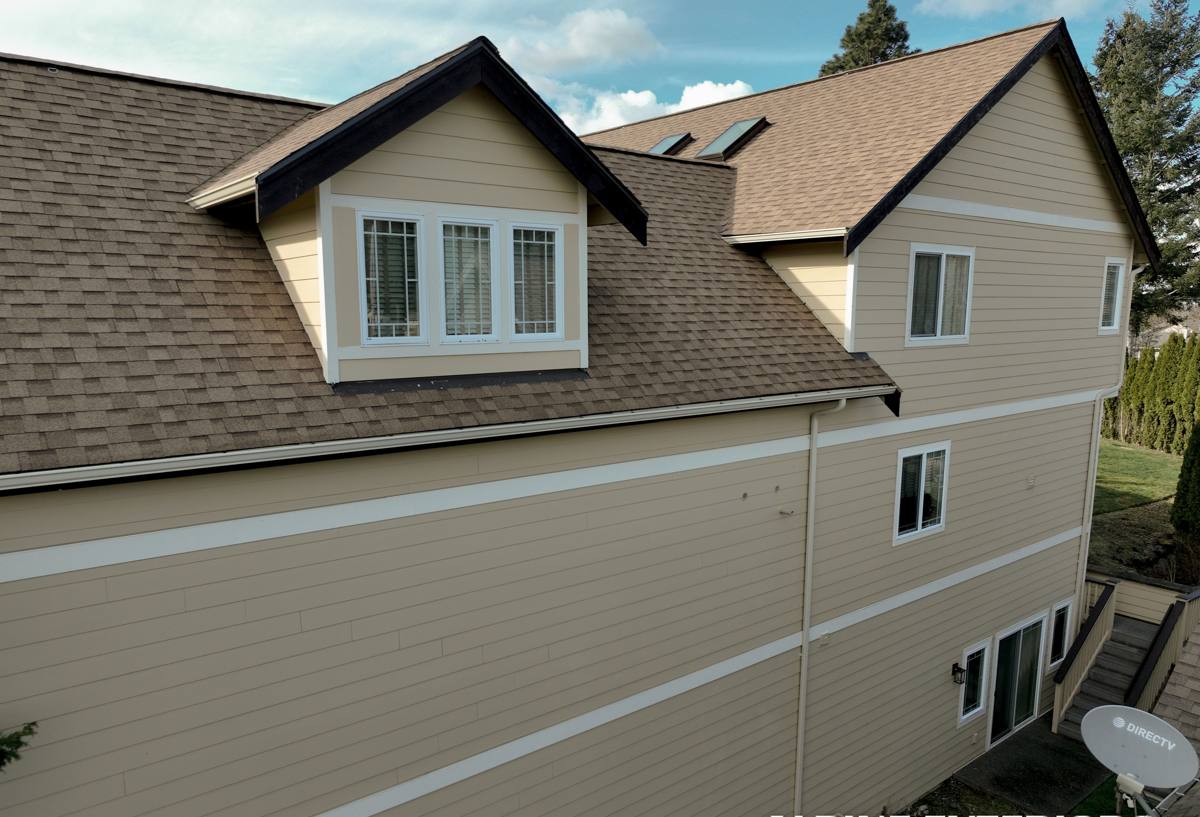
What We Typically Find on Conway Homes
A lot of the housing stock in and around Conway is older — farmhouses, ranch homes, and cabins built decades ago, many re-sided at some point with whatever product was standard at the time. That usually means one of a few things when we show up for an estimate:
- Original cedar siding that's cupping, splitting, or has gone soft at the butt joints and bottom courses
- T1-11 or plywood panel siding with delaminating layers and swollen edges near the ground
- Older LP or OSB-based products showing the telltale swelling and bubbling paint that signals moisture intrusion
- Vinyl siding that's cracked, faded, or simply loose from decades of wind exposure in an open valley
In every case, the pattern is the same: the material held up fine for a while, but the valley's damp cycle eventually found the weak points — end grain, fastener holes, panel seams — and started working. Once moisture gets behind the cladding, the siding is really only the messenger. The real question becomes what's happening at the sheathing and framing underneath.
What a Correct Siding Replacement Actually Involves
Replacing siding isn't just stripping old material and nailing up new. Done right, it's a full assembly rebuild from the sheathing out, and skipping steps here is exactly how a home ends up needing this work again in ten years instead of thirty.
Tear-Off and Sheathing Inspection
Once the old siding is off, we inspect the sheathing and framing underneath before anything new goes up. In a river valley climate, this step matters more than most homeowners expect — soft or delaminated sheathing, rot at window sills, and compromised framing are common finds behind older siding that's been holding moisture for years. Any damaged wood gets replaced before the new assembly goes on. Covering rot with new siding just hides the problem for a while.
Water-Resistive Barrier and Drainage Gap
A correctly installed weather-resistive barrier (WRB) goes over the sheathing, lapped properly so water sheds downward and out, never inward. For a climate like Conway's, we also build in a drainage gap behind the siding so any moisture that does get past the cladding has somewhere to go and dry out, rather than sitting trapped against the wall assembly.
Flashing at Every Penetration
Windows, doors, hose bibs, light fixtures, vents — every penetration through the siding is a potential entry point for water. Proper step flashing, head flashing, and sealant at these locations is what actually keeps driving rain out, far more than the siding material itself. This is also the step that gets rushed or skipped on lower-bid jobs, and it's usually the reason a "new" siding job fails early.
Why We Install Only James Hardie Fiber Cement
We standardized on James Hardie fiber cement siding for every home we side, including here in Conway, and we don't install vinyl, LP SmartSide, primed spruce, cedar, or other fiber cement brands like Cemplank or Allura. That's a deliberate choice, not a sales preference:
- Non-combustible: fiber cement doesn't burn, which matters in a region that sees wildfire smoke and drought stress in summer even alongside a wet winter climate
- Won't rot or swell from moisture the way wood-based and OSB-core products can when they stay damp for extended periods, which is exactly the risk profile in a river valley setting
- ColorPlus factory finish is baked on under controlled conditions and holds color and adhesion far better over time than field-applied paint, which matters when a home sits under near-constant humidity for months
- HZ5 product line is engineered specifically for wetter, colder climate zones like ours, with moisture and freeze-thaw performance built into the formulation
- A strong, transferable warranty backed by a large, established manufacturer, not a smaller regional brand
We're not going to tell you vinyl or LP SmartSide are junk products — they're not, and they work fine in the right application. But we've made a professional call that in this climate, with the moisture load Skagit County valley homes deal with, fiber cement is the material that holds up to spec over decades rather than years. That's the standard we put our name behind.
Our Process for a Conway Siding Job
| Step | What Happens |
|---|---|
| Estimate & walkthrough | We look at existing siding, trim, and any visible moisture damage, and give you a straight assessment of what the job involves |
| Tear-off | Old siding and trim removed, site protected and cleaned as we go |
| Sheathing inspection & repair | Any soft, rotted, or delaminated sheathing is identified and replaced before moving forward |
| WRB, flashing & drainage plane | Weather-resistive barrier installed and lapped correctly, flashing added at every window, door, and penetration |
| Hardie installation | Panels or planks installed to manufacturer spec — correct fastening, gapping, and clearances |
| Trim, caulking & touch-up | Trim installed, joints sealed, ColorPlus touch-up applied where needed |
| Final walkthrough & cleanup | Site cleared, and we walk the finished job with you |
Cost Factors for Conway Siding Replacement
Every home is different, and we don't quote a number until we've seen the house, but the factors that actually move the price on a Conway job tend to be the same handful:
| Factor | Why It Matters |
|---|---|
| Existing sheathing condition | Hidden rot found during tear-off adds repair scope you can't fully price until the old siding is off |
| Home size & wall complexity | Multiple gables, dormers, and cutouts take more labor and trim work than a simple rectangular footprint |
| Siding profile chosen | Lap siding, shingle-style panels, and board-and-batten all have different material and install costs |
| Trim & accessory scope | Full trim replacement, corner boards, and fascia work add to the total beyond the field siding itself |
| Site access | Rural lots, long driveways, or tight setbacks common around Conway can affect staging and labor time |
What to Ask Before Hiring a Siding Contractor in Conway
A lot of siding failures we get called out to replace weren't caused by bad material — they were caused by a rushed or incomplete install. Before you hire anyone for a siding job in this area, it's worth asking:
- Will you inspect and repair sheathing before installing new siding, or just cover what's there?
- What weather-resistive barrier and flashing details do you use, specifically, at windows and doors?
- Is there a drainage gap behind the siding, or is it installed direct-to-WRB?
- What manufacturer's installation instructions are you following, and can you show me the spec sheet?
- What does the warranty actually cover — material only, or labor too — and who's backing it?
- Do you have experience working in this specific area, with its drainage and access conditions?
Why a Crew That Already Works in Conway Matters
Conway isn't a dense subdivision with cookie-cutter lots — it's a rural, agricultural community, and homes here come with their own quirks: older construction, well and septic systems to work around, gravel driveways, and sometimes tighter access than a typical suburban job. A crew that's already worked in this part of Skagit County knows what to expect before the truck even shows up, which means fewer surprises and less wasted time figuring things out on your dime.
There's also the local knowledge that doesn't show up in a brochure — knowing how the valley's moisture cycle behaves through the seasons, knowing which older homes in this area tend to hide sheathing damage behind their original siding, and knowing how to sequence a job around this region's weather rather than fighting it. That's the difference between a contractor who's driving in from out of the area for one job and a crew that treats Conway as part of its regular territory.
Get a Straight Estimate
If your Conway home's siding is showing moss, soft spots, peeling paint, or you're just planning ahead before a small problem becomes a big one, we're glad to take a look. We'll give you a straightforward, no-pressure assessment of what your home actually needs — fill out the form below to schedule a free estimate.