 Anacortes Siding
 Building New on the West Side of Anacortes? Get the Windows Right the First Time
If you're framing a new home on the west side of Anacortes, your windows are going to face conditions that inland Skagit County builds simply don't deal with. Salt-laden air off the water, driving rain that comes in sideways during winter storms, and long stretches of shade and dampness that feed moss and algae growth on siding and trim. New-construction window installation is your one chance to build the water management right into the wall assembly before siding and finish work cover it up. Get it wrong here, and you're not looking at a simple caulk touch-up in five years — you're looking at opened-up walls and rot repair.
We install new-construction windows for builders and homeowners on the west side of Anacortes and understand what this specific stretch of Fidalgo Island asks of a window install: correct flashing sequencing, frame materials that don't fight the marine environment, and a crew that shows up on the builder's schedule instead of holding up the framing crew behind them.
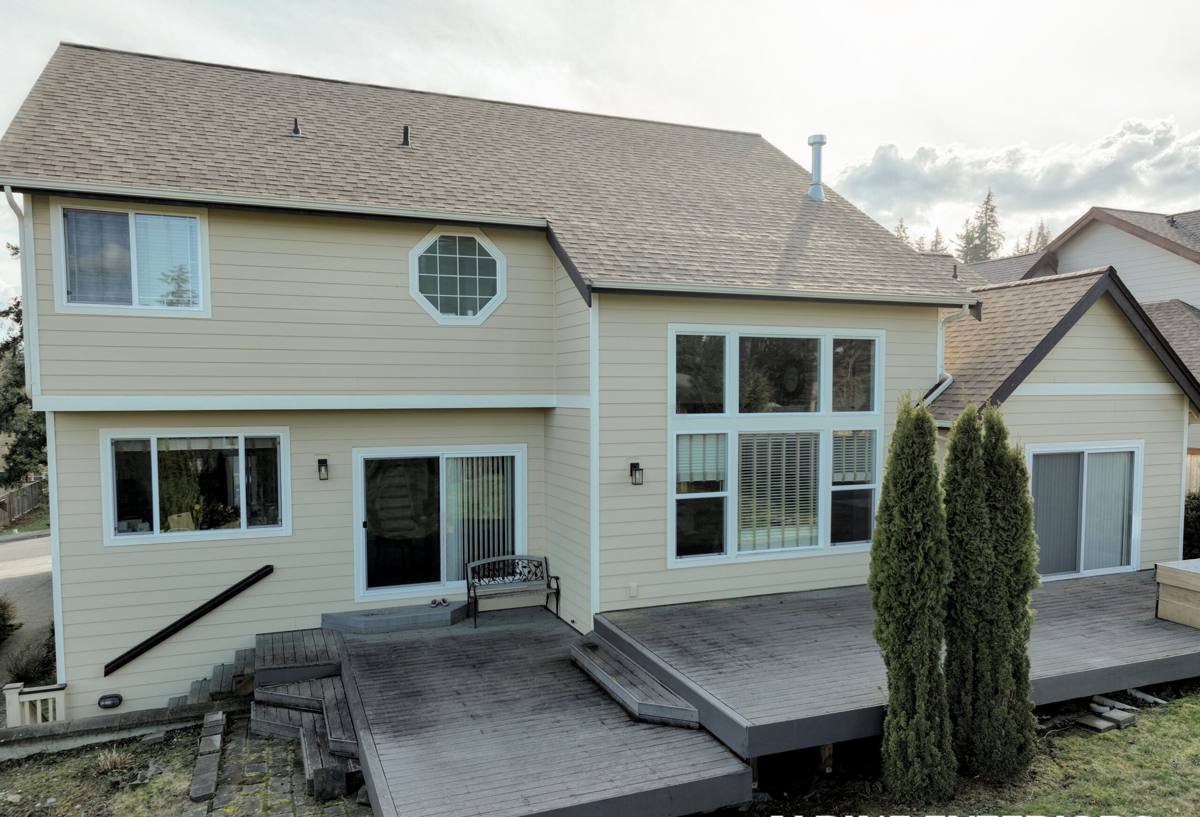
What West Anacortes' Coastal Climate Actually Does to a Window Install
Salt Air and Corrosion
Homes facing Rosario Strait and the open water to the west take on airborne salt that inland Anacortes and Mount Vernon builds never see. Salt accelerates corrosion on unprotected fasteners, low-grade hardware, and certain metal flashing products. Over years, that corrosion can work its way into hinge hardware, cranks, and screws that hold the window unit itself in the rough opening.
Driving, Wind-Driven Rain
West-facing exposure means rain doesn't just fall on this house — it's pushed against it. Wind-driven rain finds any gap in the water-resistive barrier, any shortcut in flashing tape lapping, and any window that wasn't properly sill-panned. In a new build, this is the single biggest thing separating a window install that lasts decades from one that causes hidden water damage inside the wall cavity within a few years.
Shade, Moisture, and Moss Season
Anacortes' long moss season isn't just a roof and siding problem. Shaded elevations and window sills that don't shed water properly stay damp longer, and that dampness feeds moss and algae growth right at the window perimeter — the exact spot where a failed seal does the most damage, because you often don't see it until the trim or interior sill starts showing stains.
New-Construction Installation Is a Different Job Than Replacement
A lot of window advertising blurs the line between new-construction and replacement installs, but on a framing job they're not the same task at all. New-construction windows have a nailing flange that gets integrated directly into the wall's water-resistive barrier before siding goes on. That gives us access to build correct water management into the assembly — something a replacement crew working around existing siding simply can't do to the same degree.
The Flashing Sequence Is the Whole Job
Done correctly, a new-construction window opening gets a sloped sill pan so any water that gets past the window has somewhere to go besides your framing lumber, self-adhered flashing tape at the sill and jambs lapped in the correct shingle-style order, the nailing flange integrated over the sill flashing and under the jamb and head flashing, and the head flashing lapped under the water-resistive barrier above so water sheds outward and down, never inward. Skip or reverse any one of these steps and you've built a leak path into the wall that won't show up until the drywall's long since painted.
Working on the Builder's Timeline
New-construction window install happens at a specific point in the framing schedule — after the rough openings and WRB are in, before siding starts. Miss that window (literally) and you either hold up the whole job or someone rushes the flashing to keep the schedule. We coordinate directly with the general contractor or framing crew so windows go in at the right stage without becoming the bottleneck.
Choosing a Window Frame Material for a West Anacortes Build
There's no single "best" frame material for every project — it depends on your budget, your home's design, and how much upkeep you want to do. Here's how the common options actually perform in this specific coastal, high-moisture environment:
| Frame Material | Salt Air / Moisture Behavior | Maintenance | General Cost Position |
|---|---|---|---|
| Vinyl | Won't corrode or rust; performs well in salt air. Can expand/contract with temperature swings if not installed with proper clearance. | Low — no painting or sealing needed | Most affordable |
| Fiberglass | Excellent dimensional stability, resists moisture and salt exposure well, holds paint if you want a custom color | Low, occasional repaint if painted | Mid to upper |
| Aluminum-Clad Wood | Attractive interior wood look with a protective exterior clad; the clad shell needs to be fully sealed at every joint or moisture can reach the wood core | Moderate — clad seams and interior wood finish need periodic attention | Upper |
| Bare Aluminum | Conducts cold and can corrode faster in salt air without a quality anodized or powder-coat finish | Higher in this climate | Varies |
Our standard on the west side of Anacortes leans toward vinyl and fiberglass for most builds specifically because they don't give salt air and constant moisture anything to corrode. If a homeowner wants the look of clad wood, we'll install it — but we're honest up front that it asks for more long-term attention in this environment than vinyl or fiberglass does.
Performance Ratings That Actually Matter for This Climate
Window labels list several performance numbers, and not all of them carry equal weight for a Skagit County build:
- U-factor — how well the window resists heat loss. Lower numbers matter more here than in a mild inland climate, since west-facing homes take on more wind exposure and heat loss along with it.
- Condensation resistance — a more relevant number for our damp climate than it is in a dry region; poor condensation resistance shows up as fogging and moisture buildup on interior glass and can contribute to mildew at the sill.
- Air leakage rating — directly tied to how well the window resists wind-driven rain intrusion, not just drafts.
- Solar heat gain coefficient (SHGC) — less critical here than in sunnier climates, but still worth matching to the home's orientation, especially on south and west elevations.
Washington's state energy code sets minimum efficiency requirements for new-construction windows, and we spec products that meet or beat those baselines rather than treating the code minimum as the target.
Our New-Construction Window Process
- Plan review — we review the window schedule against the framed rough openings before ordering, catching sizing mismatches before they become a job-site problem.
- Product selection — we walk through frame material, glass package, and performance ratings based on the home's exposure and your budget.
- Rough opening prep — openings get checked for square, level, and correct dimensions, and any framing corrections happen before a window ever goes in.
- Sill pan and flashing — sloped sill pan, then flashing tape in the correct lapped sequence at sill and jambs.
- Window set and fastening — unit is set plumb, level, and square, shimmed correctly, and fastened per the manufacturer's schedule to preserve the warranty.
- Head flashing and WRB integration — head flashing lapped under the water-resistive barrier above the opening so water always sheds outward.
- Final check — operation, seal, and squareness verified before we sign off and the siding crew moves in behind us.
Coordinating Permits and Inspections on a Skagit County Build
New construction in Anacortes goes through the standard building permit and inspection process, and window rough openings and flashing are commonly checked at framing inspection before insulation and drywall cover them up. We build our install sequence around that inspection point, and we're comfortable walking a building inspector through the flashing details on-site if questions come up — it's easier to show correct work at that stage than to explain it after the wall is closed.
Mistakes We See on Coastal New-Construction Window Jobs
Most window problems on west-side Anacortes homes trace back to a handful of avoidable shortcuts:
- Flashing tape lapped in the wrong order, so water is directed behind the barrier instead of over it
- No sloped sill pan, leaving standing water at the sill with nowhere to drain
- Fasteners driven through the frame in the wrong location or spacing, voiding the manufacturer's warranty
- Head flashing installed on top of the water-resistive barrier instead of underneath it
- Window units set out of square, causing hardware wear and seal failure well before it should happen
- Trim and siding installed tight against the frame with no room for the material to move seasonally
Every one of these is invisible once the house is finished — which is exactly why the install itself, not just the product you bought, determines how the window performs for the next twenty or thirty years.
Why Hire a Crew That Already Works West Anacortes
A window installer who mainly works inland jobs isn't wrong about window installation in general — they're just less likely to default to the details that matter most here: the extra care on flashing laps, the frame material choice that shrugs off salt air, and the sense of when a rain event means adjusting the day's schedule rather than pushing through it. We work new-construction jobs across Anacortes and Skagit County, including the west side's coastal exposure, and we build every install assuming the weather here is going to test it — because it will.
If you're framing a new home or working with a builder on the west side of Anacortes, we're happy to look at your window schedule and rough openings and give you a straightforward, no-pressure estimate. There's a form below — reach out and we'll get you a time to talk through the project.