 Anacortes Siding
 Why Ship Harbor Decks Take More Punishment Than Most
Ship Harbor sits close enough to the water that homes here deal with a version of Anacortes weather that's a notch harder on exterior wood and building materials than inland Skagit County. Salt-laden air off Rosario Strait and the surrounding marine waters accelerates corrosion on fasteners and hardware. Driving rain off the water pushes moisture sideways into board seams and ledger connections, not just straight down. And the long gray stretch from fall through spring gives moss and algae months to establish themselves on any surface that stays damp and shaded, which describes a lot of decks around here for a good chunk of the year.
None of that makes composite decking a bad fit for Ship Harbor — it's actually one of the better options for this exact climate. But it does mean the material choice and the installation details matter more here than they would on a dry-side deck. A deck built the same way you'd build one in Wenatchee or Yakima will not hold up the same way in a marine-exposed neighborhood like this one.
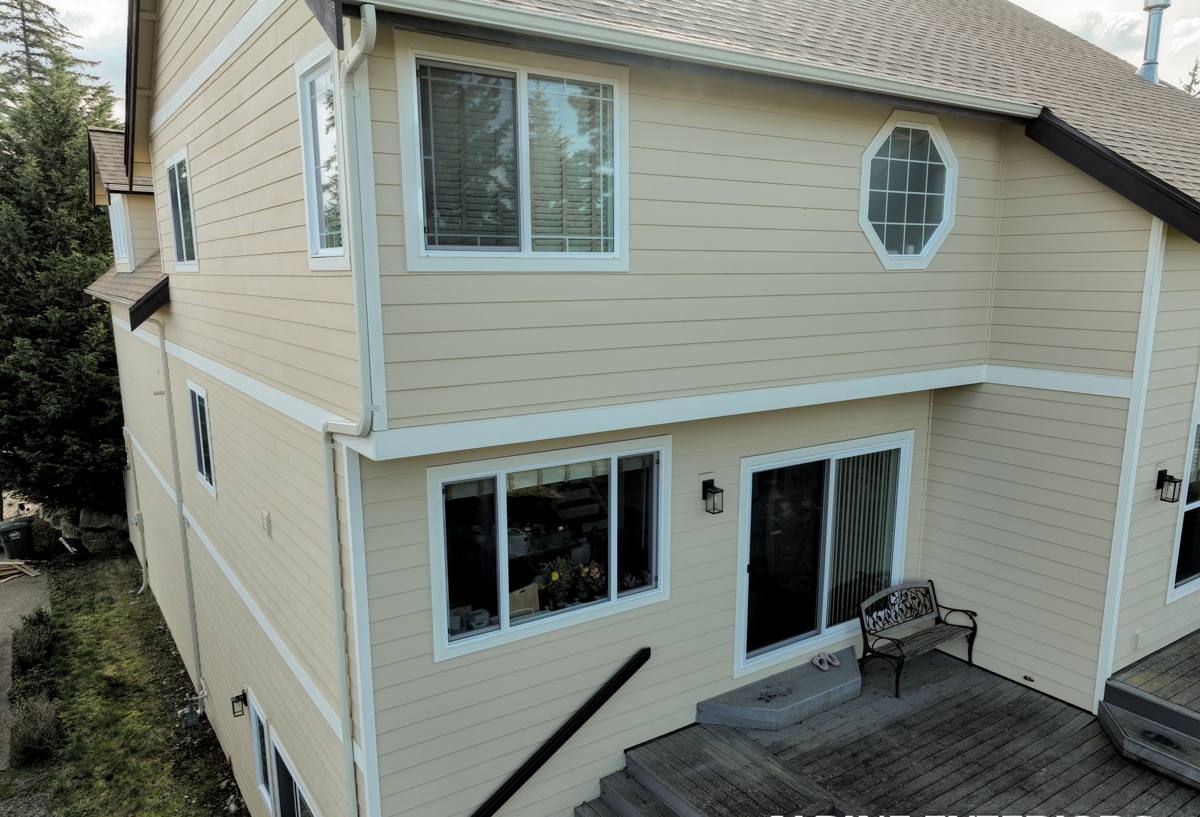
What a Correct Composite Deck Install Looks Like Here
Composite boards themselves resist rot, but the frame underneath them, the fasteners holding them down, and the way water is allowed to move through the structure are what actually determine whether a deck lasts 10 years or 25 in this environment.
Substructure and Framing
We build or inspect the joist structure before a single composite board goes down. In a salt-air setting, that means stainless steel or heavy-duty coated fasteners and hardware rather than standard galvanized, because standard coatings degrade faster this close to the water. Joist tape or a comparable flashing membrane over the top of each joist keeps water from wicking into wood framing at the fastener points — a detail that's easy to skip and expensive to regret.
Ventilation and Drainage
Composite decking doesn't rot, but the framing underneath it usually is still wood, and trapped moisture under a low-clearance deck is a slow, quiet problem. We make sure there's enough airflow beneath the deck and that water has somewhere to go — proper slope away from the house, gaps where needed, and no low spots where rain and blown spray can just sit against the substructure.
Fastening and Board Gaps
Board spacing has to account for how composite material expands and contracts with temperature and moisture swings. Too tight, and boards can buckle or trap water in the seams; too loose, and you get an uneven surface that collects grit and moss faster. We set gaps to the manufacturer's spec, not a rough guess.
Choosing the Right Composite Board for a Marine Climate
Not all composite decking is built the same, and the differences matter more in a place like Ship Harbor than they would somewhere drier and further inland.
Capped vs. Uncapped Composite
Capped composite boards have a plastic shell wrapped around a wood-plastic core, which blocks moisture absorption and resists staining and fading. Uncapped composite is more exposed at the surface and, over time in a wet, salty climate, can absorb more moisture and show wear faster. For anything facing open water or full weather exposure, we favor fully capped boards as our standard.
Grooved vs. Solid Edge Boards
Grooved-edge boards use hidden fastener systems for a clean look with no visible screws, but the grooves can hold moisture and debris if the deck doesn't drain well. Solid boards with face-screwed or color-matched fasteners are simpler, more forgiving, and often the better call on decks with heavier rain exposure or less-than-ideal slope.
Color and Heat Considerations
Darker composite boards absorb more heat on the rare sunny days but also tend to hide moss and organic staining better between cleanings than very light colors do — worth weighing given how much of the year this deck will spend under cloud cover and moisture rather than direct sun.
Composite vs. Other Decking Materials for This Area
| Material | Salt Air Resistance | Moss/Algae Resistance | Maintenance |
|---|---|---|---|
| Capped Composite | Strong — core is sealed from moisture | Good, especially with textured surfaces | Periodic washing, no staining or sealing |
| Uncapped Composite | Moderate — more surface absorption over time | Fair — can hold moisture at the surface | Occasional cleaning, watch for surface wear |
| Pressure-Treated Wood | Weak — hardware and wood both corrode/rot faster near salt air | Poor — porous surface favors growth | Annual sealing/staining, board replacement over time |
| PVC Decking | Strong — fully synthetic, no wood content | Good | Low, but higher upfront cost and different repair approach |
Wood remains the cheapest option up front, but in a marine environment it's also the one that asks the most of you afterward — more frequent sealing, more vulnerability to the fasteners and framing beneath it, and a shorter realistic lifespan before boards need replacing. Composite closes most of that gap in exchange for a higher initial cost.
Our Process for a Ship Harbor Composite Deck Project
- On-site assessment. We look at sun and wind exposure, proximity to the water, existing framing condition, and drainage before recommending a board type or system.
- Framing evaluation and repair. Any soft, rotted, or under-flashed framing gets addressed before new decking goes down — composite boards on top of a compromised frame just hide the problem.
- Material selection. We walk through capped vs. uncapped, board profile, and color options based on your home's specific exposure, not a one-size answer for every yard.
- Installation. Framing prep, flashing, fastening, and board layout done to manufacturer spec, with attention to the drainage and ventilation details that matter most here.
- Final walkthrough. We check board gaps, fastener lines, edge finishing, and drainage before calling the job done, and go over basic care with you.
Cost Factors Homeowners Should Actually Weigh
- Deck size and shape — cutouts, angles, and multiple levels add labor beyond simple square footage
- Substructure condition — repairing or replacing rotted or undersized framing before decking begins
- Board tier — uncapped composite generally costs less than fully capped, premium composite lines
- Railing and fascia choices — composite, aluminum, or cable systems price differently and affect total scope
- Site access — decks with tight access or elevation changes take longer to build safely
- Fastening system — hidden-fastener systems add cost and labor time compared to face-screwed boards
Composite decking generally costs more up front than pressure-treated wood and less than most PVC systems, with the exact number driven mostly by board tier and how much substructure work is involved. Anyone quoting a number without seeing your framing and site conditions first is guessing.
Living With a Composite Deck Through Moss Season
Composite decking is genuinely low-maintenance compared to wood, but "low-maintenance" doesn't mean "no maintenance" in a climate that produces moss on almost any shaded, damp surface for months at a time. A yearly wash with a deck cleaner formulated for composite material, kept off with a soft brush rather than an aggressive pressure washer setting, handles most of what accumulates over a wet Skagit County winter. Keeping gutters and downspouts clear so runoff isn't dumping directly onto the deck surface also goes a long way toward keeping moss from getting a foothold in the first place. Boards near the shadiest, most sheltered corners of the deck will always need a bit more attention than the open, sun-exposed sections — that's just the nature of a moss-prone climate, not a flaw in the material.
Why Hiring a Crew That Works This Area Matters
A deck built by someone unfamiliar with what salt air and driving coastal rain do over time often looks fine for the first year or two and then starts showing problems — corroding hardware, moisture trapped under boards, fastener failures — that a marine-aware build would have avoided from the start. We work on homes throughout Anacortes and Skagit County, including neighborhoods like Ship Harbor that sit close to the water, and we build to that exposure rather than to a generic inland standard.
Questions Worth Asking Any Contractor Before You Hire
- Do you use stainless or coated fasteners rated for coastal/marine exposure?
- What's your standard for joist protection and flashing under composite decking?
- Are you a licensed, bonded, and insured contractor in Washington?
- Can you walk me through drainage and ventilation for my specific site?
- What warranty coverage applies to both the material and your labor?
If you're thinking about a new composite deck or replacing an aging wood deck in Ship Harbor, we're happy to take a look at your site and put together a straightforward, no-pressure estimate. Use the form below to get in touch and we'll go from there.