 Anacortes Siding
 Window Replacement on Guemes Island: Full Exposure to the Salish Sea
Guemes Island sits just across the water from Anacortes, reached only by a short county ferry crossing, and that separation shapes more than the commute — it shapes how a house here needs to be built to hold up. Because the island has no bridge and fairly low-density development, a much higher share of Guemes homes sit close to open water or up on exposed bluffs than a typical in-town Anacortes property, with fewer trees, buildings, and hillsides to break the wind before it reaches the walls. Large expanses of glass facing the water are common on this kind of lot, and that's exactly the feature that takes the hardest hit from Skagit County's marine climate: salt air, driving rain, and a moss season that can run most of the year on shaded siding and window trim.
We handle siding, roofing, windows, and decks for homes throughout Anacortes and the surrounding Skagit County islands, and Guemes is one of the places where the gap between a correctly installed window and a poorly installed one shows up fastest. A name-brand window set with sloppy flashing will leak here within a few wet seasons. A solid, mid-grade window installed correctly — with flashing that actually ties into the surrounding wall and siding — will typically outperform it and last for decades. On an exposed island lot, the installation detail matters more than the label on the window, not less.
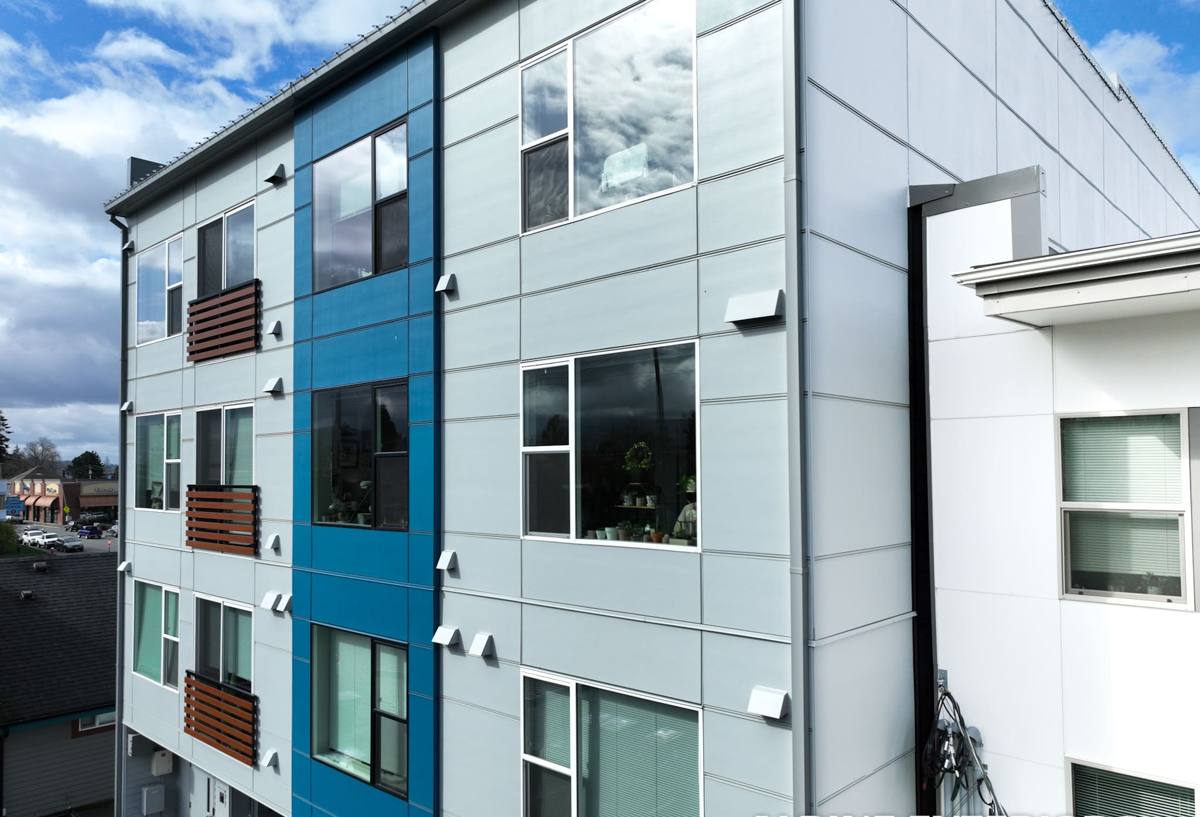
What This Climate Does to Windows on Guemes Island
Wind-Driven Rain With Nothing to Break It
Storms moving through the Salish Sea don't always drop rain straight down, and on an open island lot there's often little standing between the wall of a house and wind pushing that rain sideways. Wind-driven rain reaches gaps, seams, and corners that would stay dry in a more sheltered inland setting, and window openings are one of the most common places it finds a way in. The window unit itself is only part of what stops that — flashing that laps correctly with the surrounding wall and siding, and is sealed to handle sustained wind pressure, is what actually keeps the water out.
Salt Air and Hardware Corrosion
Being surrounded by water rather than just near it means Guemes properties often see more direct salt exposure than comparable homes a few miles inland around Anacortes. That salt-laden air accelerates corrosion on lower-grade window hardware, fasteners, and frame components — hinges that stiffen, locks that bind, screws that streak and weaken years before they would in a drier, less exposed setting. It's one of the clearest arguments for corrosion-resistant hardware on this kind of lot, since replacing failed hardware on a window that's otherwise sound is a preventable expense.
Moss, Mildew, and a Long Wet Season
Mild temperatures and near-constant moisture from fall through spring give moss and mildew a long growing season across Skagit County, and Guemes Island's shaded, tree-lined lots and damp low spots are no exception. Window sills, trim, and the wood framing around older units are common places it takes hold, especially on north-facing walls or windows tucked under eaves with poor drainage. Left alone, that growth holds moisture against wood and finish longer than it would otherwise sit, which speeds up the decay that eventually forces a replacement instead of a repair.
Sun and UV on Water-View Glass
The same water-facing exposure that makes a Guemes Island view valuable also means a lot of glass and frame material spends long hours in direct, water-reflected sun. UV exposure breaks down seals, gaskets, and lower-quality vinyl finishes faster than it would on a shaded, inland wall, and it's a factor worth weighing seriously on a home with large picture windows or slider assemblies aimed at the water. Frame material and glazing choice matter as much for UV resistance here as they do for wind and moisture.
Signs a Guemes Island Home Needs Window Attention
Some of these signs show up gradually enough that homeowners get used to them before recognizing what they actually mean:
- Fogging or trapped moisture between the panes of a double-pane window
- Cold drafts near the frame even when the window is fully closed and locked
- Sills or trim that feel soft, look discolored, or show visible rot
- Windows that stick, won't stay open, or are hard to lock the way they used to
- Visible daylight or gaps where the frame meets the siding
- Salt residue, pitting, or stiffness on hinges, locks, or cranks
- Paint or finish failing on window trim faster than on the rest of the exterior
Replacement vs. Repair: How We Make the Call
Not every window on a Guemes Island property needs to come out. A window with a failed seal but a sound frame and working hardware is often a reasonable repair or reglaze candidate, even on an exposed lot. A window with rotted framing, a warped sash, or hardware that's been failing for years usually isn't — at that point the cost of repeated patching adds up past what a proper replacement would have cost, and a failing window keeps letting water into the wall assembly around it in the meantime.
| Condition | Repair Usually Makes Sense | Replacement Usually Makes Sense |
|---|---|---|
| Fogged glass, sound frame | Yes — reglaze or seal replacement | Only if the frame is also compromised |
| Stiff or corroded hardware | Yes — hardware replacement | Not on its own |
| Soft or rotted wood framing | Rarely a lasting fix | Yes |
| Persistent drafts despite sealing | Sometimes, if flashing is the actual cause | Yes, if the unit itself is the source |
| Single-pane, no storm window | Possible short-term patch | Yes, for real energy and comfort gains |
Flashing and Installation Detail: What Actually Determines Performance
We spend more time with Guemes Island homeowners talking about flashing than about window brands, because on an exposed lot, flashing is what separates a window that stays dry for decades from one that starts leaking within a couple of wet seasons. Correct installation means the flashing laps properly with the weather-resistive barrier and siding around it, water gets directed out and away from the rough opening instead of trapped behind it, and every seam is sealed with materials rated for sustained wind and moisture exposure — not just a bead of caulk. That's standard practice on every window we install, not an upgrade homeowners have to request.
Common Mistakes We Find on Older Island Homes
On repair and replacement calls on Guemes Island, the water damage we find rarely traces back to the window unit itself failing. It almost always traces back to flashing that was never lapped correctly to begin with, or caulk that was used as a substitute for flashing instead of a supplement to it. Caulk alone cracks and shrinks over time, and on a lot with real wind exposure, it was never built to be the only barrier against driving rain.
Choosing Windows for This Kind of Exposure
We install vinyl and fiberglass window systems suited to the Pacific Northwest's wet, mild, and — on a lot like this — genuinely windy conditions, and we walk homeowners through the real trade-offs rather than pushing one brand as the only right answer. What matters most for a Guemes Island property is a tight, well-engineered frame, glazing that handles both energy performance and condensation resistance, and hardware rated for sustained salt-air exposure, not a name printed on the frame.
- Frame material: Vinyl and fiberglass both resist rot in a way uncladded wood frames don't, which matters on a lot that takes this much moisture over the year.
- Glazing package: Double or triple-pane options with low-E coatings improve energy performance and cut down on interior condensation during cold, damp stretches — worth discussing seriously on large water-facing windows.
- Hardware grade: Corrosion-resistant hardware holds up longer against direct salt-air exposure than standard-grade hardware, and it's one of the cheapest upgrades to specify up front.
- Warranty structure: A manufacturer warranty only covers the product — we stand behind our installation work separately, since installation is what actually determines whether that product warranty ever gets tested.
Ferry Access and Island Logistics: Planning the Job Right
Window work on Guemes Island comes with a scheduling layer that a mainland Anacortes job doesn't have: materials, crew, and equipment all have to move over on the ferry, and there's no quick run back into town mid-job for a missing part or a forgotten tool. We plan material orders and crew days around that reality up front rather than discovering it partway through a job. Custom-sized windows already carry a manufacturer lead time before they're even ready to ship; on an island job, we build the ferry schedule and crew logistics into the plan alongside that lead time so the project runs on the timeline we give you, not a string of delays.
Guemes Island is unincorporated Skagit County land rather than part of the City of Anacortes, and any permitting required for the work runs through the county rather than the city — worth knowing before you start collecting quotes, since it changes who you'd be checking a permit history or contractor complaint against.
Why a Crew That Already Works Guemes Island Matters
A contractor who's actually done window work on Guemes Island knows how much harder wind and salt air work on an open lot here compared to a sheltered in-town property, and that shows up in decisions that aren't visible once the job is done — how much lap a flashing detail gets, which hardware grade gets specified, whether the crew planned the day around the ferry or ends up scrambling to catch the last one back. Those decisions are what determine whether a window installation holds up for one wet winter or several decades.
A short list worth going through before hiring anyone for window work on Guemes Island:
- Ask specifically how they handle flashing integration with the existing siding, not just which window brand they sell
- Confirm current Washington contractor licensing and active liability insurance
- Ask directly whether they've worked on island properties before and how they plan around ferry logistics
- Get a written scope that separates the product warranty from the installation warranty
- Ask for a repair-or-replace recommendation on each affected window individually, not a blanket answer
Our Process
We start with an on-site look at the existing windows — checking frame condition, seal integrity, hardware function, and how the current flashing ties into the siding around each opening. From there we give a straightforward read on which windows are reasonable repair candidates and which make more sense to replace, along with a written scope and a realistic timeline that accounts for ferry scheduling before any work begins. Flashing and drainage detailing are handled as standard practice on every job, not offered as an upgrade.
If you're dealing with drafty, foggy, or salt-stiffened windows on a Guemes Island property — or you're just not sure whether repair or replacement is the right call — we're happy to take a look and give you an honest, no-pressure read. Reach out below for a free estimate.