 Anacortes Siding
 Why Cap Sante's Location Puts Extra Demands on a Roof
Cap Sante sits close to the water, and that changes what a roof has to deal with compared to a home a few miles inland. Air moving off the water carries salt, and that salt settles on every exposed surface of a house, including the roof. It works slowly but steadily on any metal it touches — fasteners, flashing, gutters, vents — unless those materials and finishes were chosen with that exposure in mind.
Wind-driven rain is the other factor. During winter storms, rain in this part of Skagit County doesn't just fall straight down — it gets pushed sideways and upward under eaves, around chimneys, and into any gap in flashing that a calmer climate might get away with. A roof detail that would hold up fine in a dry inland town can leak here if it wasn't built to handle rain coming in at an angle.
Add to that the tree cover common around Anacortes — cedars, firs, and maples that shade parts of a roof for much of the day — and you get a long moss season. Shaded, damp roof surfaces stay wet longer after every storm, which is exactly what moss and algae need to take hold. On an asphalt shingle roof, moss roots into the granules and lifts them over time. That's a different problem on metal, but it's not one you can ignore either, which we'll get into below.
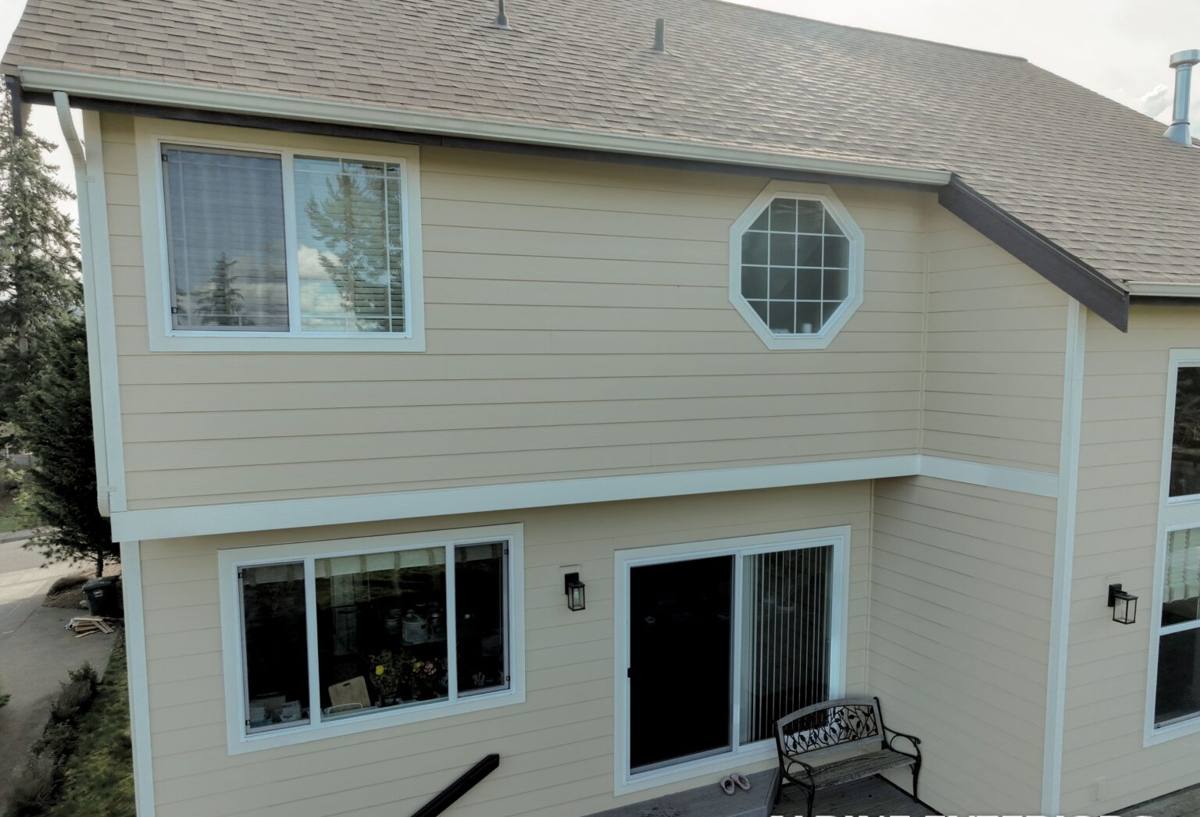
Why Metal Roofing Fits This Environment
Metal roofing isn't automatically the right answer for every home, but for a house exposed to salt air, driving rain, and heavy shade, it solves several problems at once. A properly installed metal roof sheds water fast off a continuous panel surface instead of relying on thousands of overlapping shingle edges, which reduces the number of places wind-driven rain can find its way underneath. It also gives moss and algae almost nothing organic to root into, so growth that would work its way into shingle granules mostly just sits on the surface of a metal panel, where it's far easier to rinse off.
Longevity is the other piece. A correctly installed metal roof, with the right coating and fastening system for a marine environment, is built to outlast several cycles of asphalt shingle roofing. That matters on a house exposed to salt air, because you're not just buying a roof — you're buying a roof that has to keep doing its job through decades of that exposure without the coating failing or the fasteners corroding first.
Standing Seam vs. Exposed Fastener Panels
Not all metal roofing is built the same way, and the fastening method matters more here than it would in a drier, calmer climate. The table below covers the two main systems we install and how each holds up under Cap Sante's conditions.
| Feature | Standing Seam | Exposed Fastener |
|---|---|---|
| How panels attach | Concealed clips under interlocking seams | Screws driven through the panel face |
| Exposure to salt air | Fasteners are shielded from direct weather | Fastener heads and washers face the weather directly |
| Long-term maintenance | Minimal — no fasteners to re-torque or replace | Screw gaskets and heads need periodic inspection |
| Thermal movement | Panels float on clips, so expansion is quiet and doesn't stress fasteners | Panel is pinned in place, so fasteners take the stress of expansion and contraction |
| Typical cost tier | Higher upfront | Lower upfront |
For a home directly exposed to the water and wind at Cap Sante, we generally steer homeowners toward standing seam. It's not that exposed-fastener panels can't hold up — they can, and they're a reasonable choice on a more sheltered lot — but every exposed fastener is a maintenance item and a potential future leak point once its gasket ages, and that trade-off is harder to justify a few blocks from the water.
What a Correct Metal Roofing Installation Involves
Metal roofing has a reputation for lasting a long time, but that reputation only holds up when the installation underneath the panels is done right. A metal roof is only as good as the deck, underlayment, and flashing it's built on.
Before any panel goes down, we check the roof deck itself for soft spots, old water damage, or sheathing that needs to be replaced. Covering a compromised deck with a new roof, metal or otherwise, just hides the problem instead of fixing it. From there, a correct installation includes:
- A synthetic underlayment across the full roof, rated to handle the panel system going over it
- Self-adhered ice-and-water membrane at eaves, valleys, and around every penetration — the places wind-driven rain is most likely to find a way in
- Fastener or clip spacing that follows the panel manufacturer's specifications for local wind exposure, not a generic spacing pattern
- Room for the panels to expand and contract with temperature swings, so seams don't work themselves loose over time
- Ventilation that lets the roof assembly breathe, so moisture doesn't get trapped under the metal and condense on the underside of the panels
Flashing and Fasteners Matter Most Near Salt Air
On a house near the water, the flashing details and fastener hardware are where a roof either holds up for decades or starts causing problems in a few years. We use fasteners and flashing rated for coastal exposure, and we're careful about which metals touch which — mixing incompatible metals in direct contact can set off galvanic corrosion, where one metal accelerates the breakdown of the other. It's a preventable problem, but only if it's accounted for during installation rather than discovered later as a stain or a leak.
Chimneys, dormers, skylights, and valleys all get extra attention, since these are the spots where two roof planes meet or a roof meets a vertical surface — exactly where wind-driven rain concentrates and exactly where a rushed flashing job shows up as a leak first.
Moss, Debris, and Long-Term Maintenance
Metal roofing resists moss far better than asphalt shingles, but "resists" isn't "immune." Needles, leaves, and other organic debris from the trees common around Anacortes still collect in valleys, behind chimneys, and along the low side of dormers. Left alone, that debris holds moisture against the panel and its flashing longer than the surrounding metal, and that's exactly the kind of damp, shaded spot where moss and algae can start to take hold even on a metal surface.
The good news is that keeping a metal roof clear is far less work than maintaining a shingle roof. There's no need for chemical moss treatments or granule replacement — mostly it's a matter of keeping debris from piling up and catching small issues early, before a long Skagit County wet season turns them into something bigger.
- Clear needles, leaves, and branches from valleys and behind chimneys or skylights each fall, before the heavy rains set in
- Keep gutters and downspouts clear so water isn't backing up under the drip edge
- Check sealant and closures around pipe boots and other penetrations for cracking or shrinkage
- On exposed-fastener panels, check that screw heads haven't backed out and that gaskets still look intact
- Look over the finish after storms for scratches near overhanging branches or ladder contact, and touch up any bare spots before they can start to rust
Choosing the Right Panel and Finish for Salt Air
Not every metal roofing product is suited to a waterfront-adjacent home, and this is where the material choice matters as much as the installation. Galvalume steel — steel coated with an aluminum-zinc alloy — is the standard, durable choice for most homes and holds up well under normal exposure. For homes with more direct, sustained salt exposure, aluminum roofing is worth considering: it's naturally corrosion-resistant on its own, rather than relying on a coating layer to keep rust from forming, which makes it a common upgrade for homes closer to the water.
The paint finish matters too. A PVDF-type finish (often sold under names like Kynar 500) holds its color and resists chalking longer than a standard baked-enamel finish, especially under the combination of UV exposure and salt air this area sees. It costs more upfront, but on a roof meant to last decades in this climate, it's the difference between a finish that still looks sharp in twenty years and one that's visibly faded and chalky well before then.
Panel gauge, or thickness, is the other variable — a heavier gauge holds up better to wind uplift and foot traffic during maintenance, which is worth factoring in given how exposed to wind Cap Sante can be.
Our Process for Cap Sante Metal Roofing Projects
We start every project by walking the roof in person — not just quoting off a satellite photo. That means checking the deck condition, looking at how the existing flashing was detailed, and noting how much tree cover and wind exposure the specific house deals with, since that varies block to block even within Cap Sante depending on which direction a roof faces.
From there we put together a written estimate that spells out the panel profile, gauge, fastening system, underlayment, and flashing plan — not just a single number. Depending on the condition of the existing roof, we'll talk through whether a full tear-off makes sense or whether the existing roof can serve as a base, and explain the trade-offs either way rather than defaulting to whichever is easier for us.
During installation, we protect landscaping and follow a consistent sequence — deck repairs, underlayment, panels, then flashing and trim — so nothing gets covered up before it's been done correctly. When the job is finished, we walk the roof with the homeowner, go over what maintenance to expect, and leave them with the warranty paperwork for the materials installed.
What Affects Cost
Metal roofing generally costs more upfront than an asphalt shingle re-roof, though the gap has narrowed somewhat as shingle prices have climbed. Where your project lands within that range depends on a handful of factors specific to your roof, not just the material itself.
| Factor | Why it matters |
|---|---|
| Roof pitch and complexity | Steeper roofs and more valleys, hips, and dormers mean more cutting, flashing, and labor |
| Panel system | Standing seam costs more than exposed-fastener panels but needs less long-term maintenance |
| Material | Aluminum typically costs more than Galvalume steel but resists corrosion without relying on a coating |
| Tear-off vs. recover | Removing and disposing of an old roof adds cost that installing over an approved base doesn't |
| Penetrations and flashing | Chimneys, skylights, and multiple vents each add flashing detail and labor time |
| Access | Steep sites or limited equipment access near the water can add setup time |
We break these factors out in every estimate so a homeowner can see where the cost is actually coming from, rather than getting a single lump-sum number with no explanation behind it.
Why Local Cap Sante Experience Matters
A crew that already works this specific pocket of Anacortes has seen how exposure changes house to house — a roof facing open water needs a different level of corrosion protection than one tucked behind a stand of trees a few streets back, even though both are technically in the same neighborhood. That's the kind of judgment call that's hard to make correctly from a generic estimate template.
Local experience also means understanding the realistic weather windows for installation in Skagit County, rather than pushing a crew to work a metal roof in the middle of a driving rainstorm, and knowing the permitting and inspection process for the City of Anacortes so a project doesn't stall on paperwork. None of that shows up on a spec sheet, but it's the difference between a roof that goes on smoothly and one that runs into avoidable problems.
If you're weighing a metal roof for a home near Cap Sante, we're glad to come take a look, walk the roof with you, and put together a straightforward, no-pressure estimate — just fill out the form below to get started.