 Anacortes Siding
 Decking Built for West Anacortes, Not Just Sold There
West Anacortes sits close enough to the water that homeowners feel it every day — in the air, in the moss creeping across north-facing surfaces, and in how fast an unprotected deck starts to look tired. A deck out here does a different job than one in a dry inland yard. It has to shed near-constant moisture for months at a stretch, resist salt-laden air blowing off the water, and still look good under gray Skagit County skies where UV exposure is lower but dampness is nearly year-round. Composite decking, installed correctly, is one of the few products that holds up to that combination without turning into a maintenance chore.
This page is about composite decking specifically for West Anacortes homes — what the local climate demands, what a correct installation actually involves, and how we approach the work when we're building or replacing a deck in this part of town.
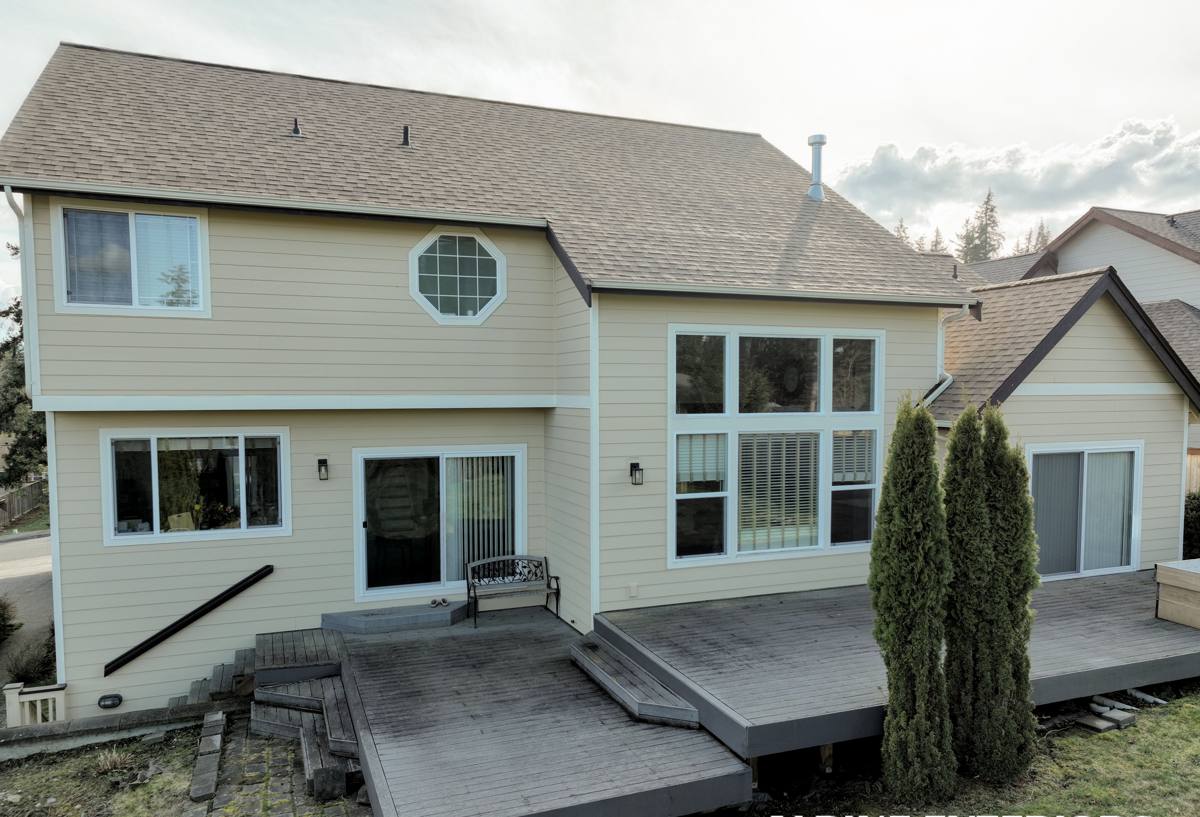
What Anacortes' Coastal Climate Does to a Deck Over Time
Composite decking exists largely because wood decking struggles in exactly the conditions West Anacortes has in abundance. Understanding the specific stresses helps explain why material choice and installation detail matter more here than they would somewhere drier.
Salt Air and Corrosion
Proximity to Puget Sound means airborne salt settles on every exterior surface, including deck hardware. Standard fasteners and connectors corrode faster in a marine-influenced environment, which is why fastener grade isn't a place to cut corners on a West Anacortes deck.
Driving Rain and Standing Moisture
Storms coming off the water don't just fall straight down — wind-driven rain gets under railings, into board gaps, and against ledger boards in ways vertical rain doesn't. A deck built without deliberate drainage and airflow underneath will trap moisture long after the rain stops.
Moss and Algae Growth
Anacortes' long damp season, moderate temperatures, and filtered sun in tree-shaded or north-facing yards create ideal conditions for moss and algae on any surface that stays wet. On wood decking this often means slippery boards, surface staining, and gradual fiber breakdown. On composite decking it's mostly a surface-cleaning issue, but board selection and airflow still affect how much moss you'll be dealing with.
Freeze-Thaw Cycling
Skagit County winters aren't severe, but they do dip below freezing often enough that trapped water in a poorly built substructure can freeze, expand, and loosen fasteners or crack framing joints over several seasons.
Why Composite Decking Fits This Environment
Composite decking is manufactured from a blend of wood fiber and plastic (or, in fully capped products, a plastic shell over a composite core). The appeal for West Anacortes homeowners isn't that it's "better" in every situation — it's that it directly addresses the failure points wood decking runs into here: moisture absorption, splintering, graying, and the recurring cycle of sanding, staining, and sealing.
Capped vs. Uncapped Composite
Fully capped composite boards have a polymer shell wrapping the core on all sides, which blocks moisture absorption and resists staining better than uncapped composite or older-generation wood-plastic blends. In a climate with this much sustained dampness, that cap is doing real work — it's the difference between a board that sheds water and one that slowly wicks it in through cut ends and exposed edges.
The Substructure Still Determines the Outcome
A common misunderstanding is that composite decking is "maintenance-free" regardless of how it's installed. It isn't. The board material resists rot, but the framing underneath — joists, beams, posts, and ledger attachment — is still typically pressure-treated lumber unless a homeowner specifies a composite or aluminum substructure. That framing needs the same moisture management principles as any Pacific Northwest deck: proper flashing, ventilation, and hardware rated for treated lumber and coastal exposure. A composite deck built on a poorly protected substructure will still develop structural problems, even if the surface boards look fine.
What a Correct Composite Deck Installation Involves
The visible part of a deck — the boards, the color, the railing style — is the smallest part of what determines whether it lasts. Most of the work, and most of the places a rushed job goes wrong, are underneath.
Site and Structural Assessment
We start by evaluating the existing structure if there is one, or the ledger attachment point, soil conditions, and drainage path if it's new construction. In West Anacortes specifically, we also look at wind exposure and how close the deck sits to grade, since low-clearance decks trap moisture and moss more readily.
Ledger and Flashing Details
Where a deck attaches to the house, proper flashing is what keeps water from tracking behind siding and into the wall assembly — this is one of the most common failure points on older Pacific Northwest decks, and it's invisible once the deck is finished, which is exactly why it has to be done right the first time.
Framing, Fasteners, and Airflow
We use fasteners and structural hardware rated for the coastal, treated-lumber environment rather than standard interior-grade hardware. Joist spacing is set to the composite manufacturer's specification (composite boards often require tighter joist spacing than wood, especially at angles or stair treads), and we maintain clearance underneath for airflow so the substructure can dry out between rain events instead of staying damp.
Hidden Fastening and Board Layout
Most composite systems use hidden fastener clips rather than face screws, which gives a cleaner look and avoids the small water-entry points that face screws create over time. Board layout is planned to minimize butt joints in high-traffic areas and to keep drainage gaps consistent so water moves through rather than pooling.
Railings, Fascia, and Trim
Fascia boards and railing posts get the same attention to fastener grade and water management as the decking itself — a deck can have flawless composite boards and still develop problems at the railing posts or stair stringers if those details are treated as an afterthought.
How Our Process Works, Start to Finish
- Free on-site estimate — we walk the space, check existing structure or ledger conditions, discuss board style and railing options, and talk through drainage and sun/shade exposure specific to your lot.
- Written scope and quote — you get a clear breakdown of materials, structural work, and timeline before anything is scheduled, with no vague allowances.
- Permitting — most deck rebuilds and new decks in Anacortes require a building permit, particularly for elevated structures or anything attached to the house; we handle that coordination.
- Demo and structural prep — removal of the old deck if applicable, inspection and repair of ledger and framing, and correction of any drainage issues found underneath.
- Framing and flashing — built to spec for the composite system you've chosen, with coastal-rated hardware and proper flashing at every water-entry point.
- Decking, railing, and trim installation — boards, hidden fasteners, railings, stairs, and fascia installed to manufacturer spec.
- Final walkthrough — we go over the finished deck with you, including basic care guidance for our climate, before calling the job complete.
Composite vs. Other Decking Materials for This Climate
There's no single "correct" decking material for every home — the right choice depends on budget, how much upkeep you want to do, and how long you plan to stay in the house. Here's how the common options compare for a West Anacortes property specifically.
| Material | Moisture & Moss Resistance | Ongoing Maintenance | Typical Lifespan Here |
|---|---|---|---|
| Capped Composite | Strong — sheds water, resists staining | Periodic surface cleaning | 25–30+ years |
| Uncapped/Older Composite | Moderate — can absorb moisture at cut edges | Occasional cleaning, watch edges | 15–20 years |
| Pressure-Treated Wood | Weak without upkeep — prone to moss, splintering | Annual cleaning, periodic sealing/staining | 10–15 years |
| Cedar | Naturally rot-resistant but softer, needs sealing | Regular sealing to prevent graying and moss | 15–20 years |
Wood decking isn't a bad choice — plenty of homeowners like the natural look and are willing to keep up with sealing and cleaning. Our standard for West Anacortes leans toward capped composite for anyone who wants to spend more time using the deck and less time maintaining it, but we'll install what fits your budget and expectations, not just what's easiest for us.
What Actually Drives the Cost
Composite decking costs more upfront than pressure-treated wood, but the total cost of ownership over 15–20 years is often closer than people expect once you factor in wood's recurring maintenance. Rather than quote a flat number that won't reflect your actual project, here are the factors that move the price up or down.
| Factor | Why It Matters |
|---|---|
| Deck size and shape | Complex angles, multiple levels, or curves increase labor and material waste |
| Substructure condition | Existing framing that needs repair or replacement adds cost before decking even starts |
| Board tier | Capped composite costs more than uncapped, but requires far less long-term upkeep |
| Railing style | Composite or metal railing systems cost more than basic wood but resist the same coastal wear issues |
| Height and stairs | Elevated decks need more structural framing, guardrails, and often a permit review |
| Site access | Tight side yards or waterfront lots with limited equipment access add labor time |
Maintaining a Composite Deck in a Marine, Moss-Prone Climate
Composite decking cuts maintenance dramatically compared to wood, but "low-maintenance" isn't "no-maintenance" — especially with the moss and pollen load West Anacortes sees for much of the year. A simple seasonal routine keeps a composite deck looking new far longer.
- Sweep debris and fallen leaves off the deck regularly — trapped organic matter is what feeds moss and algae growth, even on composite surfaces
- Rinse the deck and railings a few times a year to remove salt residue and airborne grime before it builds up
- Scrub visible moss or algae with a soft-bristle brush and a mild soap-and-water solution rather than a pressure washer set too aggressively, which can damage the board surface
- Check that gaps between boards stay clear of debris so water and airflow can pass through underneath
- Inspect railing posts and stair connections once a year for any looseness, since coastal wind exposure works hardware loose faster than in sheltered yards
- Keep planters, grills, and furniture feet from sitting in one spot for months at a time, which traps moisture against the board surface
Why Hire a Crew That Already Works in West Anacortes
A lot of decking problems we get called to fix didn't start with bad material — they started with a crew that built to a generic spec instead of the conditions actually present on that lot. Wind exposure, shade patterns, soil drainage, and even how close a property sits to the water all vary block by block in West Anacortes, and they all affect how a deck should be framed and flashed.
Working regularly in this specific area means we're not guessing at how a deck will hold up here — we've seen which details matter over multiple seasons of Anacortes weather, from the wet winters to the drier but still humid summers. That local pattern recognition is part of what you're paying for when you hire a crew based here rather than a contractor passing through from elsewhere in the region.
Ready to Talk Through Your Deck
Every yard is different, and the right composite decking approach for a shaded, moss-prone lot isn't the same as one for a sun-exposed, wind-heavy waterfront spot. If you're planning a new deck or replacing an aging one in West Anacortes, we're happy to walk the site with you and talk honestly about materials, structure, and cost — no pressure, no obligation. Use the form below to request a free estimate.