 Anacortes Siding
 Why Decks in Conway Take a Beating
Conway sits low in the Skagit River delta, close enough to Puget Sound and Skagit Bay that salt-tinged, moisture-heavy air moves through the area for most of the year. That air doesn't just make things feel damp — it actively works against wood, metal fasteners, and finishes. Combine that with the driving rain that comes through Skagit County in fall and winter, plus the shaded, slow-to-dry conditions that let moss and algae take hold, and a deck here is under more sustained stress than the same deck would face twenty or thirty miles inland.
Most decks don't fail all at once. They fail in cycles: wet, then briefly dry, then wet again, for eight or nine months straight. Wood swells and shrinks with each cycle, fasteners corrode a little more each season, and moss holds moisture directly against board surfaces long after a dry day would have let them breathe. Over years, that adds up to soft boards, rusted hardware, and a structure that's no longer doing its job safely — even if it still looks fine from a distance.
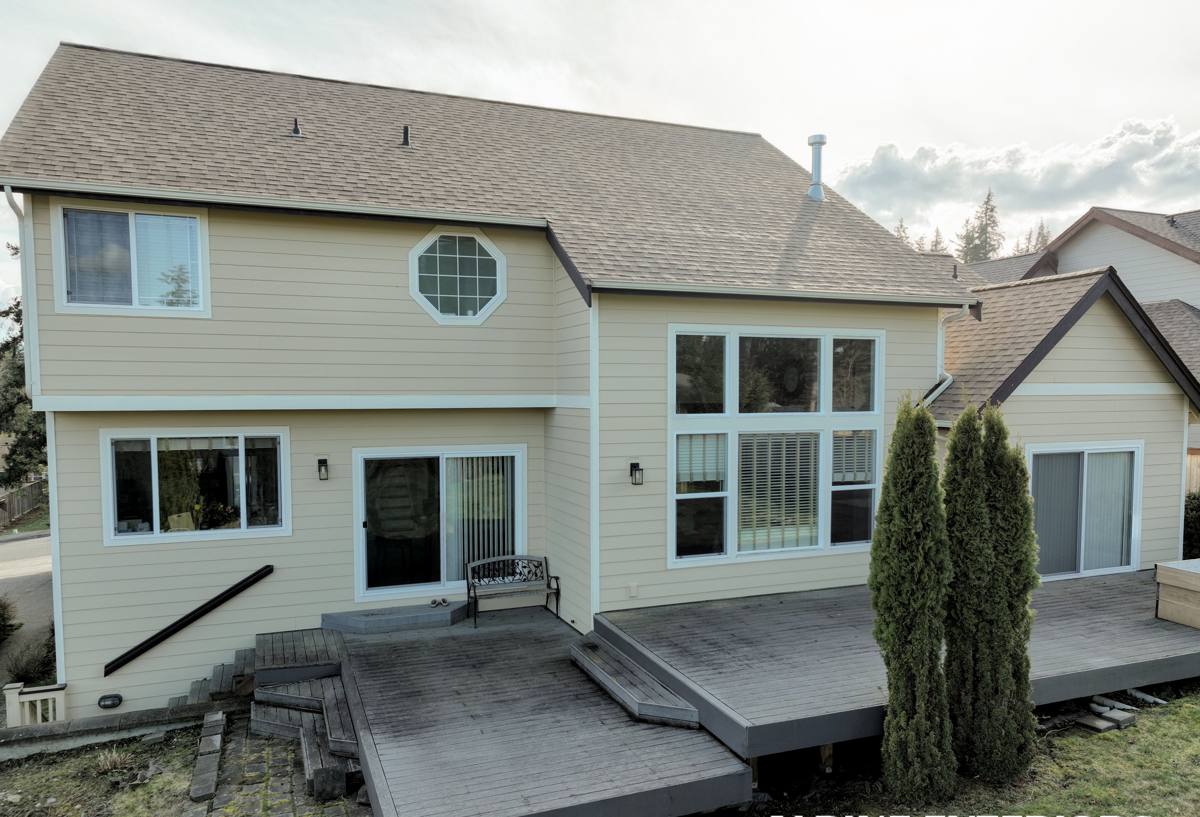
Signs a Conway Deck Needs Replacement, Not Just Repair
Repair makes sense when the problem is isolated — a cracked board, a loose railing baluster. Replacement becomes the honest answer when the damage is systemic, especially at the connections that hold the whole structure together. Here's what we look for:
- Boards that feel spongy, soft, or give underfoot, especially near the house or along the outer rim
- A ledger board that's pulling away from the house, or shows dark staining and soft wood where it meets the siding
- Footings that have shifted, settled unevenly, or heaved with the ground
- Rust streaking or bleeding around fastener heads — a sign the hardware is corroding from the inside out
- Moss or algae that comes back within a few weeks of a good cleaning, even in areas with decent sun exposure
- Noticeable bounce, sway, or flex when you walk across the deck or lean on the railing
- Visible rot or delamination at joist ends, beam pockets, or post bases
The ledger board connection deserves special attention. It's the single point where the deck attaches to the house, it's usually the last part to dry out after rain, and it's the most common place we find hidden rot during a tear-out — often well before the surface decking shows any obvious problem.
Choosing Decking Material for This Climate
There's no single "best" decking material — there's a best fit for how much upkeep you're willing to do versus what you want to spend up front. In a marine, high-moisture climate like this one, those trade-offs matter more than they would in a drier region.
| Material | Moisture & Moss Resistance | Maintenance | Typical Lifespan |
|---|---|---|---|
| Pressure-treated wood | Fair — treatment resists rot but surface still absorbs moisture | Annual cleaning and periodic resealing | 10–15 years |
| Cedar | Good natural rot resistance, but softer surface holds moisture | Regular cleaning, sealing every 1–2 years | 15–20 years |
| Composite decking | Very good — doesn't absorb water like wood, but can still grow surface moss if shaded | Periodic washing, no sealing needed | 25–30 years |
| PVC / capped polymer | Excellent — fully sealed surface, minimal water absorption | Occasional washing | 25–30+ years |
Wood costs less to install and has a natural look plenty of homeowners want to keep, but it asks for real annual maintenance in this climate — skip a year of cleaning and sealing and moss gets a foothold fast. Composite and PVC cost more up front but shed water instead of absorbing it, which matters when a deck spends half the year damp. We'll walk through the honest trade-offs for your specific site — sun exposure, how much shade the yard gets, and how much upkeep you actually want to do — rather than push one product across the board.
What a Correct Deck Replacement Actually Involves
Tear-Out and Structural Inspection
Once the old decking, railings, and any damaged framing are removed, we can see what's actually going on underneath — footing condition, joist and beam health, and how the ledger board has held up. This is where hidden rot usually turns up, and it's the reason a proper replacement starts with removal, not just an estimate from the surface.
Ledger Board and Flashing
The ledger connection is the most water-vulnerable part of any attached deck, and it's where a lot of corner-cutting happens on cheaper jobs. Done right, this means proper flashing that directs water away from the house band board, a ledger that's through-bolted (not just nailed or lag-screwed) into solid framing, and a gap or flashing detail that keeps water from wicking between the deck and the siding. Get this wrong and you're guaranteed a repeat failure within a few years, no matter how good the decking above it looks.
Footings and Framing
Footings need to sit below frost depth and bear on stable soil — something worth checking carefully on lower-lying delta ground where drainage and soil conditions vary. Joists and beams get sized to the actual span and load, not just matched to what was there before, since older decks were sometimes built to lighter standards than current code calls for.
Decking and Fastening
Hardware matters as much as the decking material itself. In this climate, we use fasteners rated for exterior, corrosion-prone conditions — standard hardware store screws and nails corrode faster here and are one of the more common causes of premature failure we see on older decks. Board spacing also gets set with airflow and drainage in mind, not just appearance, so water and debris don't sit trapped between boards.
Railings and Guards
Guardrail height, baluster spacing, and stair rail requirements aren't optional details — they're safety code, and they're one of the first things a building inspector checks. We build to current code as a baseline, not the minimum that was acceptable when the old deck went in years ago.
Permits and Code in Skagit County
Most attached deck replacements — and any deck above a certain height off grade — require a permit through the local building jurisdiction, with inspections at the footing and framing stages before decking goes down. Skipping this step is one of the more common shortcuts homeowners regret, since unpermitted work can complicate a home sale or an insurance claim later. We handle the permit application and coordinate inspections as part of the job, so you're not the one tracking down paperwork or scheduling inspector visits.
Our Deck Replacement Process
- On-site assessment — we look at the existing deck, the ledger connection, footings, and surrounding drainage before recommending anything
- Material and design conversation — an honest walk-through of wood versus composite versus PVC for your specific site and budget
- Permit handling — we prepare and submit what's needed and schedule required inspections
- Tear-out — full removal of old decking, railings, and any compromised framing
- Structural rebuild — footings, framing, and ledger flashing done to current code
- Decking and railing installation — fastened with corrosion-resistant hardware, spaced for drainage
- Final walkthrough — we go over the finished deck with you, including care and maintenance specific to the material you chose
Keeping a New Deck Ahead of Moss Season
A well-built deck still needs some seasonal attention here — the climate doesn't let anyone off the hook entirely. A few habits go a long way:
- Clean the deck surface before the wet season sets in, not after moss has already taken hold
- Make sure gutters and downspouts direct roof runoff away from the deck rather than onto it
- Trim back overhanging branches and nearby vegetation so sun and air can reach the surface
- Check fastener heads periodically for early rust or corrosion, especially on wood decks
- Reseal wood decking on the schedule the product calls for — don't wait until it's visibly gray or dry
None of this is complicated, but it's the difference between a deck that lasts its full expected lifespan and one that starts showing problems years early.
Why Hire a Crew That Already Works in Conway
A deck built to a generic spec sheet doesn't always hold up the same way in delta-adjacent, marine-air conditions as it would somewhere drier. Knowing which fastener grades actually hold up here, how to detail ledger flashing for this much sustained rain, and what the local permit process expects isn't something you pick up from a manual — it comes from doing the work in this specific area, repeatedly. We're not going to tell you a certain material is "bad" — we'll tell you honestly what it costs you in maintenance, moisture behavior, or long-term durability in this climate, and let you make the call with real information.
If your deck in Conway is showing soft spots, a shifting ledger, or moss that won't quit, we're happy to take a look and give you a straight answer — repair or replace — along with a free, no-pressure estimate using the form below.