 Anacortes Siding
 Fidalgo Island's Climate Asks More of Your Siding Than People Expect
Fidalgo Island sits right where the Salish Sea meets the mainland, and that location shapes everything about how exterior materials hold up here. Homes get a steady dose of salt-laden air off Rosario Strait and Guemes Channel, wind-driven rain that doesn't just fall straight down but gets pushed sideways into wall assemblies, and long stretches of the year — especially fall through spring — where surfaces stay damp enough for moss and algae to take hold and never fully dry out. Skagit County's marine climate is milder than a lot of the Pacific Northwest in terms of temperature swings, but that mildness is deceptive. Consistent moisture and salt exposure do slow, cumulative damage that shows up as paint failure, swelling, soft spots, and staining long before most homeowners expect to be dealing with a siding problem.
Siding on Fidalgo Island isn't decorative — it's the first line of defense against a climate that's actively working to break it down, day after day, year after year. That's the lens we use when we talk about what belongs on a home out here, and it's why fiber cement, specifically James Hardie fiber cement, is what we install.
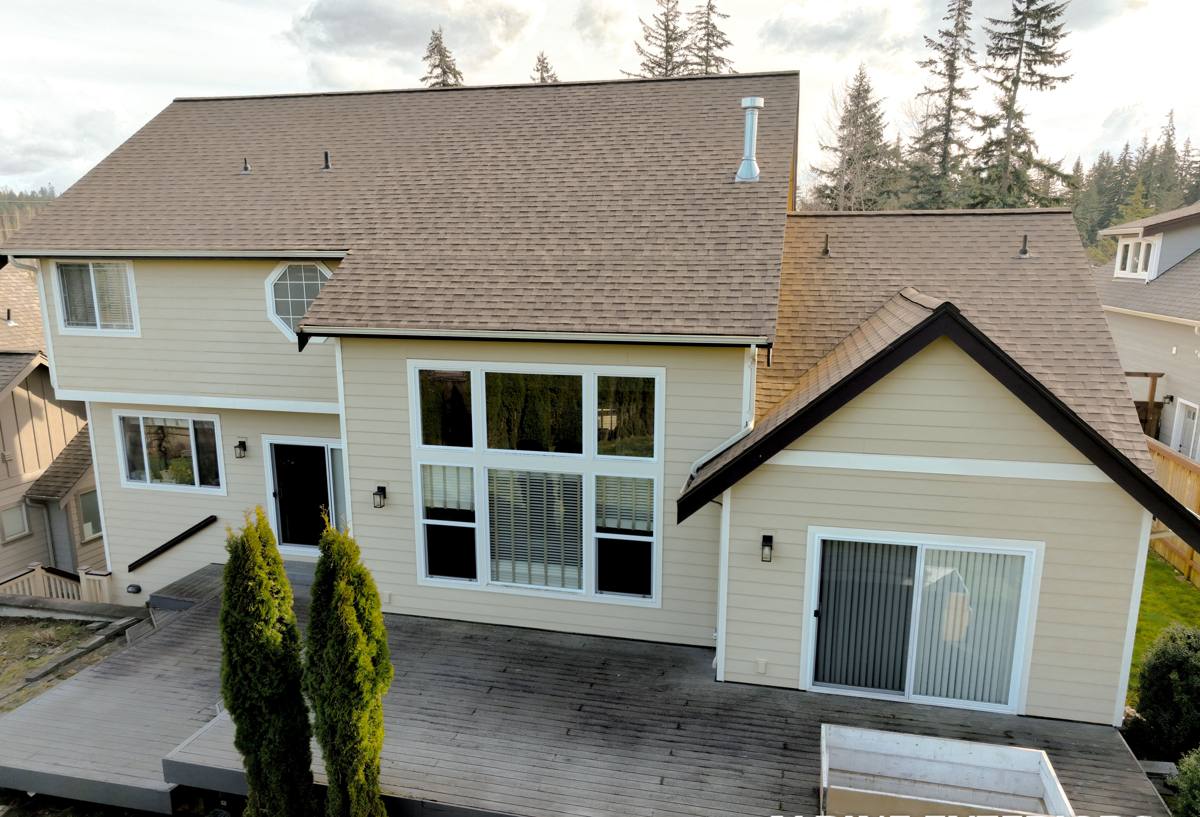
What "Correct" Fiber Cement Siding Actually Involves
A lot of siding jobs fail not because the material was wrong, but because the installation didn't account for local conditions. On Fidalgo Island, correct fiber cement installation means paying close attention to a few things that matter more here than in a drier, inland climate:
Drainage Behind the Siding
Even the best siding needs a way for incidental moisture to escape. A proper rainscreen or drainage gap behind the panels lets any water that gets past the surface drain and dry out instead of sitting against the wall sheathing. In a climate with this much sustained dampness, skipping this step is one of the most common causes of premature rot and mold behind otherwise good-looking siding.
Fastening and Clearances
James Hardie publishes specific fastening patterns, clearances from grade, roofing, and decks, and gapping requirements at butt joints and trim. These aren't suggestions — they're what keeps water from wicking into cut edges and fastener penetrations. Salt air accelerates corrosion on the wrong fastener choice too, so we use fasteners rated for the exposure.
Caulking and Flashing Details
Windows, doors, and any wall penetration are where driving rain finds its way in first. Correct flashing — installed in the right order, lapped the right direction — matters more on a site that catches wind off the water than it does on a sheltered inland lot.
Why We Install Only James Hardie Fiber Cement
We don't install vinyl, LP SmartSide, primed wood, cedar, or other fiber cement brands. That's a deliberate standard, not a sales preference, and it's worth explaining honestly.
Vinyl siding is inexpensive and low-maintenance, but it's a thin plastic product that can warp in heat, crack in cold, and fade over time — and on a wind-exposed site like Fidalgo Island, it's more prone to rattling loose or blowing off in a storm than a heavier, mechanically fastened product. Wood-based products, including primed spruce and cedar, look great initially but need consistent repainting and are genuinely vulnerable to the moisture and moss conditions this area produces — the maintenance burden compounds fast in a marine climate. Engineered wood products like LP SmartSide use a wood-strand substrate that, while treated, still relies on an intact outer coating to keep moisture out; once that coating is compromised at a cut edge or a scratch, the underlying material can swell. Other fiber cement brands exist, and some are reasonable products, but we've standardized on one system so our crews build deep, repeatable expertise in the fastening specs, trim details, and finish system of a single manufacturer rather than splitting attention across several.
James Hardie fiber cement is a cement, sand, and cellulose fiber composite. It doesn't burn, it doesn't rot, and it isn't a food source for insects. It resists the swelling and softening that plague wood-based sidings in wet climates, and it holds paint and factory finish far longer than wood substrates because the substrate itself is dimensionally stable. For a climate defined by salt air, sustained dampness, and moss pressure, that combination is the reason we stand behind it.
ColorPlus Factory Finish
Most of what we install uses Hardie's ColorPlus finish — a factory-applied, baked-on finish that's more durable and more consistent than field-applied paint, with touch-up product available for the rare nick during installation. In a climate where repainting is a real, recurring cost, a finish that's engineered to outlast typical field paint by years is a meaningful advantage, not a marketing point.
HardiePlank, Panel, and Shingle: Matching the Product to the Home
James Hardie makes several distinct product lines, and part of doing this job right is matching the product to the house rather than defaulting to one option everywhere.
- HardiePlank lap siding — the most common choice, available in several exposures and textures (smooth, cedarmill), suited to traditional and craftsman-style homes across Anacortes and Fidalgo Island.
- HardiePanel vertical siding — used for board-and-batten looks or as an accent alongside lap siding, common on garages, gables, and modern-style facades.
- HardieShingle — a staggered or straight-edge shingle profile for homes going for a coastal or cottage aesthetic, which is a natural fit for this part of the county.
- HardieTrim — matching trim boards so the whole exterior envelope, not just the field siding, is built from the same moisture-resistant material.
Hardie also makes HZ5 and HZ10 climate-engineered product formulations for different exposure zones. Western Washington's marine environment generally falls into a zone where the standard HZ5 formulation is appropriate, and matching the right formulation to the site is part of a correct spec, not an afterthought.
Our Installation Process on Fidalgo Island
The process doesn't change dramatically from house to house, but the details we watch for do, especially this close to the water.
1. Assessment and Tear-Off
We start by inspecting the existing wall assembly once old siding is removed — checking sheathing for hidden moisture damage, which is more common on homes that have gone years with failing paint or degraded caulking in a wet climate.
2. Weather Barrier and Drainage Plane
We install a code-compliant weather-resistant barrier and drainage gap system before any siding goes up. This is the step that determines whether incidental moisture becomes a non-issue or a long-term problem.
3. Flashing at Every Penetration
Windows, doors, hose bibs, vents, and light fixtures all get properly lapped flashing so water sheds outward and down, never into the wall cavity.
4. Siding Installation to Hardie Spec
Fastening patterns, gapping, and clearances follow James Hardie's published installation guidelines — the guidelines that also protect the product warranty.
5. Trim, Caulking, and Final Detailing
Trim goes on with the correct gaps and sealant, and we finish with a final inspection of every joint, corner, and penetration before calling the job complete.
What Fiber Cement Siding Costs to Install
Cost varies by home size, existing wall condition, product line, and trim complexity, but the table below outlines the major factors that move the price up or down on a typical Fidalgo Island project.
| Factor | Why It Matters Here |
|---|---|
| Existing wall condition | Hidden moisture or rot behind old siding, more common in this climate, adds sheathing repair before new siding can go on |
| Product line selected | Lap, panel, and shingle profiles carry different material and labor costs; shingle profiles take longer to install |
| Trim and detail complexity | Homes with more windows, gables, and architectural detail require more flashing and cutting time |
| Wind and water exposure of the site | Homes with more direct exposure to Rosario Strait or open water may warrant additional flashing detail at vulnerable transitions |
| Removal and disposal of old siding | Full tear-off of vinyl, wood, or old fiber cement adds labor and disposal cost versus new construction |
We don't publish a flat per-square-foot number because the variables above genuinely change the job — a straightforward rectangular home and a home with steep gables and lots of trim are not the same scope of work, even at the same square footage.
Living With Fiber Cement Siding in a Marine Climate
One of the real advantages of fiber cement over wood-based alternatives is how little ongoing maintenance it demands, but "low-maintenance" isn't "no-maintenance," especially in a moss-prone environment.
- Rinse siding periodically with a garden hose to clear salt residue and organic buildup before it becomes established moss or algae — avoid high-pressure washing directly at seams and joints.
- Trim back vegetation and tree cover that keeps siding shaded and damp longer than it needs to be.
- Check caulking at trim joints and window edges every couple of years; caulking is a wear item even when the siding behind it isn't.
- Watch gutters and downspouts — misdirected roof runoff onto siding is one of the most common causes of localized staining and premature wear.
- Address any paint chip or scratch on the ColorPlus finish with touch-up product promptly rather than letting bare substrate sit exposed.
Why Local Experience on Fidalgo Island Matters
A crew that mostly works inland, drier climates doesn't build the same instincts as one that works this coastline regularly. Knowing which walls on a given lot take the brunt of the weather off the water, how much drainage detail a particular site really needs, and how moss pressure behaves on a shaded north wall versus a sun-exposed south wall isn't something you get from a manual — it's something you learn by doing the work here, repeatedly, and seeing how houses actually perform a few winters later. That local pattern recognition is what separates a siding job that looks good at handoff from one that still looks good after five wet seasons.
It also means we're not guessing at code requirements or inspection expectations for Skagit County and the City of Anacortes — we already know them, which keeps the project moving without avoidable delays.
Get a Straightforward Estimate
If you're weighing your options for siding on a Fidalgo Island home, we're happy to take a look, walk you through what your specific house needs, and give you a clear, no-pressure estimate. There's no obligation — just an honest read on the condition of your current siding and what correct James Hardie installation would look like for your home. Use the form below to get started.