 Anacortes Siding
 Why Fidalgo Island Siding Takes a Different Approach
Fidalgo Island sits where Skagit County meets the Salish Sea, and that location shapes everything about how a home's exterior ages. Homes here don't just deal with rain — they deal with salt-laden air rolling off Rosario Strait and Guemes Channel, wind-driven moisture that finds every gap in a wall assembly, and a wet season that stretches long enough for moss and algae to get a real foothold on north-facing walls and shaded siding runs. A siding product that performs fine in a drier inland climate can start showing problems on Fidalgo Island in a fraction of the time.
We install James Hardie fiber cement exclusively. Not as one option among several, but as the only siding system we put on homes — anywhere, including Anacortes. This page explains what that means specifically for houses on Fidalgo Island: what the salt air and moisture cycle actually do to siding over time, what a correctly installed Hardie system looks like in this environment, and how our process is built around local conditions rather than a generic installation checklist.
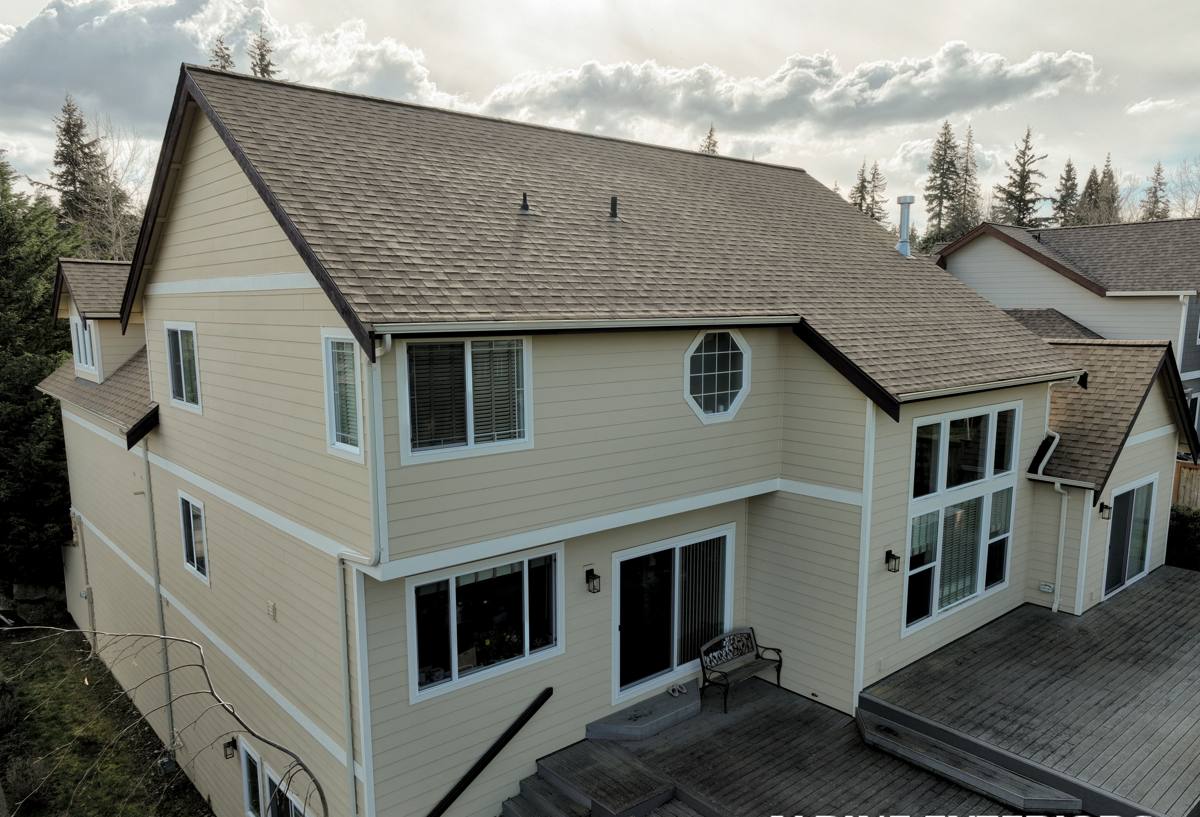
What Salt Air and Driving Rain Actually Do to Siding
It helps to understand the mechanism, not just the symptom. Salt air carries fine chloride particles that settle on exterior surfaces and accelerate corrosion of fasteners, flashing, and any exposed metal components. On siding materials that rely on paint film or a factory coating to stay watertight, salt exposure combined with UV and moisture cycling breaks that coating down faster than it would inland. Once the coating is compromised, the underlying material is exposed to whatever comes next.
Driving rain — rain pushed sideways by wind rather than falling straight down — is a bigger problem than most homeowners realize. It doesn't just wet the surface of the siding; it gets forced into laps, seams, and butt joints under pressure. A siding system that isn't detailed correctly at those joints will take on moisture behind the cladding, not just on it. That's where rot, delamination, and swelling start, usually invisible until the damage is well established.
Add Fidalgo Island's long moss and algae season — extended stretches of shade, moisture, and mild temperatures that are ideal for organic growth — and you get a third stressor: constant biological moisture sitting against the siding surface on north walls, under eaves, and anywhere airflow and sun exposure are limited.
Why This Matters More on Fidalgo Island Than Elsewhere in Skagit County
Homes closer to the water, on exposed slopes, or with west/southwest wall exposure toward incoming weather see this compounding effect the hardest. Homes further inland or more sheltered by tree cover and terrain still deal with the same climate, just with somewhat less intensity. Either way, the baseline conditions on the island are more demanding than a typical inland Pacific Northwest lot, which is exactly why product choice and installation quality matter more here, not less.
Why We Install James Hardie and Nothing Else
James Hardie fiber cement is engineered specifically to resist the failure modes that coastal and high-moisture climates create. It's non-combustible, dimensionally stable across wet-dry cycles, and finished with a factory-applied ColorPlus coating that's baked on and warrantied against fading and peeling — a meaningfully different proposition than field-applied paint that has to be maintained and eventually redone.
We don't install LP SmartSide, vinyl, Cemplank, Allura, primed spruce, or cedar. Each of those products has legitimate strengths, and we're not going to pretend otherwise. But every one of them asks a homeowner to accept a trade-off — ongoing paint maintenance, vulnerability to moisture intrusion at seams, a coating system less proven over decades, or a warranty structure that doesn't hold up the way Hardie's does. On a site with Fidalgo Island's salt exposure and rain load, those trade-offs show up faster and cost more to fix. Standardizing on one product means we install it the same correct way every time, we know its behavior in this exact climate, and we're not learning the quirks of five different systems across our jobs.
The HZ5 Climate Engineering
James Hardie manufactures its siding in different formulations tuned to specific climate zones, sold under the HZ (HardieZone) system. The Pacific Northwest, including Skagit County and Fidalgo Island, falls into the HZ5 zone — engineered for wet, moderate-temperature climates rather than the hot, arid formulation used in the Southwest. HZ5 product is built to resist moisture-related damage in exactly the conditions this region produces, which is a meaningful difference from installing a one-size-fits-all fiber cement product.
What a Correct Hardie Installation Involves
The material is only half the equation. Fiber cement siding fails prematurely far more often from installation mistakes than from a defect in the board itself. On a coastal, high-moisture site like Fidalgo Island, the margin for error is smaller.
- Weather-resistive barrier and flashing first. A correctly lapped water-resistive barrier, properly integrated window and door flashing, and flashed penetrations for vents, hose bibs, and fixtures — all installed before a single piece of siding goes up.
- Rainscreen gap where conditions call for it. A drainage gap between the siding and the wall assembly lets any moisture that does get past the cladding drain and dry instead of sitting against sheathing — important on driving-rain-exposed walls.
- Correct fastener pattern and type. Corrosion-resistant fasteners, placed per Hardie's blind- or face-nail specifications, driven to the correct depth — overdriven or underdriven nails are one of the most common causes of early siding failure.
- Proper clearances. Minimum gaps from grade, roofing, decks, and other transitions so water doesn't wick into the bottom edge of the siding or sit trapped against it.
- Caulked and sealed joints done right — not overdone. Butt joints, trim intersections, and penetrations sealed with the correct sealant, without over-caulking in ways that trap moisture instead of shedding it.
- Factory-cut and field-cut edges sealed. Any field cut through the ColorPlus finish exposes raw material that needs to be sealed per manufacturer spec to keep the warranty intact.
Our Process on Fidalgo Island Homes
1. On-Site Assessment
We walk the exterior and look specifically at exposure: which walls take direct weather, where moss and algae are already established, where existing flashing or trim is failing, and what the current siding's condition tells us about how the house has handled moisture over time.
2. Wall Assembly Check
Once existing siding comes off, we inspect the sheathing and framing underneath before anything new goes up. This is where hidden water damage from a previous installation typically shows up, and it needs to be addressed before new siding goes on, not covered over.
3. Weather Barrier and Flashing Installation
This is the step that determines how the house performs in wind-driven rain for the next several decades, done to manufacturer and code specification, not shortcuts.
4. Hardie Installation to Spec
Correct fastening, clearances, joint treatment, and finish detailing, matched to the HZ5 product line appropriate for the project.
5. Final Walkthrough
We review the finished work with the homeowner and confirm trim, caulking, and transitions are complete and correctly detailed.
Comparing Siding Options for a Fidalgo Island Home
| Factor | James Hardie Fiber Cement | Vinyl | Wood (Cedar/Primed Spruce) |
|---|---|---|---|
| Salt air resistance | Engineered for it (HZ5); factory finish resists chloride-driven coating breakdown | Can become brittle and discolor faster in coastal exposure | Vulnerable without diligent, ongoing maintenance |
| Driving rain / moisture behavior | Dimensionally stable; doesn't swell or rot when detailed correctly | Sheds water on the surface but seams can allow intrusion | Absorbs moisture; prone to rot and warping over time |
| Moss/algae season | Factory finish resists staining better than field-painted surfaces | Can trap moisture behind panels, encouraging growth | Highly susceptible; needs regular cleaning and re-coating |
| Finish maintenance | ColorPlus factory finish, no repainting for many years | Low maintenance but fades and can't be easily refinished | Requires repainting/staining on a recurring cycle |
| Fire resistance | Non-combustible | Combustible, can melt/deform near heat | Combustible |
Signs Your Current Siding Isn't Holding Up
Homeowners on Fidalgo Island often live with early warning signs longer than they should because the damage isn't obvious from the street. Worth checking for:
- Soft or spongy spots when you press on siding, especially near the bottom courses or window sills
- Persistent moss, algae, or dark staining that returns quickly after cleaning
- Visible gaps, cracking, or separation at butt joints and corners
- Paint that's peeling, bubbling, or chalking rather than just faded
- Rust streaks below fasteners or trim, indicating corroding hardware
- Musty smell or visible staining on interior walls that share an exterior wall with problem siding
Cost Factors Specific to This Project Type
Every Fidalgo Island home is different, so we won't quote a number without seeing the site, but the factors that actually move the price on a project like this are consistent:
- Condition of the existing wall assembly — whether sheathing repair or replacement is needed before new siding goes on
- Amount of trim, window, and door detailing, since these areas take more labor than flat wall runs
- Wall exposure and access — steep roofline transitions, multi-story walls, and tight side yards add labor time
- HZ5 product line and profile selected (lap width, texture, ColorPlus color)
- Scope of flashing and moisture barrier work required for the specific exposure of the home
Why Hiring a Crew That Already Works Fidalgo Island Matters
A crew that installs siding across a range of climates has to generalize. A crew that works Fidalgo Island and greater Anacortes regularly already knows which walls on which lot orientations take the worst of the weather, how long the moss season really runs in a given microclimate, and where driving rain tends to concentrate on homes near the water versus further inland. That local pattern recognition shows up in the details — where we add extra flashing attention, which walls get the rainscreen gap prioritized, how we sequence a project around the wet season. It's the difference between a technically correct installation and one that's correct for this specific place.
Ready to Talk About Your Home's Siding?
If your Fidalgo Island home's siding is showing its age, or you're planning ahead of a needed replacement, we're happy to take a look and walk you through what we'd recommend and why. Request a free, no-pressure estimate using the form below — there's no obligation, and you'll get a straight answer about what your home actually needs.