 Anacortes Siding
 Fidalgo Island sits where Puget Sound, Rosario Strait, and Guemes Channel meet, and that setting shapes how a roof holds up here. Salt-laden air moves through daily, driving rain comes in sideways during fall and winter fronts, and Skagit County's mild, damp climate keeps roof planes wet or shaded long enough for moss and lichen to take hold most of the year. None of that is dramatic on its own, but stacked together over a decade or two, it wears down roofing that wasn't built with a marine environment in mind. Metal roofing, installed the right way for this specific setting, is one of the few systems that handles all three at once. This page covers what that actually takes for a home on Fidalgo Island — not metal roofing in general, but metal roofing here.
Why Fidalgo Island Is Hard on a Roof
A lot of roofing material is engineered and tested for an average American climate — moderate humidity, occasional storms, a dry season that lets things rest. Fidalgo Island doesn't get much of a dry season. Between the marine layer, rain rolling off the water, and wind funneling through the channels and straits around the island, a roof here sits under near-constant low-grade stress. Add tree cover and the shaded north- and east-facing slopes common on wooded Fidalgo Island lots, and roof planes stay damp longer than a simple rainfall total would suggest.
Three things drive most of the roofing failures we see in this area: sustained moisture that never fully dries between storms, wind-driven rain that finds its way under poorly lapped materials, and moss that holds water against the surface and works its way under shingle tabs and fasteners over time. A correct roofing job here has to be designed around those three pressures, not just installed to a generic manufacturer spec written for a drier region.
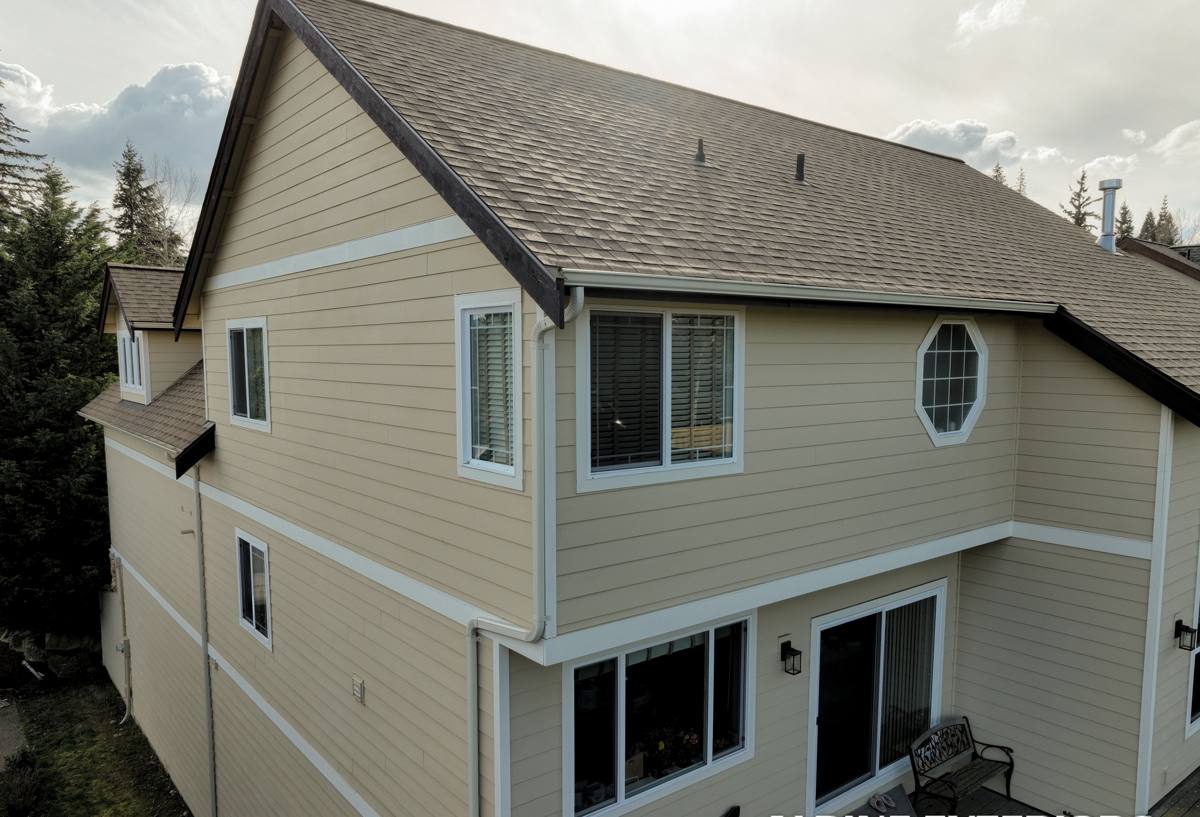
Why Metal Roofing Fits This Climate
It Sheds Water Instead of Absorbing It
Asphalt shingles are granule-coated mats that absorb some moisture and rely on overlapping courses to shed the rest. Over years of wet-dry cycling, granules wash off and the mat underneath weakens. A properly installed metal panel is a continuous, non-absorbent surface with sealed or mechanically locked seams — rain runs off with nowhere to soak in and no granule layer to erode. On a roof that's wet more days than it's dry, that difference compounds year after year.
It Holds Up to Wind Off the Water
Homes on Fidalgo Island, particularly those with exposure toward Rosario Strait or Guemes Channel, take wind loads that inland Skagit County properties see less often. Correctly installed metal roofing — especially standing seam systems with concealed fasteners and mechanically seamed panels — resists uplift far better than asphalt shingles, which are only as strong as their adhesive strip and the nails driven through the nailing zone. Wind resistance comes down to the fastening system and panel engineering, which is why installation quality matters as much as the panel itself.
It Doesn't Give Moss Much to Hold Onto
Moss needs a rough, porous surface and a food source to establish on. Asphalt granules give it both; a smooth coated metal surface offers far less to grip, and because metal sheds water quickly, it dries faster between rain events. Metal roofing doesn't make a home moss-proof — a shaded, tree-covered Fidalgo Island lot can still see growth over time, especially in valleys and at flashing details where debris collects. But it removes one of the biggest variables that lets moss take over an asphalt roof in three or four seasons instead of ten or more.
Panel Types and What Drives the Cost
Comparing Metal Roofing Panel Types
Not all metal roofing is the same product in different colors. The panel type changes how the roof performs, how it's fastened, and what it costs.
| Panel Type | How It's Fastened | Best Fit | What to Know |
|---|---|---|---|
| Standing Seam | Concealed clips, mechanically seamed panels, no exposed fasteners on the field | Homes prioritizing longevity, wind performance, and a clean look | Highest material and labor cost, but no exposed screws to fail or leak over time |
| Exposed-Fastener Panel (5V, corrugated, ribbed) | Screws driven through the panel face with rubber-washer sealing | Budget-conscious projects, outbuildings, accessory structures | Lower upfront cost, but every fastener is a potential leak point once washers age — needs periodic inspection |
| Stone-Coated Steel Shingle/Shake Panel | Interlocking steel panels with a stone-chip coating, concealed fastening | Homeowners who want a traditional shingle or shake look with metal's durability | Mid-to-high cost; the textured surface can still collect some debris and moss over time |
What Actually Moves the Price
Two roofs of the same square footage can price out very differently once you account for the roof itself, not just the panel choice. On Fidalgo Island, pitch, tree exposure, and access tend to matter more than on a simpler inland roof.
| Cost Factor | Why It Matters Here |
|---|---|
| Roof pitch and complexity | Steep or cut-up rooflines with multiple valleys take more time to flash correctly, and every seam is a potential leak path |
| Tear-off vs. overlay | Older asphalt roofs with trapped moisture underneath usually need a full tear-off, especially where moss has held water against the deck |
| Panel gauge and coating | Heavier-gauge steel and marine-grade coatings cost more but resist salt-air corrosion and denting significantly longer |
| Access and site conditions | Wooded lots, steep driveways, and limited staging area — common here — can add setup and material-handling time |
| Underlayment and flashing detail | A roof built for driving rain needs a higher-spec underlayment and careful flashing, which adds labor but isn't a place to cut corners here |
What a Correct Metal Roof Installation Involves
Underlayment That Backs Up the Panel
Metal panels are the visible layer, but the underlayment beneath them protects the roof deck if wind-driven rain ever gets past a seam or a fastener. We don't treat underlayment as an afterthought — a quality synthetic underlayment, with self-adhered membrane at eaves, valleys, and other vulnerable transitions, gives the roof a real second line of defense instead of a single point of failure.
Fasteners and Clips Matched to the Panel
On a standing seam roof, concealed clips let the panel expand and contract with temperature without tearing loose — this matters through Fidalgo Island's swing between cold, damp winters and warmer summer days. On exposed-fastener panels, every screw needs to be driven straight, at the correct torque, through the flat of the rib with an intact rubber washer. Over- or under-driven screws are one of the most common causes of early leaks, and it's a detail that's easy to rush and hard to inspect once the roof is finished.
Flashing and Penetrations
Valleys, chimneys, vents, skylights, and wall-to-roof transitions are where most roof leaks start, on metal roofs just as much as any other. Correct flashing means custom-formed metal at every transition, proper lap direction so water always flows over the next piece downhill, and sealant used as a backup, not the primary defense. Driving rain off the water finds shortcuts that a calmer climate's roofs never get tested against.
Ventilation
A metal roof needs a ventilated attic or roof assembly behind it just as much as any other roofing material — arguably more, since condensation can form on the underside of metal panels if warm, moist interior air isn't given somewhere to go. Balanced intake and exhaust ventilation keeps moisture from condensing against the deck, which matters where the air outside is often as damp as the air you're venting from inside.
Salt Air and Coastal Metal: Getting the Metallurgy Right
Fidalgo Island's proximity to open salt water means corrosion resistance isn't optional — it's one of the most important decisions in the project, and one homeowners rarely get walked through. Two mistakes cause most of the corrosion problems we see on coastal metal roofs: a coating or gauge that wasn't rated for marine exposure, and mixing incompatible metals.
That second issue — galvanic corrosion — happens when two dissimilar metals stay in contact with moisture between them; the less noble metal corrodes faster than it would on its own. On a roof, this shows up when the wrong fastener alloy is used with a given panel metal, or when copper flashing sits directly against aluminum or steel without a separating layer. It doesn't show up as a problem for a year or two, then shows up as rust streaks and pitting right at the point of contact. Matching fastener and flashing metal to the panel system is a standard we hold to on every coastal roof, not an upgrade.
Coating quality matters just as much. A baked-on coating with strong resistance to UV and salt spray holds its finish and protective function far longer than a bargain finish that looks the same on day one. Panel gauge, coating warranty, and manufacturer all matter more on Fidalgo Island than on a dry, inland roof — the environment here simply tests the material harder.
Moss, Debris, and Long-Term Roof Health
Even a well-installed metal roof isn't immune to moss on a shaded, tree-covered Fidalgo Island lot — it just resists it far longer and more evenly than asphalt does. Moss and debris tend to establish in the same low-flow spots every roof has: valleys, behind chimneys and vent stacks, and anywhere leaves or needles collect and hold moisture. Left unaddressed over years, trapped organic matter can eventually affect the coating and, at fastener penetrations, the seal underneath.
The fix isn't aggressive pressure washing, which can strip coatings and drive water under laps and seams. It's periodic clearing of debris from valleys and low points, keeping nearby limbs trimmed back where practical, and catching buildup before it becomes a sustained wet spot.
Our Process, Start to Finish
We approach every metal roofing project on Fidalgo Island the same structured way, because skipping steps is how leaks and premature failures happen in this climate.
- Inspection and assessment — we look at the existing roof deck, ventilation, moisture staining, and moss patterns to understand what the current roof is telling us about how the house handles water
- Tear-off decision — we determine whether the existing roofing and deck can be built over safely or whether a full tear-off is the honest call, particularly if there's trapped moisture or deck damage
- Deck repair and underlayment — soft or damaged decking gets replaced before anything goes back down, followed by underlayment specified for this climate, not a generic minimum
- Panel installation — panels, clips, and fasteners installed to manufacturer spec and matched metallurgically for coastal exposure
- Flashing and detail work — valleys, penetrations, and transitions custom-fit and flashed, since this is where most long-term performance is decided
- Final walkthrough — we go over the finished roof with you, including what routine maintenance looks like for your property and tree exposure
Maintaining a Metal Roof on Fidalgo Island
A metal roof is lower-maintenance than asphalt or wood, but "lower-maintenance" isn't "no-maintenance" in this climate. A short seasonal routine goes a long way toward getting the full lifespan out of the system:
- Clear leaves, needles, and moss buildup from valleys and low-slope sections once or twice a year, more often on heavily wooded lots
- Check and clear gutters regularly so water isn't backing up against eave flashing during heavy rain
- Trim back limbs that overhang the roof to reduce debris load and keep the surface drying faster after storms
- Have flashing at chimneys, vents, and skylights visually checked periodically, since these are the most likely spots for an early leak
- Avoid pressure washing the panels — use gentle rinsing and soft tools if cleaning is needed, to protect the coating
- After major wind events, do a visual check for lifted panels, loose fasteners, or debris impact damage
Why a Local Fidalgo Island Crew Matters
Metal roofing done right depends on details that don't show up on a spec sheet — how much wind exposure a specific slope actually sees, how long moisture sits on a shaded plane, which coating and fastener combinations have actually held up nearby over time. A crew that works Fidalgo Island regularly has already seen how the local combination of salt air, wind funneling through the channels, and a long moss season plays out on real roofs here, not just in a manufacturer's general climate zone rating. That experience shows up in the underlayment spec we choose, how we detail valleys and penetrations, and which fastener and flashing metals we're willing to put on a coastal roof.
It also matters for the ordinary, practical reasons: knowing local permitting requirements, being close enough to respond quickly if a storm causes damage, and having a track record in the community you can actually check on rather than take on faith from an out-of-area company that won't be around for a warranty call five years from now.
If you're weighing a metal roof for a home on Fidalgo Island, we're glad to take a look at your specific roof — pitch, tree exposure, and current condition — and walk you through what makes sense for your property. Reach out for a free, no-pressure estimate.