 Anacortes Siding
 Decks Near Flounder Bay Face a Tougher Environment Than Most
Flounder Bay sits close enough to the water that every deck in the area lives with conditions an inland deck never has to deal with. Salt-laden air moves through fasteners and connectors year-round, wind-driven rain gets pushed sideways into board gaps and ledger connections, and the shaded, damp stretches of the season let moss and algae take hold on any surface that doesn't dry out quickly. None of this is unique to any one home — it's just what waterfront and near-waterfront exposure in Skagit County does to exterior wood and hardware over time.
A deck built to a generic spec, or one that's simply aging out after 15-20 years of that exposure, tends to fail in predictable spots: the ledger board where it meets the house, the post bases where wood sits closest to grade, and the fastener heads that were never rated for a marine-influenced climate. Replacing a deck here isn't just swapping old boards for new ones — it's an opportunity to correct whatever the original build got wrong for this environment.
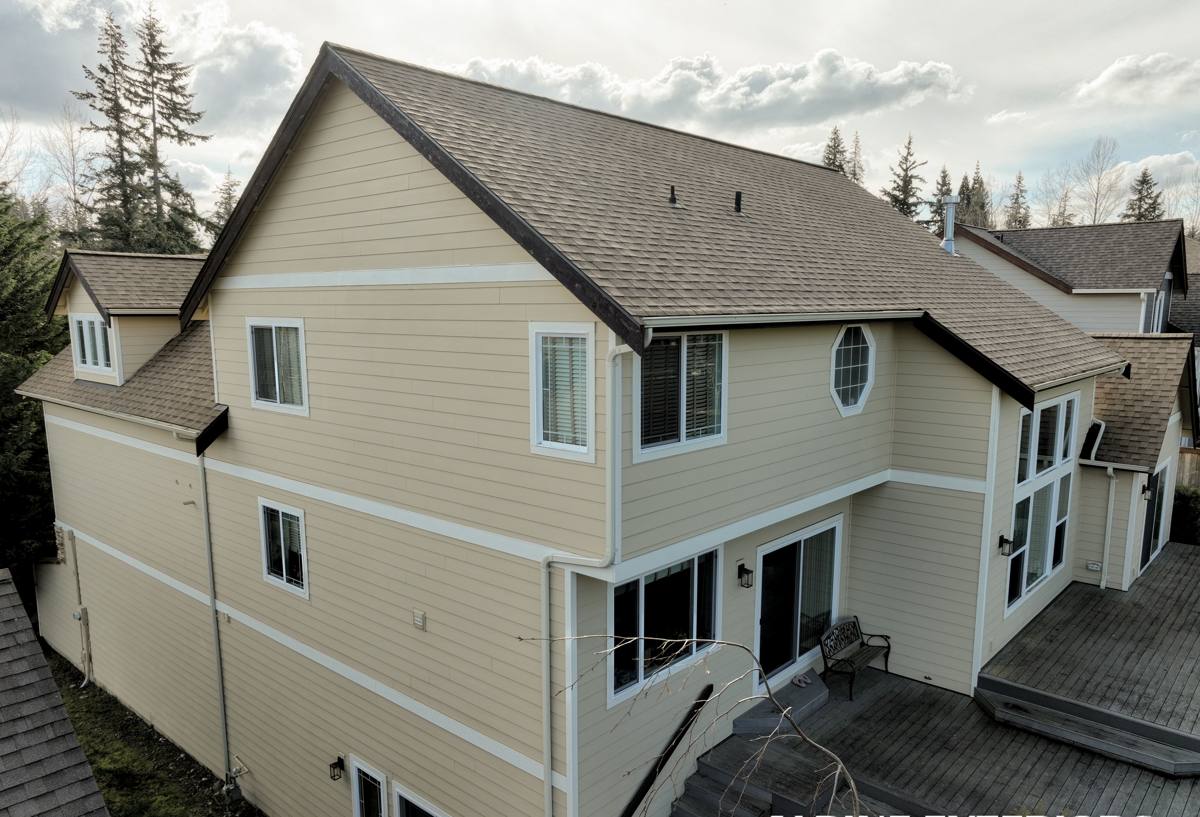
Signs a Flounder Bay Deck Needs Replacement, Not Just Repair
Homeowners often ask whether a deck can be patched instead of replaced. Sometimes it can. But there are a few signs that point toward full replacement being the more honest answer:
- Soft or spongy spots in the decking or framing when you walk across it, especially near the house or along the perimeter
- Visible rot or splitting at the ledger board, the point where the deck attaches to the structure
- Rust streaking from fasteners or visible corrosion on structural hardware and post bases
- Persistent moss or dark staining that keeps returning within weeks of cleaning
- Railings or stairs that feel loose or flex under normal weight
- A deck more than 20 years old built with older fastening standards or undersized framing for today's code
If the framing underneath is sound and it's really just the surface boards showing wear, resurfacing can make sense. But once the ledger connection, footings, or structural framing are compromised, patching individual boards just delays a bigger problem — and on a deck that's constantly exposed to salt air and rain, that problem tends to move faster than people expect.
Why the Ledger Board Deserves Extra Attention Here
The ledger board — the piece that bolts the deck to the house — is the single most common failure point on any deck, and it's an even bigger concern in a marine-influenced climate. Wind-driven rain gets forced against the house wall and can work behind flashing that wasn't detailed correctly the first time. When we replace a deck near the water, we treat the ledger connection as the most important part of the job, not an afterthought.
Choosing Materials for Near-Marine Exposure
Every decking material has trade-offs, and those trade-offs shift once salt air and constant moisture enter the picture. There's no single "best" choice for every homeowner — it depends on budget, how much upkeep you want to do, and how the deck gets used.
| Material | Upfront Cost | Salt Air / Moisture Behavior | Maintenance | Typical Lifespan |
|---|---|---|---|---|
| Pressure-treated lumber | Lowest | Good if properly sealed and re-sealed on schedule; fasteners must be rated for treated lumber | Annual cleaning, re-sealing every 1-2 years | 15-20 years with upkeep |
| Cedar | Moderate | Naturally moisture- and insect-resistant, but still needs sealing to hold color and resist checking near salt air | Cleaning and sealing every 1-2 years | 15-25 years with upkeep |
| Composite decking | Higher | Doesn't absorb moisture or rot; some capped composites handle salt air with minimal issue | Occasional washing, no sealing or staining | 25-30+ years |
For homes right around Flounder Bay, we lean toward capped composite or a well-sealed cedar when a client wants to minimize maintenance trips up and down a ladder every summer. But plenty of homeowners are happy with pressure-treated lumber as long as they understand the sealing schedule that comes with it. Our job is to lay out the honest trade-offs, not push a single product.
Fasteners and Hardware Matter as Much as the Decking
A composite deck installed with the wrong fasteners, or a cedar deck framed with hardware that isn't rated for coastal exposure, will fail at the connections long before the boards themselves wear out. In this climate, we spec stainless or coated fasteners and structural connectors rated for corrosive environments — it costs a little more up front and saves the deck from an early hardware failure.
What a Correct Deck Replacement Actually Involves
A deck replacement done right is more than pulling up old boards and screwing down new ones. The parts that don't show are the parts that determine how long the deck lasts.
- Full tear-out and structural inspection — removing the old decking and railings to inspect the framing, footings, and ledger connection underneath before deciding what gets reused and what doesn't.
- Footings and post bases — checking that footings meet current code depth and that post bases keep wood off grade, since ground-level wood is the first thing to rot in a wet climate.
- Ledger flashing — installing proper flashing and a moisture barrier where the deck meets the house, so wind-driven rain can't work behind the connection.
- Framing — sizing joists and beams to current span tables, with corrosion-resistant hardware throughout.
- Decking installation — proper board spacing for drainage and expansion, especially important with composite in temperature swings.
- Railings and stairs — built to current code height and baluster spacing, which has tightened over the years on many older decks.
- Final grading and drainage check — making sure water moves away from the structure instead of pooling under the deck.
Our Process for Flounder Bay Homeowners
We start with an on-site walkthrough, not a phone estimate, because you can't judge the condition of a ledger board or footing from a photo. From there:
- We assess the existing structure and tell you honestly whether repair or full replacement makes sense
- We walk through material options and their real-world trade-offs for this specific location
- We handle permitting where required — Anacortes and Skagit County have setback and, in some cases, shoreline-related requirements that can apply to waterfront and near-waterfront properties
- We schedule tear-out and rebuild around weather windows, since a half-finished deck exposed to a wet stretch isn't good for anyone
- We do a final walkthrough with you before calling the job done
Permits and Local Requirements
Deck replacement projects in Anacortes generally require a building permit once the work goes beyond a like-for-like surface swap, and properties near the water can carry additional review depending on proximity to the shoreline. Requirements vary by parcel, so we check the specifics for your address rather than assuming — and we handle the permit application as part of the job so you're not the one chasing it down.
Protecting the Deck After Installation
Even the best-built deck needs some ongoing attention in this climate. A short seasonal routine goes a long way:
- Rinse off salt residue and debris a few times a year, more often if the deck sits close to open water
- Keep gutters and downspouts clear so runoff isn't dumping extra water onto or near the deck
- Sweep leaves and needles off the surface before they trap moisture against the boards
- For wood decking, follow the sealing schedule — don't wait until it looks dry and gray
- Check railings and stair connections once a year for any looseness
- Address moss with a gentle wash early, before it stains or gets slick underfoot
Why a Crew That Already Works Flounder Bay Makes a Difference
A contractor who works this specific stretch of Anacortes regularly already knows how the wind sits relative to the water, how much salt exposure to plan for, and which building department questions come up on shoreline-adjacent properties. That's not something you can fully replicate by reading a spec sheet — it comes from having built and stood behind decks in this exact environment. It also means someone local is available if a question comes up after the job is done, instead of a crew that's moved three towns over.
If your deck near Flounder Bay is showing its age, or you're not sure whether repair or replacement is the right call, we're happy to take a look and give you a straight answer. Reach out for a free, no-pressure estimate using the form below.