 Anacortes Siding
 Why Similk Beach Homes Need a Different Approach to Siding
Similk Beach sits close enough to the water that homes here take on a different kind of weathering than siding just a few miles inland in downtown Anacortes. The combination of salt-laden air off Similk Bay, wind-driven rain coming straight off the Sound, and long stretches of gray, damp weather each fall and winter creates conditions that punish the wrong siding material fast. Add in the shade from mature evergreens that many Similk Beach properties enjoy, and you get an extended moss and algae season that keeps siding damp longer than homes in more open, sun-exposed parts of Skagit County.
We install James Hardie fiber cement siding exclusively, and homes in this specific pocket of the Anacortes area are a good example of why. Salt air corrodes fasteners and finishes over time. Driving rain finds every gap in flashing and trim. Moss and algae hold moisture against a wall for weeks at a time. A siding system that isn't engineered for this combination will show it within a handful of years — chalking, staining, soft spots, or paint that won't hold. Hardie's fiber cement products were built to resist exactly this kind of punishment, which is why it's the only siding we put on Similk Beach homes.
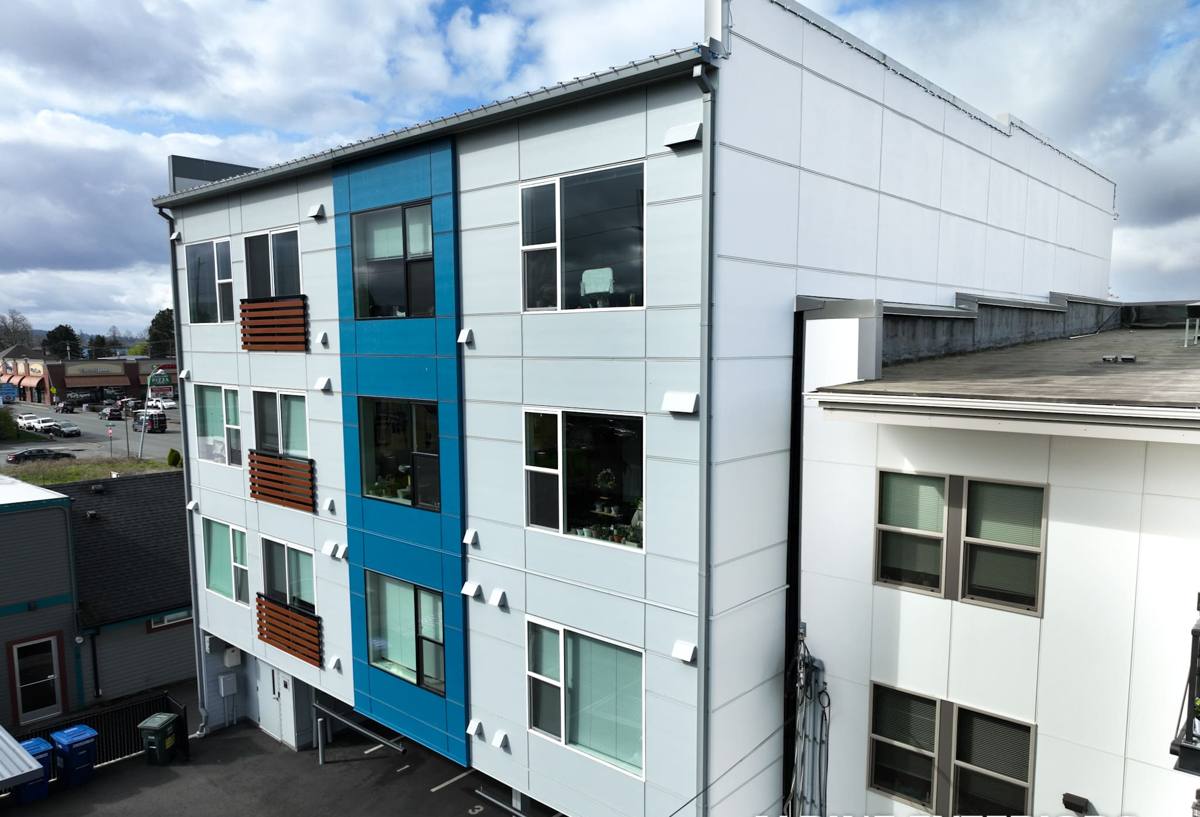
What Salt Air and Coastal Moisture Actually Do to Siding
It's worth understanding the mechanism, not just the symptom. Salt air carries fine airborne salt particles that settle on exterior surfaces and accelerate corrosion of exposed metal — nail heads, trim fasteners, flashing edges. On many siding materials, that corrosion telegraphs through the surface as rust streaks or bubbling within a few seasons. Combine that with near-constant humidity and the driving rain typical of storms rolling in off the Sound, and you get moisture that doesn't just land on the siding — it gets pushed into every seam, lap, and butt joint by wind pressure.
Wood-based and wood-fiber siding products absorb that moisture. Even well-maintained wood and engineered wood siding can swell, delaminate at cut edges, or invite rot where moisture sits the longest — typically near grade, under windows, and behind foundation plantings. Vinyl doesn't rot, but it flexes and can warp under the region's temperature swings, and its butt joints and lap seams are a common point where wind-driven rain gets behind the cladding. Fiber cement, by contrast, is dimensionally stable and doesn't absorb water into its core the way wood-based products do, which is the primary reason it holds up better in a coastal-influenced microclimate like Similk Beach.
Where Moss and Algae Fit In
Anacortes and the rest of Skagit County get a long wet season, and shaded, north-facing walls — common on wooded Similk Beach lots — can stay damp for weeks without direct sun to dry them out. That's ideal growing conditions for moss and algae. On porous or textured surfaces, organic growth gets a foothold in the material itself, not just on top of it, which makes it harder to clean without damaging the finish. Hardie's factory-applied ColorPlus finish is smoother and more resistant to that kind of embedded growth than raw or field-painted surfaces, and it's engineered specifically for the wet Pacific Northwest climate.
What a Correct James Hardie Install Looks Like Here
The siding material is only half the equation — how it's installed determines whether a home actually gets the protection Hardie is designed to provide. For a coastal-influenced property like a Similk Beach home, we pay particular attention to a few things that get skipped on rushed jobs:
- Water-resistive barrier and flashing first. Hardie panels are the outer layer of a system, not a standalone waterproofing product. Correct house wrap, window and door flashing, and kick-out flashing at roof-wall intersections have to be right before a single board goes up.
- Proper fastener selection. In a salt-air environment, we use corrosion-resistant fasteners rated for the exposure, not whatever's cheapest on the truck. Fastener corrosion is one of the most common causes of streaking and premature failure on coastal homes.
- Correct clearances at grade and roof lines. Hardie specifies minimum clearances between siding and the ground, decks, and roofing to prevent wicking and splash-back moisture — clearances that matter even more on a damp, shaded lot.
- Caulking and joint treatment per Hardie's spec. Butt joints and trim transitions are where driving rain gets tested. We follow Hardie's installation instructions on joint treatment rather than relying on caulk alone to do the job.
- Painting and finish touch-up done right. Field-cut edges need to be sealed and any touch-up paint matched and applied per manufacturer guidance to preserve both appearance and warranty coverage.
Skipping any one of these doesn't usually show up right away. It shows up two, five, or eight years later as a callback — and by then the fix is more involved than it would have been to do it correctly the first time.
HZ5 vs. Standard Hardie Lines: What Similk Beach Homes Actually Need
James Hardie engineers its products for different climate zones, and this is one of the more practical reasons we recommend it over other materials — the manufacturer has already done the climate matching for you.
| Product Consideration | Why It Matters for Similk Beach |
|---|---|
| HZ5 climate engineering | Formulated for wetter, harsher climates with better resistance to moisture-related damage — appropriate for a Pacific Northwest coastal-influenced property |
| ColorPlus factory finish | Baked-on finish resists fading and holds up to damp, shaded conditions better than field-applied paint |
| Panel vs. lap profile | Lap siding sheds driving rain effectively when installed with correct overlap; panel systems suit different architectural styles but need the same rigorous joint detailing |
| Trim and fascia matching | Using Hardie trim alongside Hardie siding keeps expansion, finish, and warranty coverage consistent across the whole exterior |
We'll walk through which specific product and color line makes sense for your home's exposure, sun/shade pattern, and style during the estimate — there's no one-size answer, but there is a wrong answer, and it's usually a material that wasn't engineered for this climate in the first place.
Why We Don't Install Anything Else Here
We get asked from time to time about vinyl, LP SmartSide, or cedar, and we're straightforward about why we've standardized on James Hardie fiber cement instead. Vinyl is inexpensive and low-maintenance in mild climates, but it can crack in cold snaps, fade unevenly over time, and its seams are a known weak point against wind-driven rain — a real factor for a bay-facing property. Engineered wood products like LP SmartSide perform reasonably well when maintenance stays current, but any breach in the factory coating exposes a wood-based substrate that doesn't handle sustained moisture as gracefully as fiber cement. Cedar is beautiful and has real fans, but it requires ongoing refinishing and is genuinely vulnerable to the rot and moss issues that a shaded, damp Similk Beach lot will throw at it.
None of these are bad products in every situation — they're products with trade-offs, and those trade-offs line up poorly with this specific location's climate. James Hardie's fiber cement composition, factory finish, and climate-zone engineering line up well with it, backed by a strong transferable warranty. That's the whole reason we only install one brand: it's the one we're comfortable standing behind on a home that's going to face salt air, driving rain, and moss season every single year.
Our Process for Similk Beach Projects
Every home is a little different, but the sequence stays consistent:
- On-site assessment. We look at your current siding, existing moisture damage if any, sun exposure, tree cover, and drainage around the foundation before recommending a product line.
- Written estimate. You get a clear scope — product, color, trim details, and what's included — with no surprise add-ons buried in fine print.
- Tear-off and inspection of the sheathing. Removing old siding lets us catch and address any hidden rot or water intrusion before it's covered back up.
- Water barrier and flashing install. This is the step that determines long-term performance and is not something we shortcut regardless of schedule pressure.
- Hardie siding, trim, and finish work. Installed to manufacturer spec, with corrosion-resistant fasteners and correct clearances throughout.
- Final walkthrough. We go over the finished work with you directly before calling the job done.
Why Local Experience Matters for This Neighborhood
A crew that's worked in the Similk Beach area already knows the practical realities of the neighborhood — narrower or wooded lots, well and septic considerations that affect equipment staging, tree cover that changes how quickly siding dries after a job, and the general wind and rain exposure that comes with proximity to the water. That's not something you can fully learn from a spec sheet; it comes from having done the work here before. It also means we're not guessing about which side of a house needs extra attention to flashing or which product line makes the most sense for a shaded, damp lot versus a more open one nearby.
Beyond the technical side, a local crew is accountable in a way an out-of-area contractor isn't. If a question comes up two years after installation, we're still in Anacortes, not three counties away.
What to Expect Cost-Wise
Siding costs vary by home size, existing condition, trim complexity, and product line, so we won't quote a number without seeing the property. In general, expect fiber cement to cost more upfront than vinyl and be competitive with or less than high-end cedar over the life of the siding once you factor in maintenance. The bigger cost driver for most Similk Beach homes is scope — how much of the existing siding and sheathing is sound versus how much needs repair — which is exactly why we start with an in-person assessment rather than a phone estimate.
If your Similk Beach home's siding is showing moss staining, chalking paint, soft spots, or you're just planning ahead for a replacement, we're happy to take a look and walk you through your options. Reach out for a free, no-pressure estimate — we'll tell you honestly what your home needs and why.