 Anacortes Siding
 Why March Point Decks Take More Punishment Than a Typical Backyard
March Point sits close to the water, and that changes what a deck has to survive. Homes here deal with a steady drift of salt air off Fidalgo Bay and Padilla Bay, wind-driven rain that doesn't just fall straight down but gets pushed sideways into ledger boards and railing joints, and a wet season that runs long enough for moss and algae to get a real foothold on any horizontal surface that doesn't drain and dry quickly. None of that is exotic for Skagit County, but it does mean a deck built with generic, one-size-fits-all methods tends to show problems faster here than it would in a drier inland town.
The failures we get called out for most often aren't dramatic. They're slow: fasteners that started bleeding rust after a couple winters, a ledger connection that trapped moisture against the house band board, decking that stayed damp and grew a moss film in the shaded corners because nobody thought about drainage or airflow underneath. A deck built for March Point conditions from the start avoids almost all of that.
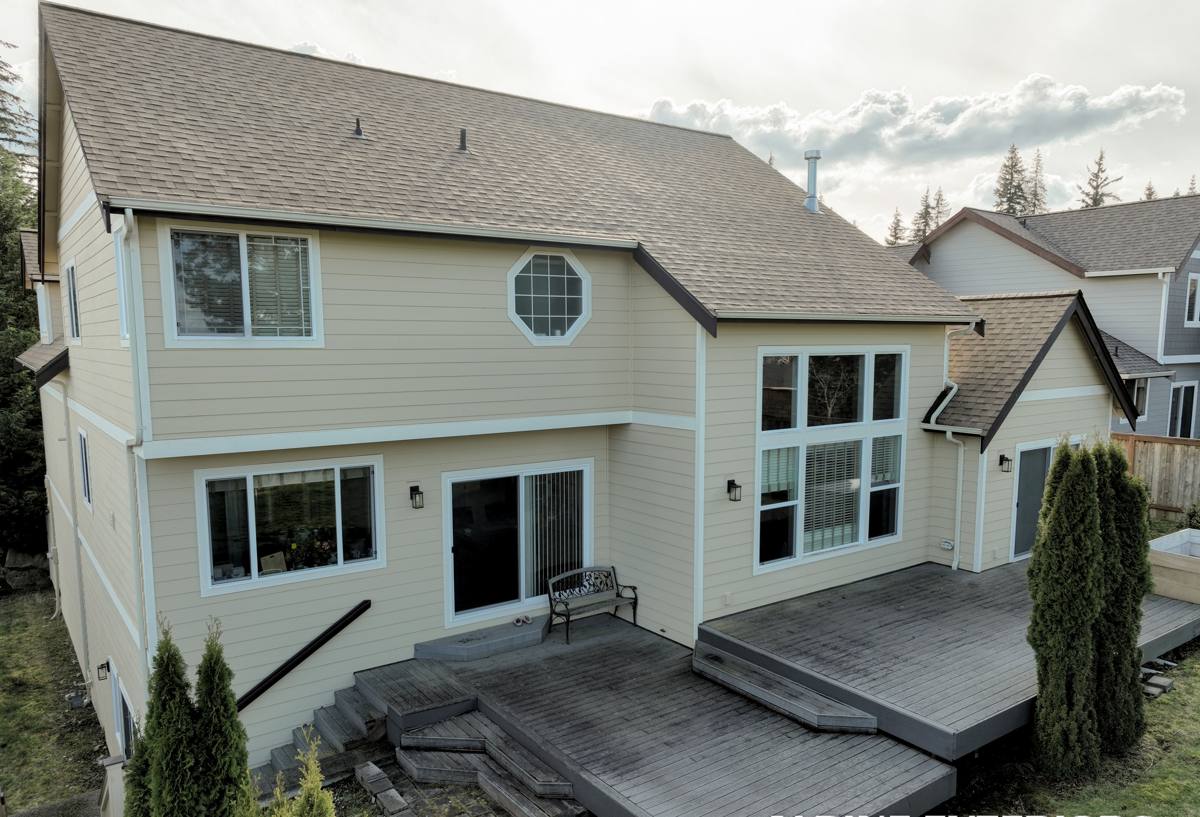
What "Built Right" Actually Means for This Site
Footings and Framing
Frost depth and drainage both matter for footings in this part of Anacortes. We size and set footings to local code requirements rather than guessing, and we grade the soil under and around the deck so water has somewhere to go instead of pooling against posts. Framing lumber gets treated for ground contact where it's called for, and we keep joists and beams sized with a margin, not the bare code minimum, because a deck that flexes over time is a deck that starts working its fasteners loose.
Ledger Attachment and Flashing
The ledger board — where the deck ties into the house — is the single most common failure point we see on older decks in wet coastal climates. If that connection isn't properly flashed to shed water away from the house structure, moisture works its way behind the ledger and into the rim joist and sheathing, and you don't find out until there's rot. We flash every ledger connection with proper counter-flashing and a code-compliant fastening pattern, and where the original siding or trim makes that difficult, we address it rather than flash around the problem.
Fastener and Hardware Selection
Salt air corrodes fasteners faster than people expect, even a few miles inland from the shoreline. We use fasteners and structural hardware rated for the type of wood or composite being installed and for a coastal-influenced environment — stainless or high-grade coated hardware where it matters most, matched to what the decking manufacturer actually requires to keep any product warranty valid. Mixing incompatible metals (the wrong screw with the wrong joist hanger, for instance) can cause galvanic corrosion that eats hardware from the inside, so we pay attention to that pairing, not just the individual parts.
Decking Material Options for March Point Homes
There's no single right answer for every house — it depends on budget, how much upkeep you want to do, and how much sun or shade the deck sees. Here's how the common options actually compare for this climate:
| Material | Upfront Cost | Moisture & Moss Behavior Here | Maintenance |
|---|---|---|---|
| Pressure-treated wood | Lowest | Absorbs moisture; needs sealing to resist moss staining and checking | Annual cleaning, periodic sealing/staining |
| Cedar | Moderate | Naturally rot-resistant but still needs finish upkeep in this rainfall | Regular cleaning, refinishing every few years |
| Composite decking | Higher | Doesn't absorb water like wood, but can still grow surface algae/moss if it stays shaded and damp | Periodic washing; no sealing/staining |
| PVC/capstock decking | Highest | Fully non-absorbent surface; best resistance to moss film buildup in shaded, wet spots | Occasional washing |
We don't push one product on every job. What we will tell you honestly is that in the shadier, damp corners a lot of March Point lots have — tree cover, north-facing sides of the house — a low-maintenance capped composite or PVC board earns its higher price back in fewer weekends spent scrubbing and re-sealing. On a sunnier, more open site, a well-finished cedar or treated-wood deck can perform fine and cost noticeably less.
Drainage, Grading, and Keeping Moss From Taking Over
Moss doesn't grow because a deck is old — it grows because a surface stays wet and shaded longer than it should. Two things control that: board spacing and airflow, and what's happening underneath the deck.
- Correct board gapping so water sheds through rather than sitting in tight seams
- Under-deck grading and drainage so runoff doesn't collect and hold moisture against the framing
- Ventilation gaps at skirting and low-clearance areas so air can actually move underneath
- Gutter or drip-edge planning where a roofline dumps water directly onto or near the deck
- Material choice matched to how much shade the specific deck location gets
We look at all of these during the estimate walk-through, not as an afterthought. A deck on the sunny side of a March Point home and one tucked under fir trees on the shaded side genuinely need different detailing to stay moss-free, and we'll tell you which parts of your site are going to need more attention.
Railings, Stairs, and Coastal Hardware Wear
Railings and stair hardware take a disproportionate amount of the weather exposure on a deck — they're vertical, exposed on both sides, and handled constantly, which shows wear faster than the decking surface does. Metal railing components and stair stringer hardware need the same salt-air-aware fastener selection as the deck framing. We also make sure railing posts are through-bolted into framing rather than just lag-screwed into decking, since that's a common shortcut that leads to wobbly railings well before the rest of the deck shows its age.
How Our Process Works, Start to Finish
- Free on-site estimate — we walk the site, check sun/shade exposure, existing drainage, and how the deck will tie into the house
- Material and layout discussion — we go over honest tradeoffs for your budget and how much upkeep you want, not just what we'd prefer to sell
- Permit handling — we prepare and submit what's required for your project so you're not navigating that alone
- Footings and framing — built to size, properly drained, with treated lumber where needed
- Ledger flashing and structural connections — done to code, not shortcut, since this is where most long-term problems start
- Decking, railing, and stair installation — with fastener and hardware choices matched to the material and the site's exposure
- Final walkthrough — we go over care and maintenance specific to your deck's material and location on the property
Permits and Inspections in Skagit County
Most new decks and many significant deck rebuilds in and around Anacortes require a permit, and the requirements can depend on deck height, size, and how it attaches to the house. We handle the permit application and coordinate inspections as part of the job rather than leaving that step to the homeowner. Skipping permitting on a deck that requires one isn't a shortcut worth taking — it can complicate a future home sale and, more importantly, it removes the inspection checkpoint that catches structural issues before they're buried under decking.
Caring for Your Deck After It's Built
Every deck, regardless of material, does better with a small amount of regular attention. This is the routine we recommend to March Point homeowners:
- Sweep off standing debris and needles regularly, especially in fall and through the wet months
- Rinse the surface a few times a year to keep algae and moss film from establishing
- Check that gaps between boards stay clear so water keeps draining through
- Inspect railings and stair connections yearly for looseness
- Reseal or restain wood decking on the schedule the product actually needs — don't wait until it's visibly gray and cracking
- Keep gutters and downspouts near the deck clear so runoff isn't dumping directly onto it
None of this is complicated, but skipping it is exactly how a well-built deck starts looking neglected years before it should.
Why Local Experience in March Point Matters
A crew that's worked on homes throughout Anacortes and Skagit County has already seen how the specific combination of salt exposure, wind-driven rain, and long wet seasons plays out on real decks over years, not just on paper. That experience shows up in small decisions — how a ledger gets flashed, which fastener grade actually holds up, how much drainage a shaded corner really needs — that a crew unfamiliar with this coastline might not think to prioritize. It's the difference between a deck that looks good at handoff and one that still looks and performs well five or ten winters later.
If you're planning a new deck or replacing one that's showing its age, we're happy to come take a look and give you a straightforward, no-pressure estimate — no obligation, just an honest read on what your specific site needs.