 Anacortes Siding
 Why March Point Siding Takes More of a Beating Than Most
March Point sits out on open water, and that exposure shapes everything about how siding performs here. Homes on this peninsula catch wind and salt-laden air off Fidalgo Bay and Padilla Bay from multiple directions, not just one prevailing side like a lot of inland Anacortes lots. That means more wall area is exposed to driving rain during winter storms, and more surfaces stay damp longer after a system passes through.
Add in Skagit County's long, gray moss season — roughly October through April — and you've got a climate that's genuinely hard on exterior materials. Shaded, north-facing walls and anything tucked under tree cover stay damp for days at a stretch, which is exactly the environment moss and algae need to take hold. Salt air adds a second problem on top of that: it accelerates corrosion on fasteners and trim, and it breaks down paint finishes faster than the same product would fade a few miles inland.
None of this means a house on March Point is doomed to constant siding problems. It means the material and the installation both have to be chosen with this specific exposure in mind, not with a one-size-fits-all approach borrowed from a drier climate.
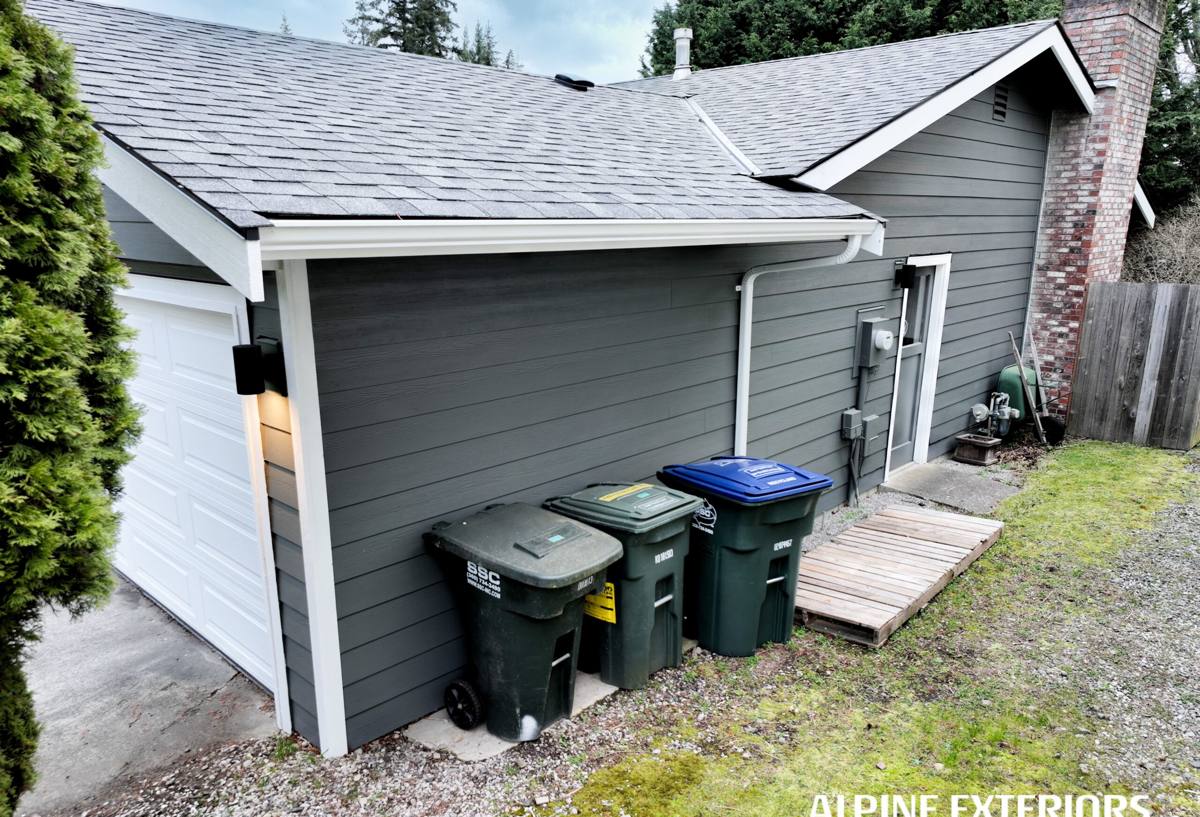
What James Hardie Siding Brings to This Environment
We install James Hardie fiber cement siding exclusively, and on a site like March Point that choice isn't just a brand preference — it's a material decision driven by what actually holds up out here.
It Doesn't Feed Moss and Rot the Way Wood Does
Fiber cement is made from cement, sand, and cellulose fibers, not wood. It doesn't rot, and it doesn't give moss and algae the organic surface they thrive on the way cedar or untreated wood trim does. That matters enormously in a climate where a shaded wall can stay damp for a week after a storm.
ColorPlus Factory Finish
James Hardie's ColorPlus finish is baked on in a controlled factory environment, with multiple coats and a UV-cured process, rather than applied on-site with a brush and sprayer. In a salt-air environment, that factory finish resists fading and peeling far longer than field-applied paint typically does, and it comes with its own dedicated finish warranty separate from the product warranty.
Engineered for This Climate Zone
James Hardie designs its siding formulations by climate zone rather than shipping one universal product nationwide. Our part of western Washington falls into their coastal HZ10 zone, and the products engineered for it are formulated with this kind of moisture exposure in mind — a meaningfully different starting point than a generic siding product not built for a marine climate.
How James Hardie Compares to the Alternatives Out Here
We get asked fairly often why we don't offer vinyl, cedar, or engineered wood siding as options. The honest answer is that we looked at how each of these performs in a coastal Skagit County climate specifically, and Hardie held up better across the board. Here's the comparison as we see it:
| Material | Moss & Moisture Behavior | Salt Air Durability | Long-Term Maintenance |
|---|---|---|---|
| James Hardie fiber cement | Non-organic, doesn't feed moss growth | Factory finish holds color, resists corrosion-driven wear | Occasional wash and caulk checks |
| Cedar / natural wood | Absorbs moisture, prone to rot and moss under damp conditions | Finish degrades faster in salt air | Regular refinishing, ongoing rot inspection |
| Vinyl | Doesn't rot, but traps moisture behind panels if not detailed correctly | Can become brittle and fade with prolonged UV and salt exposure | Low, but panels crack and can't be spot-repaired cleanly |
| LP SmartSide / engineered wood | Wood-strand core is vulnerable if the factory seal is compromised | Edge and cut-end sealing is critical near salt air | Moderate; edge maintenance is not optional |
Every one of those products has a legitimate place somewhere. We simply concluded that for the exposure homes get on a peninsula like this, fiber cement is the material worth standing behind, and we'd rather install one product well than offer several we're less confident about long-term.
What a Correct Installation Actually Involves
Fiber cement siding is only as good as the installation behind it. This is where a lot of the real protection against driving rain and moisture actually comes from — not just the panel itself.
The Rainscreen Gap
Correct installation includes a drainage gap and weather-resistant barrier behind the siding, so any moisture that gets past the outer layer has somewhere to go instead of sitting against the sheathing. On a wind-exposed site, this detail matters more than it does on a sheltered inland lot.
Flashing and Fastening
Every window, door, and penetration needs flashing detailed to shed water downward and outward, not just caulked and hoped for. Fasteners need to be placed and spaced to James Hardie's published specifications — over-driven or under-driven nails are one of the most common causes of premature siding failure we see on homes we're asked to look at.
Clearance and Joints
Siding needs proper clearance from grade, decks, and roof lines, and joints need to be caulked with a product rated for the movement and moisture this climate produces. Skipping any one of these steps can undercut the performance of even the best siding material.
Our Process for a March Point Project
We walk every project through the same sequence, adjusted for what a given house's exposure actually needs.
Assessment
We look at which walls take the most wind and rain, check for existing moisture damage behind the current siding, and identify any trim, flashing, or venting issues that need to be corrected before new siding goes up — not covered over.
Installation
We install James Hardie panels, trim, and accessories to manufacturer specification, including the drainage plane, flashing details, and fastening schedule appropriate to the exposure of each wall.
Final Walkthrough
Before we consider a job finished, we walk the exterior with the homeowner, check caulking and trim lines, and confirm drainage details at every penetration are done right, not just done fast.
Living With Fiber Cement Siding Through a Salt-Air Moss Season
James Hardie siding is low-maintenance compared to wood, but "low-maintenance" doesn't mean "no maintenance," especially in this climate. A little seasonal attention goes a long way toward protecting the investment.
- Rinse salt spray and grime off exterior walls once or twice a year, especially on wind-facing sides
- Keep gutters and downspouts clear so water isn't sheeting down the siding face
- Trim back vegetation and tree limbs that keep a wall shaded and damp longer than necessary
- Check caulking at trim, windows, and joints annually and re-caulk any cracked or pulled-away sections
- Watch north-facing and shaded walls for early moss or algae film and wash it off before it builds up
- Avoid pressure-washing directly into seams or behind trim, which can force water where it doesn't belong
Warranty and Long-Term Value
James Hardie backs its siding with a transferable warranty, and ColorPlus-finished products carry a separate finish warranty covering the factory color and coating. That transferability matters on the resale side too — a documented, warrantied siding job is a real selling point on a home in a market where buyers are increasingly asking about exterior condition and moisture history, especially near the water.
The value of Hardie siding here isn't just curb appeal. It's fewer callbacks for rot repair, less repainting, and a material that's still doing its job fifteen and twenty years out, which is the timeline that actually matters for a coastal home.
Why It Matters That We Already Work This Area
A crew that's replaced siding across Anacortes and the surrounding peninsula neighborhoods knows which walls on a given lot orientation take the worst of the weather, where moss tends to establish first, and how far to go with flashing detail on a wind-exposed elevation versus a sheltered one. That local pattern recognition doesn't replace following manufacturer spec — it's what tells us where to be extra careful within that spec on a specific house.
It also means we're not guessing about permitting or working through Skagit County's inspection process for the first time on your project. We've done it enough times in this area that the paperwork side moves as smoothly as the install itself.
If your March Point home's siding is showing moss, fading, soft spots, or you're just planning ahead for a replacement, we're happy to take a look and walk you through what your home specifically needs. Reach out for a free, no-pressure estimate — there's a form right below to get started.