 Anacortes Siding
 March Point sits in an exposed pocket of Skagit County — open to salt-laden wind off Fidalgo Bay and the Guemes Channel, with little in the way of tree cover or terrain to slow down weather moving through. Homes here take a harder hit than siding in more sheltered parts of Anacortes, and it shows up in how fast repairs become necessary and how often a "small" repair turns out to be bigger once the siding comes off.
This page covers what siding repair actually looks like for March Point homes specifically — what the local climate does to different siding types, how to tell a cosmetic issue from a structural one, and what our repair process involves when we come out to look at your home.
Why March Point Siding Wears Differently Than Siding Elsewhere in Anacortes
March Point is a low-lying, wind-exposed area with direct water frontage nearby. That combination means three things happen to siding here more aggressively than in more protected neighborhoods:
- Salt air corrosion. Airborne salt accelerates the breakdown of fasteners, metal trim, and any exposed wood. It also eats through lower-grade paint finishes faster than inland exposure would.
- Driving rain intrusion. Open wind exposure means rain doesn't just fall here — it's pushed sideways into seams, laps, and butt joints. Siding that would perform fine in a calmer setting can leak here if the laps, flashing, or caulking aren't done correctly.
- Extended moss and algae season. Skagit County's damp, mild winters already favor moss growth; the added moisture load in exposed areas like March Point stretches that season longer. Moss holds water against the siding surface, which is a problem for any material that isn't inherently water-resistant.
None of this means March Point is a bad place to live — it just means the siding on your house is doing more work than siding thirty minutes inland, and repairs need to account for that.
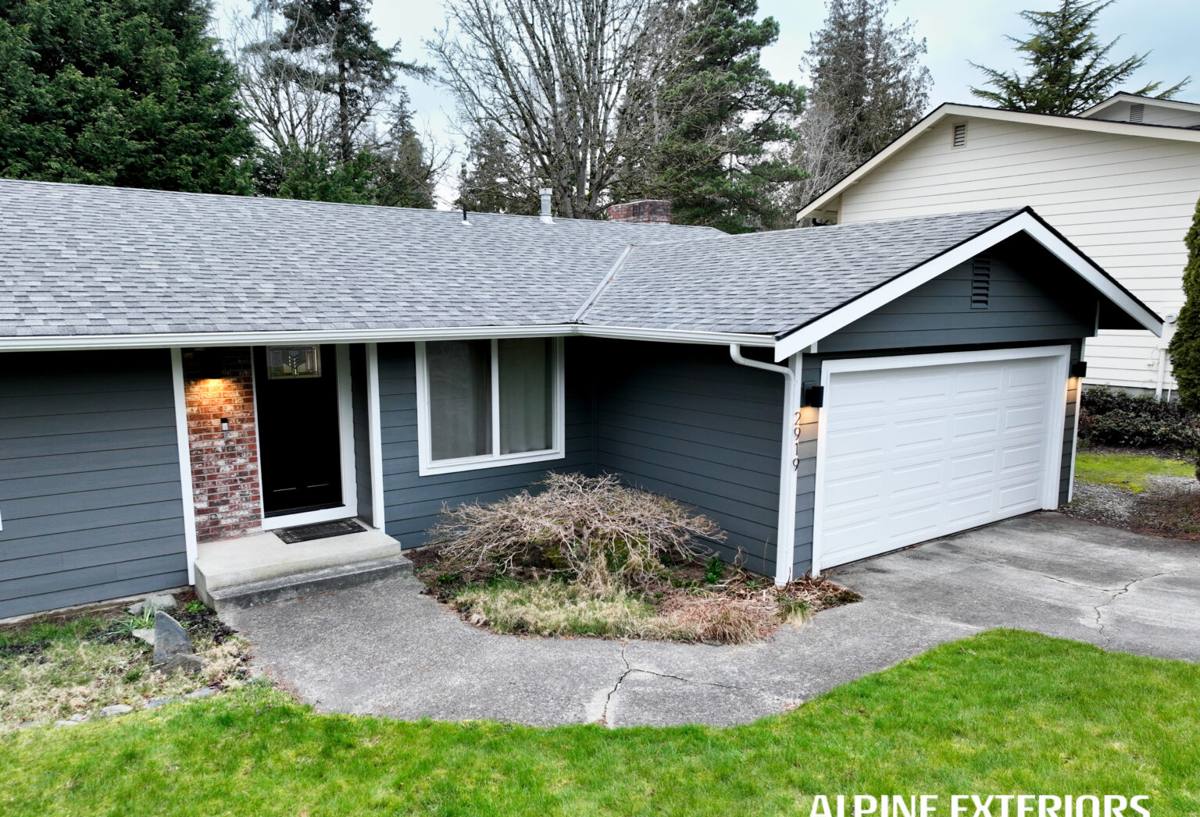
Common Siding Repair Issues We See in This Area
Wood and Engineered Wood Siding
Older wood siding and engineered wood products (like LP SmartSide) are the most common source of repair calls in exposed coastal-adjacent areas. The failure pattern is usually the same: moisture gets into a seam, joint, or cut edge that wasn't fully sealed, and the material swells, delaminates, or softens from the inside out. By the time it's visible from the ground, the damage is often already a few boards deep.
Vinyl Siding
Vinyl doesn't rot, but wind and salt air create their own problems for it. Sustained wind exposure can work panels loose at the nailing strip, and UV plus salt exposure fades and chalks the surface faster than the manufacturer's warranty language usually anticipates. Cracked or bowed panels are common after a hard windstorm.
Fiber Cement Siding
Properly installed fiber cement holds up well against salt air and rain because the material itself doesn't absorb and swell the way wood does. Where we do see repair needs on fiber cement is almost always an installation issue, not a material issue — caulking that failed, flashing that was missed at a window or trim detail, or fasteners that weren't set correctly. This is why installation quality matters as much as the product choice.
How to Tell a Cosmetic Issue From a Structural One
Not every mark or gap on your siding means trouble, but a few signs are worth taking seriously before your next inspection or repair call:
| What You See | Likely Meaning | Urgency |
|---|---|---|
| Faded or chalky surface color | UV and salt weathering of the finish | Low — cosmetic, monitor |
| Moss or algae patches, especially north-facing walls | Prolonged moisture retention on the surface | Medium — clean and inspect underneath |
| Soft or spongy spots when pressed | Moisture has penetrated the material | High — schedule inspection soon |
| Visible gaps at seams, corners, or trim | Sealant failure or original installation gap | Medium to High — entry point for water |
| Staining or dark streaks below a seam | Active water intrusion path | High — address before it spreads |
| Warping, bowing, or panels pulling away from wall | Fastener failure or underlying rot | High — structural concern |
If you're seeing anything in the "High" category, it's worth having someone look at it before the next stretch of driving rain, not after.
What a Correct Siding Repair Actually Involves
A repair that just patches the visible symptom without addressing what let water in tends to fail again within a season or two, especially in a wind-exposed spot like March Point. A repair done right generally includes:
- Removing enough siding to see the actual extent of damage — not just the board that looks bad, but the ones around it.
- Checking the water-resistive barrier (house wrap) and flashing underneath. If that layer failed, replacing the siding alone won't fix the leak.
- Assessing the sheathing for soft spots or rot if moisture has been present for a while.
- Replacing damaged material with a matching or compatible product, correctly lapped, nailed, and sealed at every seam and penetration.
- Re-checking trim, caulking, and flashing details around windows, doors, and any wall penetrations near the repair.
Skipping the underlying inspection is the single most common reason a "repaired" section fails again — usually in the exact same spot, usually within a year or two.
When Repair Isn't the Right Call
Sometimes a homeowner calls about a repair and what we find is a broader pattern — moisture damage in multiple areas, siding that's aged out and is failing at seams across the whole elevation, or a product that was never well-suited to this level of wind and salt exposure in the first place. In those cases, we'll tell you honestly if repair is a short-term fix versus a longer-term investment, and what the trade-offs are either way. We're not going to talk you into a full replacement you don't need, but we're also not going to patch something that's going to call us back out in six months.
When replacement does make sense, our position is straightforward: we install James Hardie fiber cement siding exclusively. We don't install vinyl, LP SmartSide, primed wood, cedar, or other fiber cement brands. That's not a marketing line — it's because in an exposure profile like March Point's, we've seen which products hold up to salt air, wind-driven rain, and a long moss season without becoming a repeat repair call, and which don't. Hardie's HZ5 product line is engineered specifically for climates like ours, and the factory-applied ColorPlus finish holds color and resists the moisture-driven failures that plague site-primed or field-painted materials.
Our Repair Process for March Point Homes
We keep the process simple and low-pressure:
- On-site inspection. We look at the damaged area and check adjacent siding, trim, and flashing for related issues rather than just the spot you called about.
- Honest diagnosis. We'll tell you what's actually wrong, what caused it, and whether it's isolated or part of a bigger pattern.
- Written estimate. A clear scope of work and price before anything starts — no surprise add-ons mid-job.
- Repair matched to conditions. Given March Point's exposure, we pay particular attention to lap spacing, fastener placement, and sealant details that resist wind-driven rain, not just standard installation minimums.
- Cleanup and walkthrough. We show you what was done and what to watch for going forward, including moss and algae maintenance guidance suited to your specific exposure.
Maintenance Checklist for March Point Siding
Between repairs, a few habits go a long way toward avoiding the next call — especially given how much moss and salt spray this area sees:
- Rinse siding annually to remove salt residue, especially on wind-facing walls
- Trim back vegetation that shades siding and keeps it damp longer than sun-exposed areas
- Clear gutters and downspouts before the fall rains so water isn't overflowing onto walls
- Check caulking at trim, window, and door junctions yearly — this is usually the first thing to fail
- Look for moss or algae buildup in shaded or north-facing sections and address it before it spreads
- After any significant windstorm, do a quick visual check for loose, cracked, or missing panels
Why a Crew That Already Works in This Area Matters
Repair work in a wind- and salt-exposed spot like March Point isn't identical to repair work in a sheltered Anacortes neighborhood a few miles inland. The failure patterns are different, the flashing and sealant details that matter most are different, and knowing which products actually hold up under this specific combination of driving rain, moss season, and salt air comes from having done the work here repeatedly — not from a general siding checklist. A crew that already knows this stretch of Skagit County can usually spot the real cause of a problem faster and repair it in a way that's built for the conditions it'll actually face, not just the conditions on a spec sheet.
If you're seeing damage, staining, or gaps in your siding, we're happy to come take a look. Estimates are free, there's no pressure to move forward, and we'll give you a straight answer on whether you're looking at a targeted repair or something bigger — just fill out the form below to get started.