 Anacortes Siding
 Decks Built for Mount Vernon's Weather, Not Just Its Looks
A deck in Mount Vernon lives a harder life than a deck in a dry climate. Skagit County sits close enough to the water that salt-laden air moves through regularly, and the region's long wet season means a deck's structure and surface can stay damp for days at a time between dry spells. Add a shady lot near mature trees or a north-facing yard, and moss and algae get a season-long head start on any wood or composite surface that isn't detailed correctly. None of this means a deck can't last decades here — it means the build has to account for moisture from the first footing to the last board, not just at the finish coat.
We build custom decks for homeowners in and around Mount Vernon, and we design every one around this reality: driving rain that gets pushed sideways by wind, ground that stays saturated longer than it does east of the Cascades, and a moss season that can run from fall through spring. A deck that ignores those conditions might look fine the day it's finished and still cause problems within a few years.
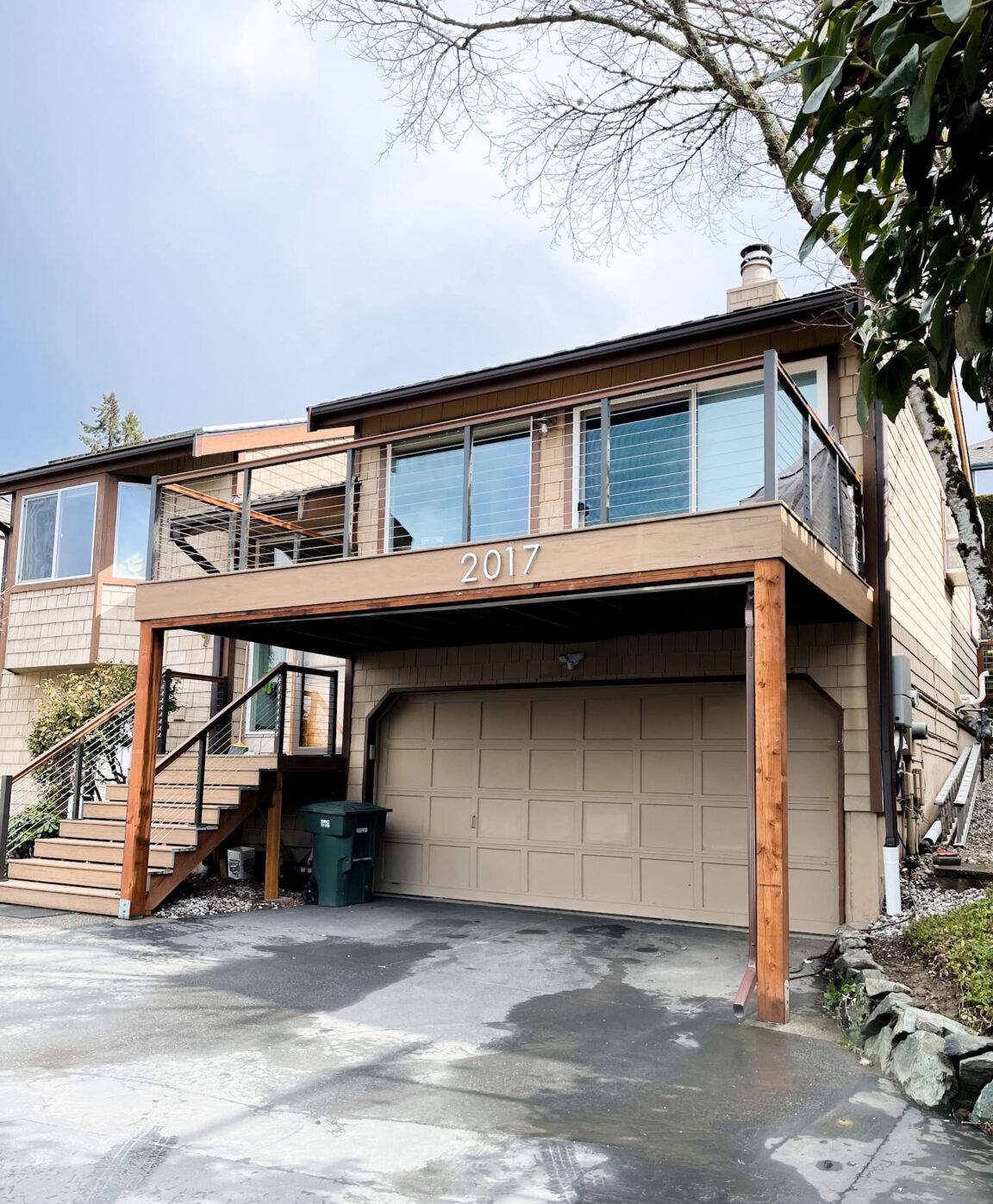
What Happens When a Deck Isn't Built for This Climate
Most deck failures we're called out to inspect aren't from bad luck — they're from decisions made (or skipped) during the original build. In a marine, high-rainfall climate like this one, the common failure points are predictable:
- Ledger boards attached to the house without proper flashing, letting water track behind the siding and into the rim joist
- Joists and beams with no gap or drip edge, so water sheets across the top and never sheds cleanly
- Fasteners and hardware that aren't rated for treated lumber's chemical makeup, leading to corrosion and staining
- Post bases set directly on concrete or soil without a standoff, wicking moisture straight into the end grain
- Decking installed tight to the house or a wall with no airflow behind it, creating a permanent damp pocket
- Surfaces with no slope for drainage, so standing water sits after every rain
Any one of these shortens the life of a deck. Several of them together are how a ten-year deck becomes a three-year problem — soft spots in the decking, rust streaks down the fascia, or a persistent green film that pressure washing only knocks back for a few weeks.
Choosing Decking Material for a Wet, Salt-Air Climate
There's no single "best" decking material — there's a best material for your budget, your maintenance appetite, and your specific site. What changes in a climate like Mount Vernon's is how much each option's weaknesses actually get exercised. A material that performs fine in a dry climate can show its flaws here within a couple of seasons.
| Material | How It Handles Rain & Moisture | Moss/Algae Behavior | Maintenance |
|---|---|---|---|
| Pressure-treated lumber | Good if detailed with gaps, sealer, and proper drainage; end grain is the weak point | Prone to surface growth if not cleaned and resealed regularly | Annual cleaning, resealing every 1-2 years |
| Cedar | Naturally moisture-resistant, but softer and needs a breathable finish, not paint or heavy sealants | Resists rot better than most softwoods but still hosts moss without upkeep | Cleaning and finish renewal every 1-2 years |
| Capped composite | Very stable in moisture; core is protected by a plastic cap on all sides | Grows on the surface like any material left damp and shaded, but doesn't feed rot | Periodic washing; no sealing or staining |
| PVC decking | Fully synthetic, essentially unaffected by moisture absorption | Same surface growth risk as composite in shaded, damp spots | Periodic washing; no sealing or staining |
An important point that gets missed: composite and PVC don't rot, but they aren't immune to moss and algae. Anything left damp and shaded long enough will host organic growth, including plastic decking. The advantage of capped composite and PVC isn't that they stay clean forever — it's that a season of neglect doesn't compromise the structural integrity of the board the way it can with untreated wood.
Hardware and Fasteners Matter as Much as the Decking
We match fasteners, joist hangers, and post hardware to the lumber and to the coastal-adjacent air quality here. Standard electro-galvanized hardware corrodes faster than it should in this environment, especially in contact with modern treated lumber's chemical treatment. We use hardware rated for ACQ-treated lumber and, on exposed structural connections, stainless steel where it earns its keep — mainly because replacing corroded hardware later means partially disassembling a finished deck.
What a Properly Built Deck Requires Here
A deck that's going to hold up through repeated Skagit County winters needs a few things done right below the surface, where nobody looks until something goes wrong:
Ledger Attachment and Flashing
Where the deck ties into the house, the ledger board needs mechanical fasteners rated for the load plus flashing that directs water out and away from the house framing, not behind the siding. This single detail is responsible for more hidden rot damage than almost anything else in deck construction.
Footings and Post Bases
Footings need to sit below frost depth and bear on stable, well-draining soil — something we confirm on-site rather than assume, since drainage varies block to block even within the same neighborhood. Posts sit on standoff bases that keep the end grain off concrete and out of standing water.
Framing Gaps and Airflow
Joists get spaced and protected with a joist tape or cap to shed water off the top instead of letting it soak in through fastener holes. Decking boards are gapped for drainage and, where the deck sits low to the ground or close to a wall, we make sure there's enough clearance underneath for air to actually move and dry the structure out between storms.
Surface Slope
A deck surface should have a slight slope away from the house — usually a small fraction of an inch per foot — so water runs off instead of pooling. It's a subtle detail that's easy to skip and expensive to fix after the fact.
Our Process, Start to Finish
- On-site consultation. We walk the yard, look at drainage, sun/shade exposure, existing grade, and how the deck will connect to the house.
- Design and material selection. We talk through material options honestly, including trade-offs on cost, maintenance, and how each will actually perform on your specific lot.
- Written estimate. A clear scope and price before any work starts — no vague allowances that turn into surprise change orders.
- Permitting. We handle the permit application and inspections required for the project, so you're not tracking down paperwork yourself.
- Site prep and footings. Excavation, footing placement, and inspection sign-off before framing begins.
- Framing and structure. Ledger, posts, beams, and joists built to the details above, not just to minimum code.
- Decking, railing, and finish work. Surface installation, railing per code height and spacing requirements, and any stairs or lighting included in scope.
- Final walkthrough. We go over the finished deck with you and cover maintenance expectations for the material you chose.
Permits and Local Requirements
Deck construction in and around Mount Vernon generally requires a permit once you're above a certain height or attached to the structure of the house, along with inspections at key stages like footings and framing. Exact thresholds and requirements can vary and do change, so rather than guess at specifics here, we confirm current requirements with the local building department for your project and handle the application and inspection scheduling as part of the job. Skipping permitting on a deck isn't just a compliance issue — it can complicate a home sale or insurance claim down the road.
Maintaining a Deck Through Skagit County's Wet Season
Every decking material benefits from some seasonal attention here — the difference is how much and how often. A basic annual routine keeps most decks looking good and structurally sound for their full expected lifespan:
- Sweep debris and standing leaves off the surface regularly, especially in fall when they trap moisture against the boards
- Wash the deck at least once a year to remove moss, algae, and pollen buildup before it gets a foothold
- Check and clear the gaps between boards so water and debris aren't collecting and blocking drainage
- Inspect fasteners, railings, and stair connections annually for looseness or corrosion
- Reseal or refinish wood decking on the schedule appropriate to the product — waiting too long lets moisture back into the grain
- Trim back overhanging branches and vegetation that keep the deck shaded and slow to dry
None of this is complicated, but skipping it in a climate this wet compounds quickly. A deck that gets an annual wash and a quick hardware check tends to outlast one that's left alone until something looks visibly wrong.
Why Local Experience Building Decks in Mount Vernon Matters
A crew that only occasionally works in this region can build a structurally sound deck on paper and still get the details wrong for this specific climate — the flashing detail that matters here, the drainage slope that matters here, the hardware upgrade that's worth the small extra cost given how much rain this area sees over a deck's lifetime. We work in Mount Vernon and the surrounding Skagit County area regularly, which means we're not guessing at how a design will hold up through a wet winter — we've already seen how similar builds perform, and we build accordingly from the start.
If you're planning a new deck or replacing one that's showing its age, we're happy to come take a look, walk the site with you, and put together a clear, honest estimate — no pressure, no inflated scope. The form below gets you started.