 Anacortes Siding
 Why West Anacortes Roofs Age Differently
West Anacortes sits close enough to the water that salt-laden air is a daily fact of life, not an occasional nuisance. Combine that with the driving, wind-pushed rain that rolls off Rosario Strait and Guemes Channel through the fall and winter, plus a moss season that can stretch from October well into spring, and you get a roofing environment that's genuinely harder on materials than most inland parts of Skagit County. Fasteners corrode faster near the water. Algae and moss get a longer growing window because the roof rarely dries out completely for weeks at a time. And wind-driven rain finds weak points in flashing and underlayment that would never be tested in a drier climate.
None of this means a roof in West Anacortes needs to be exotic or overbuilt. It means the details — ventilation, underlayment, flashing, and material choice — matter more here than they would in a lot of other places, and cutting corners on any one of them tends to show up sooner rather than later.
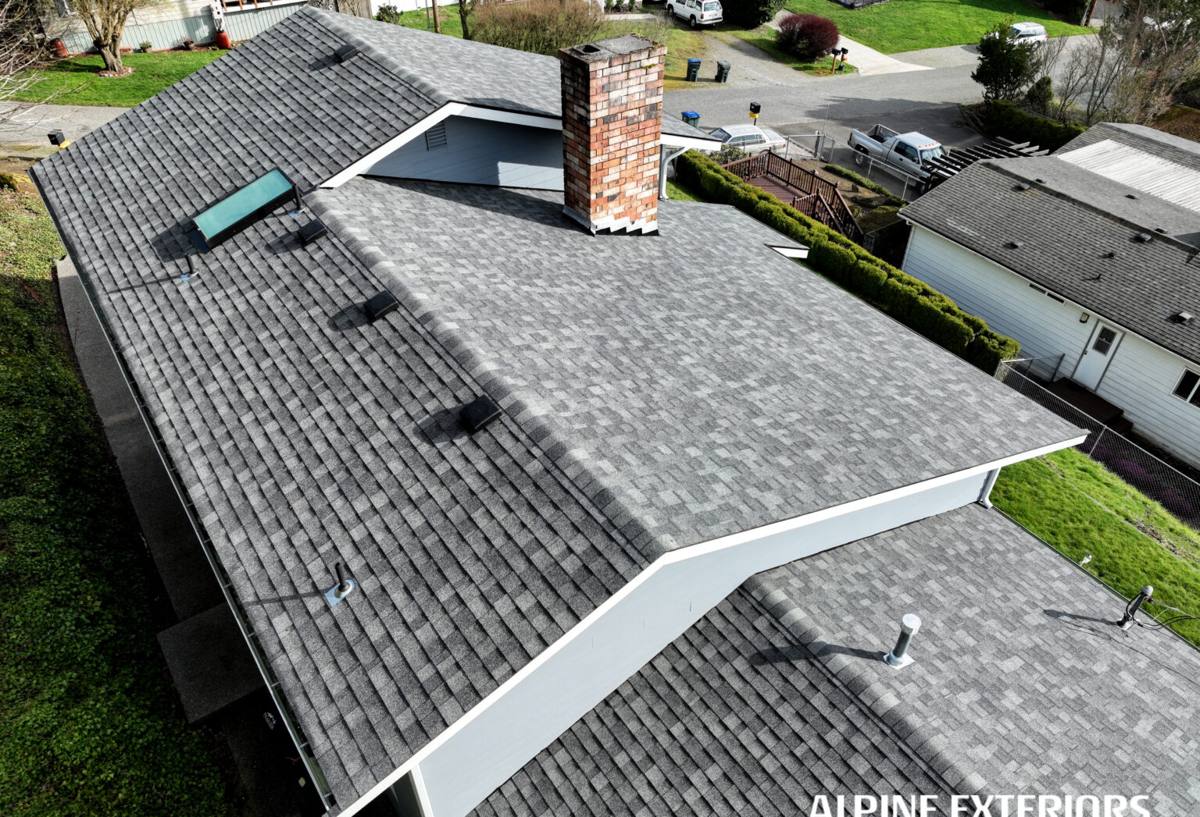
Signs a Roof Needs Replacement, Not Another Repair
We get a lot of calls where the honest answer is "you need one more repair, not a new roof." But there's a point where patching stops making financial sense. Some of the clearer signals:
- Granule loss heavy enough that you can see bare shingle mat, especially on south- and west-facing slopes that take the most sun and weather
- Shingles that are cupping, curling, or cracking across large sections rather than a single isolated area
- Moss that keeps returning within a season or two of cleaning, which usually means the shingle surface has degraded enough to hold moisture
- Soft spots in the decking you can feel underfoot, or staining on interior ceilings that tracks back to the roof
- A roof that's already had two or more significant repairs in the last five years
- Flashing around chimneys, skylights, or valleys that's been patched repeatedly instead of properly re-flashed
Age matters too, but it's not the whole story. A well-ventilated, well-installed asphalt roof can hold up reasonably well for two decades or more even in this climate; a poorly ventilated one can show serious wear well before that. We'll always tell you honestly if repair is the smarter move — replacement is a bigger investment and it shouldn't be sold to someone who doesn't need it yet.
What a Correct Roof Replacement Actually Involves
Tear-Off and Deck Inspection
A proper replacement starts with a full tear-off down to the decking, not a layover. Layovers hide problems and trap moisture, which is exactly the wrong move in a climate that already struggles to dry roofs out. Once the old material is off, the decking gets inspected board by board. Any wood that's soft, delaminated, or water-stained gets replaced before anything new goes down — skipping this step is one of the most common ways a roof fails early.
Underlayment and Ice-and-Water Protection
In West Anacortes, we lean on synthetic underlayment across the full roof and self-adhering ice-and-water shield at the eaves, valleys, and any roof penetrations — the spots most exposed to wind-driven rain and standing water. This isn't about ice damming in the way a mountain climate would worry about it; it's about giving the roof a fully sealed second line of defense against the sideways rain this area sees several months a year.
Flashing Done Right
Flashing failures cause more leaks than shingle failures. Chimneys, skylights, sidewall intersections, and valleys all need new, properly stepped and counter-flashed metal — not caulk smeared over old flashing. Caulk is a maintenance item, not a repair strategy, and it fails fast in salt air.
Ventilation
A roof that can't breathe traps moisture in the attic, which shortens the life of the decking and the new shingles from underneath. We check intake at the soffits and exhaust at the ridge or roof vents and correct the balance where needed. This is a step that's easy to skip because it doesn't show on the surface, but it's one of the biggest factors in how long a roof actually lasts here.
Choosing a Roofing Material for This Microclimate
There's no single "best" roofing material for West Anacortes — the right choice depends on budget, how the home is used, and how much long-term maintenance a homeowner wants to take on. Here's how the common options actually compare in a salt-air, high-moisture setting:
| Material | Moss/Algae Resistance | Typical Lifespan Here | Maintenance Burden |
|---|---|---|---|
| Standard 3-tab asphalt | Low without added protection | 15–20 years | Regular moss/algae cleaning recommended |
| Architectural (dimensional) asphalt | Moderate; better with algae-resistant granules | 20–25 years | Periodic cleaning, less frequent than 3-tab |
| Standing seam metal | High; moss struggles to root on smooth metal | 40+ years | Low; occasional debris clearing |
| Cedar shake | Low; absorbs moisture and feeds growth | Varies widely with upkeep | High; requires consistent treatment |
We don't install cedar shake as a standard recommendation in this specific climate — not because it's a bad-looking product, but because its moisture-absorbing nature is a poor match for an environment that's damp for a large part of the year and sits this close to salt water. That's a maintenance and moisture-management call, not a knock on the material itself. For most West Anacortes homes, we point people toward architectural asphalt with algae-resistant granules as the value-for-money default, and standing seam metal for anyone who wants to minimize moss issues and long-term upkeep, even at a higher upfront cost.
How Our Roof Replacement Process Works
- On-site inspection. We look at the whole system — shingles, decking, flashing, ventilation, gutters — not just the surface wear that prompted the call.
- Written estimate. You get a clear scope: materials, tear-off details, flashing and ventilation work included, and timeline, so there are no surprise change orders mid-project.
- Material selection. We walk through the tradeoffs above based on your budget and how long you plan to be in the home.
- Weather-aware scheduling. We plan around the wet season where we can, and use dry-in protection so an open roof is never left exposed overnight.
- Tear-off, deck repair, and install. Full removal, deck inspection and repair, underlayment, flashing, and final material install, in that order — no shortcuts.
- Final walkthrough. We go over the finished roof with you before calling the job done, including how ventilation and drainage were addressed.
Moisture and Ventilation: The Factor Most Roofs Get Wrong Here
If there's one thing that separates a roof that lasts in West Anacortes from one that doesn't, it's how well moisture moves through and off the system — not just the shingle brand on top. Attics that are under-ventilated stay damp longer after our long stretches of rain, which softens decking and shortens shingle life from below, where nobody's looking. Gutters that are undersized or poorly pitched send water back toward the fascia and eaves instead of away from the house. And moss left to grow unchecked holds moisture directly against the shingle surface, which accelerates the exact granule loss and cracking that leads to early failure.
None of this is complicated to get right, but it does require treating the roof as a full system during replacement rather than just swapping old shingles for new ones. That's the difference between a roof that needs attention again in twelve years and one that comfortably reaches the upper end of its expected lifespan.
What Roof Replacement Costs Depend On
We won't quote a number without seeing the roof — pitch, size, layout, and current condition all move the price — but these are the main factors that drive cost up or down on most West Anacortes projects:
| Factor | Effect on Cost |
|---|---|
| Roof pitch and complexity (valleys, dormers, multiple planes) | Steeper and more complex roofs take longer and use more material |
| Deck condition underneath the old roofing | Rot or soft decking found during tear-off adds repair cost |
| Material choice | Standard asphalt is the lowest upfront cost; metal costs more but needs less upkeep |
| Number of penetrations (chimneys, skylights, vents) | Each one needs proper flashing, which adds labor |
| Ventilation upgrades | Adding or correcting intake/exhaust vents adds modest cost but extends roof life |
What to Ask Before Hiring Anyone for This Job
- Are you licensed and insured to work in Washington State, and can you show current documentation?
- Does the estimate include full tear-off, or is a layover being proposed?
- Will the deck be inspected and repaired as part of the job, with pricing set ahead of time for what happens if rot is found?
- Is flashing being replaced, or reused and re-sealed?
- Is attic ventilation being checked and corrected if needed?
- What's the manufacturer's warranty, and is it a full material-and-labor warranty or material-only?
- Do you have recent work in this specific area that reflects experience with our weather conditions?
A contractor that's used to working this stretch of Skagit County already knows to plan around the wet season, already carries the right underlayment for driving rain, and already understands why moss keeps coming back on a roof that wasn't ventilated correctly the first time. That local pattern recognition is worth something — it's the difference between a crew learning on your roof and a crew that's already solved these problems on the house down the street.
Get a Straight Answer on Your Roof
If you're not sure whether your West Anacortes home needs a full roof replacement or just targeted repair, the fastest way to find out is a walk-through, not a guess from the ground. We'll give you a clear, honest read on the condition of your roof and what it would take to do the job right — no pressure, no inflated scope. Reach out using the form below for a free estimate.