 Anacortes Siding
 Siding Repair Built for Edison's Weather, Not Just Any Weather
Edison sits in a stretch of Skagit County where the weather does not mess around. You are close enough to Samish Bay and the surrounding tidal flats to get real salt air pushing inland, open enough to catch driving rain off the water, and shaded enough by the farmland tree lines and evergreen cover that moss gets a foothold on anything that stays damp for more than a day or two. That combination is hard on siding in a way that inland Skagit Valley homes simply do not deal with. A repair approach that works fine in a drier part of the state can fail here within a couple of seasons if it does not account for what this specific stretch of ground throws at a house.
When we get called out to Edison for siding repair, we are not just patching a hole or swapping a cracked board. We are looking at why that section failed in the first place, because in this climate the cause is almost always moisture, salt, or both, and if you do not address the cause, the repair does not last.
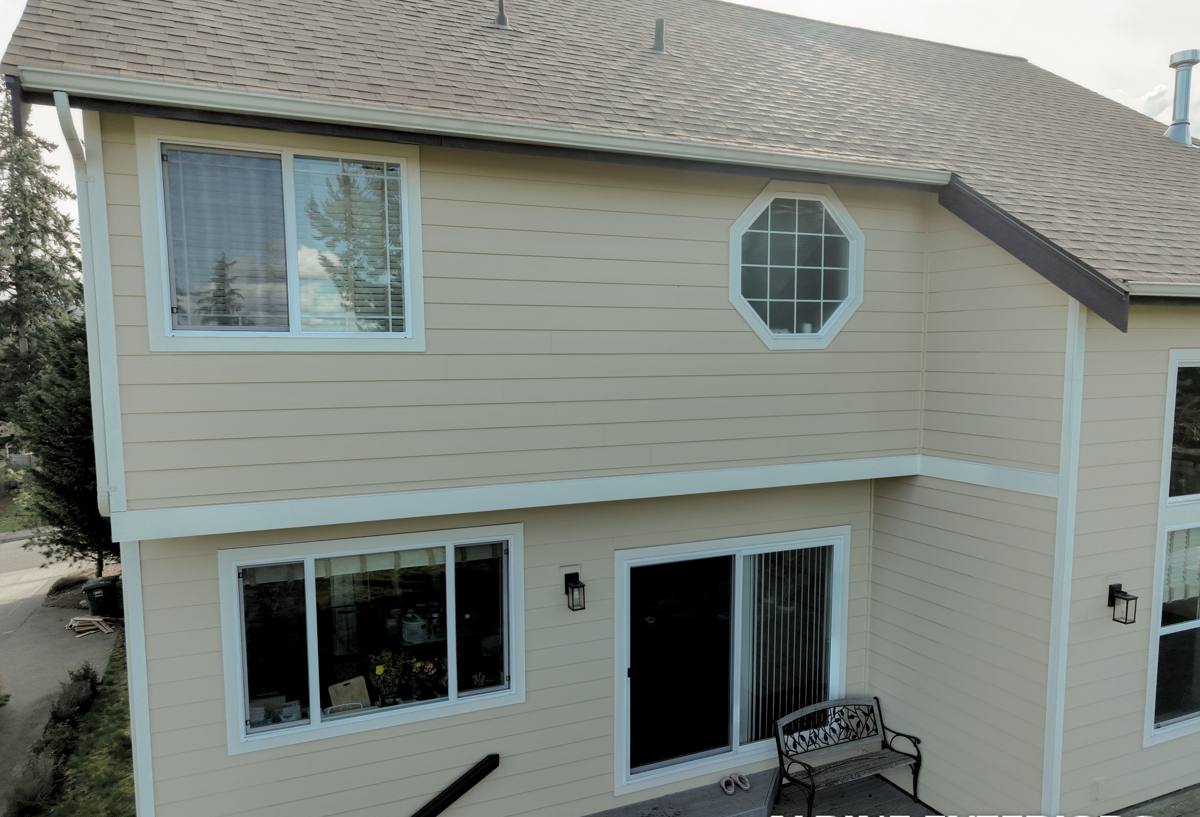
What Salt Air, Rain, and Moss Actually Do to Siding
Salt Air
Airborne salt from the bay settles on exterior surfaces and accelerates corrosion on fasteners, flashing, and any metal trim. On wood-based or wood composite siding, salt exposure also draws moisture into the material, which speeds up swelling, cupping, and rot at joints and butt seams.
Driving Rain
Wind-driven rain does not just fall straight down — it gets pushed sideways into laps, seams, and anywhere caulking has started to fail. Once water gets behind a siding panel, it can sit against the wall sheathing for days before it evaporates, especially on north-facing or shaded walls.
Moss and Algae
A long moss season means anything that holds moisture — the bottom edge of a lap, a window trim joint, a spot where two panels overlap — becomes a place moss and algae can establish. Moss root structures hold water against the siding surface and, over time, work into any gap or crack, widening it.
Individually these are manageable. Together, on a home that has not had its siding inspected in a while, they compound fast — and by the time damage is visible from the ground, there is usually more going on behind the siding than what you can see.
Signs Edison Homeowners Should Watch For
- Soft or spongy spots when you press on siding near the bottom courses or around window and door trim
- Visible moss or dark green-black staining that keeps coming back after cleaning
- Cracked, bubbled, or peeling paint concentrated on one wall (usually the side that takes the worst weather)
- Gaps opening up at seams, corners, or where siding meets trim boards
- Fastener heads showing rust streaks bleeding down the face of the siding
- Warped, bowed, or separating panels, especially near the ground where splash-back and standing moisture are worst
- A musty smell near an exterior wall from inside the house — often the first sign of trouble that has already been going on behind the siding for a while
What a Correct Repair Actually Involves
A siding repair that only replaces the visible damaged piece and stops there is a short-term fix. Done right, a repair in this climate needs to check a few things beyond the obvious:
- What's behind the siding. We pull back damaged sections to check the water-resistive barrier and sheathing underneath. If moisture has already reached the sheathing, that gets addressed before any new siding goes back on — otherwise you are covering up a problem, not fixing it.
- Flashing and trim details. A huge share of siding failures we see in this area trace back to a flashing detail that was missed or done wrong originally — over a window, at a roof-to-wall transition, or at an outside corner. Repairing the siding without correcting the flashing just means the same spot fails again.
- Material match. If the original siding is James Hardie fiber cement, we match the profile, exposure, and finish so the repair is not a visible patch. If the original material is something else, we will walk you through your options honestly — including where a small patch makes sense and where it does not.
- Fastening and gaps. Correct fastener placement and proper gapping at butt joints and trim are what keep water moving out instead of getting trapped. This is a detail that gets rushed on a lot of repair jobs, and it is one of the first things that fails again if it is not done to spec.
Repair vs. Replace: How We Help You Decide
| Factor | Leans Toward Repair | Leans Toward Replacement |
|---|---|---|
| Extent of damage | Isolated to one wall or a few sections | Spread across multiple walls or the whole house |
| Sheathing condition | Dry, solid wood behind the damaged area | Soft, delaminating, or moisture-damaged sheathing found |
| Age of existing siding | Newer install, still under warranty or well within service life | Original siding is decades old and nearing end of life anyway |
| Material | James Hardie fiber cement — repairs blend in cleanly | Discontinued profile or material we don't install, hard to match |
| Root cause | Isolated flashing or fastener issue, easily corrected | Systemic moisture problem tied to original installation |
We will always tell you straight when a repair is the smarter call and when you would be spending money to delay a replacement you will need anyway. That call should be based on what we find when we open up the wall, not on which option is more work for us.
Why We Repair With James Hardie Fiber Cement — And Won't Patch Some Materials
Our company installs and repairs James Hardie fiber cement siding exclusively. We do not install or repair LP SmartSide, vinyl, Cemplank, Allura, primed spruce, or cedar siding. That is a deliberate standard, not a limitation we are apologizing for.
Fiber cement handles the conditions Edison sees better than the alternatives, and it is not close. It does not swell, rot, or feed moss the way wood-based products can when moisture gets trapped against them. It is non-combustible. Its ColorPlus factory finish holds up to UV and salt exposure far longer than field-applied paint, which matters a lot on a home that faces sun, rain, and salt air in the same season. Hardie's HZ5 product line is engineered specifically for the kind of wet, marine-influenced climate this part of Skagit County has.
When we find non-Hardie siding on an Edison home that needs repair, we are upfront about what that means: a small patch may hold for a while, but we are not going to install new sections of a product we do not stand behind long-term, and we will tell you honestly if the smarter move is a phased or full transition to fiber cement rather than continuing to chase repairs on a material that is fighting the climate here.
Our Repair Process for Edison Properties
- On-site inspection. We look at the whole exterior, not just the spot you called about — damage in this climate rarely shows up in only one place.
- Open and assess. Where damage is suspected, we pull siding back to check the barrier and sheathing before quoting a fix.
- Honest scope and estimate. You get a clear explanation of what caused the damage, what needs to happen to fix it correctly, and what it will cost — repair or replacement, whichever actually makes sense.
- Correct the cause. Flashing, barrier, or fastening issues get fixed as part of the job, not skipped to save time.
- Match and install. New James Hardie material is installed to match the existing siding's profile and color as closely as possible, per manufacturer spec.
- Final walkthrough. We show you exactly what was done and what to watch for going forward.
Why a Crew That Already Works This Area Matters
Edison is a small community, and the homes here share a lot of the same exposure — proximity to the water, tree cover that holds shade and moisture, and weather that comes off the bay differently than it does even a few miles inland in Anacortes or Skagit County's more sheltered pockets. A crew that has worked on siding around here already knows which walls typically take the worst of it, which original installation shortcuts tend to fail first in this climate, and what a repair actually needs to hold up through another wet season — not just look fixed on the day the job wraps.
That local pattern recognition is the difference between a repair that lasts and one you are calling about again in two years.
Keeping Siding in Good Shape After a Repair
A correctly done repair should hold up well, but a little upkeep goes a long way in this climate:
- Rinse siding periodically to keep salt residue and organic buildup from accumulating, especially on walls facing the water or shaded by trees
- Trim back vegetation and tree limbs that keep a wall damp or shaded longer than the rest of the house
- Check caulking at trim, window, and door joints yearly — this is usually the first thing to fail and the easiest to catch early
- Address moss at the first sign of it rather than letting it establish, since it is far easier to remove early than after it has taken hold
- Have your siding looked at after any major windstorm, since driving rain events are when hidden gaps get exposed
If your siding in Edison is showing damage, staining, or soft spots, we would rather take a look and give you a straight answer than have you guess. We offer free, no-pressure estimates — use the form below to get one scheduled.